
Views: 0 Author: Site Editor Publish Time: 2026-06-21 Origin: Site


Hazardous environments are rapidly accelerating the adoption of robotics in emergency response operations worldwide. Procurement teams frequently encounter a major friction point during the evaluation process. High initial capital expenditure often stalls these critical safety upgrades before they begin. We must view this purchase as much more than a simple equipment upgrade. It represents a highly strategic investment in comprehensive risk mitigation. You actively protect vital infrastructure assets while ensuring absolute personnel safety on the front lines. This guide aims to break down the complex financial landscape of these autonomous machines. We provide a transparent, evidence-based look at the exact components driving the initial price tag. You will clearly understand implementation realities. Furthermore, we will show you how to evaluate true return on investment beyond the raw sticker price.
You cannot evaluate expenses without defining your operational intent. Machine capabilities vary wildly across different use cases. We categorize these units into three main tiers. Each tier directly dictates the initial financial commitment. Understanding your baseline application prevents massive overspending. It also ensures you do not buy an underpowered unit.
Entry-level units prioritize situational awareness over direct intervention. Teams deploy them to scout hazardous areas before committing personnel. These machines typically feature smaller physical profiles. They utilize basic remote control systems over short distances. Manufacturers install standard optical cameras. The payload capacity remains minimal. These design choices keep the overall expense much lower. Fire departments use them to assess structural integrity safely. Since they lack heavy extinguishing monitors, their engineering requires less robust heat shielding. You save money but sacrifice direct fire suppression capabilities.
Mid-range models handle direct fire intervention. Industrial facilities commonly deploy these balanced machines. They represent a significant jump in capital requirements. Engineers build them around high-flow water and foam monitors. Tracked mobility systems allow them to cross rugged debris. Standard thermal shielding protects internal electronics from intense ambient heat. These units carry the power to suppress active flames directly. Consequently, the Firefighting Robot Cost increases substantially here. Municipal fire departments often target this tier. It offers a highly reliable balance between suppression power and manageable pricing.
Extreme hazard zones demand premium enterprise-grade machines. Chemical plants and oil refineries require these top-tier models. They survive environments completely hostile to standard equipment. Manufacturers include strict explosion-proof certifications. Advanced autonomy allows them to operate deep inside structural fires. They possess massive towing capacity. This power lets them drag fully charged supply hoses through thick debris. The highly specialized engineering drives up the price significantly. You pay for absolute reliability in the most dangerous environments imaginable.
| Robot Tier | Primary Application | Key Features | Relative Cost Level |
|---|---|---|---|
| Entry-Level | Reconnaissance | Standard optical cameras, light chassis, short-range control. | Low |
| Mid-Range | Standard Extinguishing | High-flow monitors, thermal shielding, rugged track systems. | Moderate |
| Enterprise | HazMat & Extreme Hazard | Explosion-proof materials, massive towing torque, full autonomy. | High |
Many mechanical variables dictate the final retail price. You are essentially buying an armored tactical vehicle. Physical construction demands highly specialized, durable components. Each mechanical upgrade adds to the bottom line. Let us examine the specific hardware elements. These represent the core firefighting robot price factors.
The chassis forms the protective foundation. Standard steel rusts and degrades too quickly. Manufacturers often substitute aerospace-grade aluminum. This material reduces overall weight while maintaining extreme structural integrity. Specialized thermal shielding wraps the sensitive internal electronics. Without this shielding, extreme heat melts internal wiring within minutes. High-traction, heat-resistant track systems provide essential mobility. Standard rubber tracks fail immediately in structural fires. Teams need kevlar-reinforced or pure steel drive tracks. These custom material upgrades push manufacturing expenses much higher.
The suppression system acts as the primary weapon. Integrated monitors dictate fluid output limits. A monitor delivering 500 gallons per minute costs less than a 2,000 GPM cannon. The internal plumbing must withstand massive fluid pressures. Flow rates scale the price upward linearly. Furthermore, chemical compatibility affects the financial math. Simple water monitors require standard valving. Multi-agent systems handle water, foam, and dry chemicals simultaneously. Engineers must design complex, corrosion-resistant internal piping. You invest more upfront for this versatile suppression capability.
Dragging water hoses requires immense mechanical torque. A fully charged supply hose weighs hundreds of pounds. The robot must pull this dead weight over scattered debris. It cannot stall or flip over during emergency deployment. Achieving this requires high-torque electric or hydraulic motors. Engineers reinforce the drivetrain to handle sudden resistance spikes. Heavy-duty gearboxes transfer power to the tracks efficiently. High payload capacity translates directly to higher manufacturing expenses. You are buying raw mechanical pulling power.
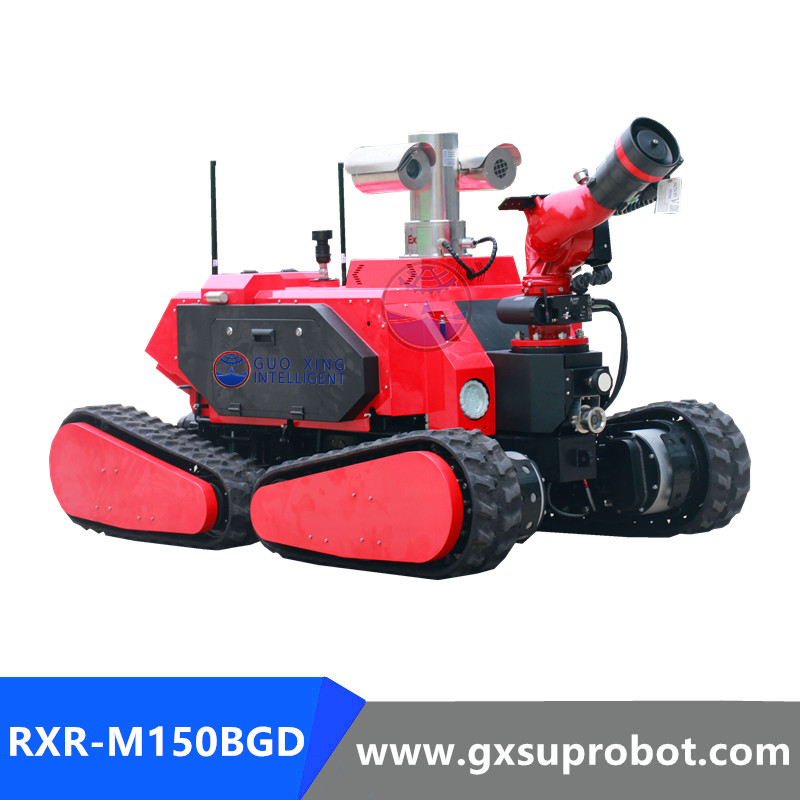
Modern incident response relies heavily on environmental data. A blind machine offers very little tactical advantage. Manufacturers integrate complex sensor arrays to solve this problem. These electronic payloads increase the base price significantly. We break down the vital sensory components below.
Standard optical cameras fail instantly in thick smoke. Operators need clear visibility to direct the water stream accurately. DIY-friendly-grade thermal imaging cameras solve this crucial visibility issue. They penetrate smoke and locate the primary fire seat. These infrared sensors add substantial upfront cost. HazMat environments require even more specialized data collection. Multi-gas sensors evaluate the ambient air for explosive chemical concentrations. They transmit real-time hazard data back to the command center. This integration protects human crews but demands premium pricing.
Basic models rely strictly on line-of-sight remote control. If the operator cannot see the machine, it becomes useless. Semi-autonomous navigation eliminates this dangerous tactical limitation. Engineers mount LiDAR scanners on the exterior chassis. These lasers map the surrounding environment in three dimensions. The onboard computer identifies debris and charts safe paths automatically. Implementing obstacle avoidance software requires powerful internal processors. The price jumps considerably when transitioning from manual to semi-autonomous control. Zero-visibility environments make this upgrade absolutely necessary.
You cannot afford a disconnected machine inside a burning building. Thick concrete and steel walls block standard radio waves. Secure, anti-interference radio frequency systems maintain the vital control link. Manufacturers invest heavily in complex mesh networking technologies. The robot drops small signal repeaters as it moves forward. This creates an unbroken communication chain back to the operator. Signal loss can strand an expensive machine in a lethal environment. High-end communication protocols prevent this nightmare scenario. They represent a non-negotiable expense for serious tactical operations.
The initial purchase price only tells half the story. Successful deployment requires ongoing financial commitments. Teams must prepare for comprehensive lifecycle expenses. Failure to budget for these realities ruins deployment strategies entirely. Let us examine the hidden compliance and maintenance factors.
Emergency equipment must survive brutal operational conditions. Authoritative bodies like the NFPA establish strict performance guidelines. Achieving these certifications involves rigorous, destructive testing phases. Manufacturers destroy multiple prototypes to prove long-term durability. They pass these testing expenses directly onto the consumer. A certified unit costs much more than a non-certified prototype. However, this compliance guarantees performance during critical emergencies. Procurement teams must verify these certifications before finalizing any purchase. It acts as a baseline insurance policy for the hardware.
Robots do not simply replace human firefighters. They fundamentally change tactical operations on the ground. Shifting from traditional firefighting to human-machine teaming requires extensive education. Departments must hire specialized external instructors. Operators need hundreds of hours behind the control console. They must learn emergency retrieval procedures and routine maintenance protocols. This specialized training program requires a dedicated annual budget. Ignoring this step directly leads to operator error and damaged equipment. Training constitutes a major part of the overall financial picture.
Heavy-duty machines require constant, reliable logistical support. You cannot transport a 2,000-pound robot in a standard pickup truck. Departments frequently must retrofit existing fire apparatus completely. Some choose to buy custom enclosed transport trailers instead. Furthermore, ongoing maintenance demands steady annual funding. Heavy-duty lithium batteries degrade over time naturally. They require expensive replacements every few years. Mechanics must apply firmware updates and calibrate sensitive sensors routinely. Post-deployment decontamination adds further intensive labor expenses. You must secure dedicated funding for these essential tasks.
Municipalities and corporations strictly scrutinize major capital expenses. You must clearly justify the heavy initial price tag. Traditional equipment seems cheaper on the surface level. However, robotics alter the long-term financial equation entirely. We must evaluate return on investment through a much broader lens.
Human safety provides the strongest possible financial justification. Firefighter injuries cause massive financial strain on local municipalities. Severe burns or respiratory damage lead to expensive medical treatments. Worker's compensation claims drain departmental budgets for decades. Robots eliminate direct human exposure in extreme hazard zones. You send a machine into an impending flashover instead of a human crew. Calculating the financial offset of reduced injuries makes the math remarkably clear. The long-term health protections often pay for the machine after one major incident.
Some fires simply burn too hot for human intervention. Battery storage facility fires present terrifying thermal runaway scenarios. Chemical spills threaten to level entire industrial complexes. Incident commanders must pull human crews back to safe perimeters. They let the facility burn to the ground entirely. A specialized robot changes this passive strategy completely. It drives directly into the danger zone and applies cooling agents. Rapid deployment prevents total structural loss. Saving a multi-million-dollar facility instantly justifies the robotics investment.
Traditional firefighting consumes massive amounts of expendable gear. Turnout gear degrades quickly under intense radiant heat. Breathing apparatus components require frequent, costly replacements. Furthermore, human crews face severe physiological fatigue limits. A robot does not suffer from heat exhaustion. It requires no breathing air. It operates continuously until the suppression task ends. Analyzing the complete lifecycle value reveals a clear tactical advantage. The machine outperforms consumable traditional equipment over a decade of service.
| Investment Factor | Traditional Human Crews | Robotic Teaming Solutions |
|---|---|---|
| Initial Capital Cost | Low (per unit of personal gear) | High (heavy upfront equipment cost) |
| Injury Liability | High (worker's comp, medical bills) | Zero (for the machine itself) |
| Operational Endurance | Limited by air supply and fatigue | Continuous (until battery/fuel depletes) |
| Asset Recovery Rate | Low in extreme hazard zones | High due to close-proximity suppression |
We must remember the core reality of emergency robotics. The upfront expenditure remains undeniably substantial. However, the exact price directly correlates to operational capability and strict safety thresholds. You buy durable engineering, advanced sensors, and absolute tactical reliability. Procurement teams must clearly define their most frequent extreme-hazard scenarios first. Differentiate between municipal structural needs and industrial chemical environments. Clearly map out your operational requirements before requesting any custom quotes. This thorough preparation ensures you do not over-spec or under-spec your unit. Strategic planning transforms a daunting expense into a lifesaving tactical asset.
A: A high-quality commercial unit typically lasts between seven and ten years. The heavy-duty chassis and mechanical drivetrains exhibit excellent durability under stress. However, lithium-ion battery packs degrade faster and require replacement every three to five years. Regular exposure to extreme thermal environments dictates standard chassis wear. Adhering to strict replacement cycles ensures the unit maintains operational readiness.
A: Yes, numerous financial assistance programs exist. Municipal departments frequently utilize state and federal emergency responder grant programs. The Assistance to Firefighters Grant (AFG) regularly funds advanced robotics and specialized hazard equipment. Departments should highlight the reduction of human risk and capability upgrades in their applications. Partnering with professional grant writers greatly increases your chances of securing full funding.
A: Routine maintenance requires a dedicated but manageable annual budget. Technicians must perform monthly mobility checks and mechanical lubrication. Advanced sensor calibration happens quarterly to ensure tactical accuracy. Post-deployment decontamination represents the largest ongoing labor cost. Chemical exposure demands thorough cleaning to prevent long-term corrosion. Departments should allocate approximately five to ten percent of the initial purchase price for annual upkeep.
A: Current technological limits prevent fully autonomous operation during chaotic emergencies. Most units remain remote-controlled or semi-autonomous. The machine can navigate obstacles and map environments independently using LiDAR. However, a human operator must dictate the actual suppression tactics and monitor progress. This human-in-the-loop requirement firmly manages legal liability. It also ensures strict tactical control over high-pressure monitors in unpredictable environments.