
Views: 0 Author: Site Editor Publish Time: 2026-07-23 Origin: Site


While wheeled vehicles rely on pivoting axles, understanding exactly how tank treads steer remains the foundational step in engineering a reliable tracked vehicle. Standard wheels pivot smoothly on an axis. Continuous tracks demand a much more aggressive mechanical approach. For procurement teams, robotics engineers, and heavy machinery designers, the steering mechanism directly dictates a machine's turning radius, power efficiency, and terrain impact. Engineers face massive friction and torque requirements when rotating heavy platforms. Selecting the wrong steering method often leads to premature component wear or severe operational failures. Selecting the proper tracks chassis requires evaluating different steering mechanisms against your specific operational needs. We will explore solutions ranging from basic clutch-brake systems to advanced hydrostatic drives. You will learn to balance payloads, terrain constraints, and maintenance capabilities. This guide provides actionable insights for your next mechanical integration project.
Tracked vehicles steer by varying the speed between the left and right tracks (skid steering), eliminating the need for a traditional steering axle.
Different steering mechanisms (clutch-brake, differential, dual-drive) offer distinct trade-offs between mechanical complexity, cost, and power retention during turns.
Selecting a tracks chassis requires matching the steering system to the operating environment to mitigate risks like severe terrain rutting or premature tread wear.
Modern applications increasingly favor independent hydrostatic or electric drives for precise, on-the-spot pivoting (neutral steering).
Traditional steering remains impossible on continuous track setups. You cannot angle the wheels left or right. The vehicle must force the treads to skid laterally. This skidding action changes direction across the ground. It generates massive surface friction. It also requires immense torque inputs from the primary drivetrain. Engineers call this the skid steer principle. Turning requires creating a speed differential between the two sides. One side moves faster. The opposite side slows down or reverses completely. This forces the entire heavy chassis to pivot.
A successful engineering integration maximizes maneuverability. It simultaneously minimizes engine power loss during tight maneuvers. You must prevent track shedding. The heavy machinery industry calls this detracking. Detracking happens when high lateral forces push the track off the idler wheels. You must also reduce mechanical stress on gearboxes. High friction environments multiply these baseline stresses exponentially. Deep mud, loose sand, and rough gravel demand excessive torque. Proper engineering anticipates these variables early in the design phase. Field tests quickly confirm whether a chassis design can survive dynamic side-loads.
Engineers rely on established frameworks to calculate necessary steering torque. They evaluate the coefficient of friction for expected operating environments. A chassis operating on wet clay requires vastly different torque calculations than one operating on dry concrete. You must account for the track footprint length divided by the track gauge width. A longer, narrower footprint creates massive resistance during a skid steer maneuver. You must balance the vehicle dimensions to optimize turning efficiency. We recommend keeping the track length to track width ratio as close to 1.5 to 1 as possible. This specific ratio minimizes lateral drag while maintaining forward stability.
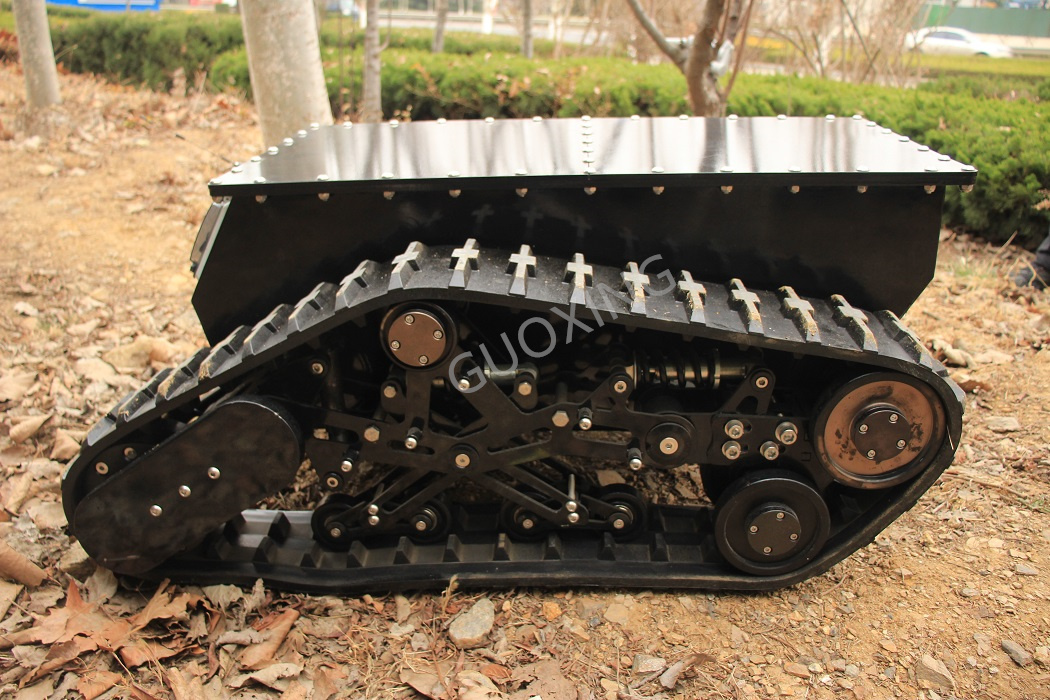
Engineers utilize three primary mechanical strategies to steer tracked vehicles. Each offers distinct benefits and mechanical drawbacks. Your specific payload and operational environment will dictate the ideal choice. Let us break them down thoroughly.
This mechanism disconnects power to the inner track. It then applies a heavy mechanical brake to stop it. The outer track continues driving forward. This outer force pushes the vehicle into a turn. Legacy systems utilize this setup heavily. Low-cost light machinery often still uses it. The main drawback involves extreme power loss. The vehicle easily loses fifty percent of its driving force during a turn. Turns feel jerky and lack precision. It stalls easily in deep mud. We see this primarily in older bulldozer models and budget agricultural equipment.
This setup uses a complex internal gear system. It transfers power from the slower inner track directly to the faster outer track. Medium-to-heavy industrial platforms prefer this method. The primary benefit centers on continuous power delivery. Both sides receive torque during the turn. This results in smoother, wider-radius turns. The machine maintains forward momentum efficiently. It prevents bogging down in soft terrain. Epicyclic gear trains handle this power distribution. They require precise manufacturing tolerances. You will find this system in heavy mining equipment and military platforms.
Two separate power sources drive each track independently. You typically use dual hydraulic motors or dual electric motors. Modern robotics, excavators, and advanced heavy equipment rely on this approach. It enables neutral steering. You can pivot entirely in place. One track runs forward. The other track runs in reverse. It gives operators infinite turning ratio control. Electric systems use pulse-width modulation (PWM) to control motor speeds accurately. This precise digital control makes it ideal for autonomous navigation systems.
Steering Mechanisms Comparison Chart
Steering System | Power Retention During Turn | Turning Radius | Primary Use Case | Mechanical Complexity |
|---|---|---|---|---|
Clutch and Brake | Low (Loses ~50%) | Wide to Medium | Legacy machinery, low-cost equipment | Low |
Controlled Differential | High (Continuous power) | Wide, Smooth | Heavy industrial, sustained movement | High |
Dual-Drive / Hydrostatic | Medium to High | Zero (Neutral Steering) | Robotics, modern excavators | Medium (Requires dual power sources) |
How do you choose the best system? You must match the steering mechanism to your specific operational outcomes. Different jobs require different movement profiles. Consider these four core evaluation dimensions.
Maneuverability vs. Power Retention: Evaluate your pivoting requirements. Does the application require tight, on-the-spot pivots? Dual-drive systems excel here. Do you need sustained forward momentum? Differential setups perform best for sweeping turns across long distances. Evaluate how often the machine must alter its heading during a standard operational cycle.
Terrain Impact: Assess the tendency of the vehicle to tear up the ground. Harsh clutch-brake steering causes severe rutting. It damages sensitive turf and soft soil substrates. Differential steering minimizes this surface disruption. It allows the inner track to keep rolling slowly rather than locking up and dragging.
Scalability and Form Factor: Determine how the steering system impacts overall dimensions. Independent electric drives free up internal space. They remove bulky central transmissions. However, they require high-capacity power distribution networks. You must allocate space for heavy battery banks or hydraulic fluid reservoirs depending on your drive choice.
Redundancy in Advanced Designs: Consider niche structural variations. Quad-tread or split-track systems utilize articulated steering mechanisms. They physically bend the frame rather than purely skidding. These advanced designs offer extreme terrain bridging capabilities. Forestry equipment often uses articulated track frames to navigate around dense trees without destroying the forest floor.
Best Practices for Evaluation: Always test turning capabilities in the most hostile environment you expect to encounter. Do not rely on concrete warehouse floor testing if your machine operates in wet clay. Clay alters the friction coefficient drastically.
Common Mistakes: Overestimating a battery's capacity to handle constant neutral steering. Neutral turns draw massive amperage spikes from electric systems. You must size your electrical components to handle these peak surge loads without overheating.
Real-world deployment exposes equipment to harsh elements. Engineers must anticipate several strict maintenance realities. Failing to account for these forces will result in premature mechanical failure. You must design preventative maintenance protocols into your operational guidelines.
Skid steering naturally grinds the tracks against the substrate. This friction accelerates material degradation immensely. You must specify robust track materials. Highly aggressive steering profiles demand heavy-duty steel tracks. Lighter, wider-radius applications can utilize reinforced rubber safely. Inspect treads regularly for uneven wear patterns. Rubber tracks utilize embedded steel cables for tensile strength. If sharp rocks cut the rubber and expose these cables to moisture, the track will snap eventually. Vulcanized rubber compounds resist abrasion better in high-temperature environments.
Throwing a track represents a massive operational failure. Differential turns place immense lateral stress on the suspension system. Proper tensioning mechanisms must integrate directly into the chassis. We highly recommend hydraulic tensioners for heavy equipment. They adjust dynamically under heavy loads. Spring-based tensioners work well for lighter robotics. A loose track will derail during a tight pivot. A track tensioned too tightly will destroy the idler bearings quickly. You must find the precise operational tension window.
Steering heavy vehicles generates significant heat. Constant braking creates immense friction heat. Hydrostatic bypass systems heat up hydraulic fluid rapidly during tight maneuvers. Your chassis selection must account for adequate cooling capacity. Overheating destroys rubber seals. It degrades fluid viscosity. It causes catastrophic pump failures. Add robust heat exchangers if your machine performs continuous pivoting. Monitor differential gear oil temperatures closely during continuous heavy turning operations.
Moving from theory to procurement requires a structured approach. Use these steps to finalize your selection properly. A methodical evaluation prevents costly redesigns later in the production cycle. Protect your engineering budget by verifying capabilities early.
Assess the Application: Light duty and autonomous platforms should prioritize dual-electric motors. They provide unmatched digital precision. You can control them easily via software algorithms. Heavy duty applications require different priorities. Hydrostatic drives offer necessary brute force. Heavy mechanical differentials survive harsh physical impacts much better than delicate electrical components.
Vendor Evaluation Criteria: Do not evaluate vendors purely on static load capacities. Vet chassis manufacturers based on dynamic turning loads. Turning stresses components exponentially more than driving straight. Ask vendors for testing data regarding lateral forces. Check the availability of replacement wear parts. You will need replacement sprockets, idlers, and tank treads readily accessible. Supply chain delays on custom tracks can paralyze your operations.
Prototyping Recommendations: Never jump straight into full-scale deployment. Start with a scaled proof-of-concept model. Test the steering logic in a controlled environment. Verify your motor torque calculations practically. Prototyping identifies fatal flaws before manufacturing begins. You can validate software controllers, track tensioning behavior, and power draw metrics safely.
You should also evaluate the integration software. Modern dual-drive systems require sophisticated PID (Proportional-Integral-Derivative) controllers. These controllers monitor wheel speed sensors. They adjust motor output hundreds of times per second. This ensures the vehicle tracks perfectly straight when commanded. It prevents unintended drifting caused by uneven ground friction.
Understanding how tracked vehicles steer remains a critical mechanical variable dictating mobile platform viability.
Base your chassis selection on realistic turning radius needs rather than focusing purely on initial acquisition costs.
Evaluate power constraints carefully; clutch-brake systems lose significantly more power than controlled differential setups.
Factor in long-term maintenance tolerances, specifically addressing dynamic track tensioning and aggressive thermal management.
Next Step: Audit your primary operating environment to determine if continuous neutral steering is a strict requirement for your next design project.
A: Yes, vehicles with dual-drive or specific differential systems can execute a "neutral turn" by driving one track forward and the other in reverse. This pivots the machine exactly on its own center axis, requiring immense torque but providing a zero-degree turning radius.
A: While the chassis is in motion, the portion of the track touching the ground is completely stationary relative to the earth. Meanwhile, the top portion of the track moves forward at twice the speed of the vehicle. This relative motion impacts how tension is managed during a turn.
A: Through a central transmission paired with a differential or cross-drive system. These complex gearboxes mechanically split and regulate the RPMs sent to each drive sprocket, allowing a single internal combustion engine to vary speeds between the left and right sides seamlessly.