
Views: 0 Author: Site Editor Publish Time: 2026-08-28 Origin: Site


Tunnel fires create some of the most unforgiving environments on Earth. The chimney effect accelerates thermal runaway. Toxic gas accumulates rapidly. Zero-visibility conditions quickly turn these enclosed spaces into death traps. Consequently, fire departments are fundamentally shifting their operational tactics. They are moving away from high-risk manual entry. They now prioritize remote-first containment strategies to protect human personnel.
This article gives safety engineers and procurement teams an objective framework. You will learn how robotic systems integrate into municipal and private tunnel safety infrastructure. We will explore their core functions, evaluation criteria, and implementation realities. Ultimately, this guide helps you evaluate these technological interventions properly. You can confidently deploy advanced tools to secure evacuation routes. You will understand exactly how to extinguish deep-seated infernos without risking lives.
Primary Value: Firefighting robots serve as force multipliers in confined spaces, enabling continuous suppression and reconnaissance where human survival limits are exceeded.
Critical Specs: Successful deployment in tunnels hinges on thermal endurance, non-line-of-sight communication reliability, and adequate flow rates.
Implementation Reality: Technology does not replace human crews; it requires specialized tactical training, maintenance protocols, and precise deployment logistics.
Evaluation: Shortlisting requires matching robot specifications to the specific structural realities of the target tunnel system (e.g., metro, highway, or utility).
Traditional fire suppression fails quickly in enclosed infrastructure. When a vehicle ignites underground, the tunnel architecture traps the energy. Heat reflects directly off the concrete ceilings and walls. It creates an intense oven effect. Electric vehicle (EV) battery fires compound this hazard immensely. They burn longer and reach hotter peak temperatures than internal combustion engines. Thermal runaway in lithium-ion cells releases highly flammable gases. These gases ignite and push structural temperatures past 1,000°C. At these extremes, concrete begins to spall. Chunks of ceiling material explode outward. This creates an immediate risk of catastrophic structural collapse. Human crews simply cannot survive these conditions. They cannot push deep enough into the portal to reach the seat of the fire.
You must establish strict benchmarks for any technological intervention. A successful deployment looks very specific. First, it must achieve rapid temperature reduction. Cooling the environment prevents the fire from spreading to adjacent vehicles. Second, it must actively secure civilian evacuation routes. You achieve this by knocking down the heat barrier. Finally, the intervention must maintain structural integrity. The primary goal is cooling the concrete lining. You must accomplish all these objectives without exposing human crews to the active burn zone. Firefighting Robots meet these exact success criteria. They operate tirelessly in spaces too toxic for human entry.
Standard municipal fire apparatus are built for open-air or urban street deployment. They cannot navigate deep tunnel portals safely. Fire trucks are massive. Tunnels offer limited turnaround space. If a truck drives into a smoke-filled tube, it often cannot reverse out. Crews become trapped. The engines require oxygen to run. Thick smoke starves diesel engines, stalling the apparatus. Furthermore, standard hoses dragged by hand become impossibly heavy over long distances. Crews suffer exhaustion quickly. This operational gap demands a smaller, remote-controlled solution.
Visibility inside a burning tunnel drops to zero within minutes. Toxic smoke fills the space completely. Unmanned units map the seat of the fire. They use heavy-duty infrared and thermal imaging sensors. These sensors pierce the thick smoke. The robot feeds live video back to the command center. Incident commanders can identify the exact location of the blaze. They can spot trapped civilians. They do this long before committing any human crews to the hazard zone.
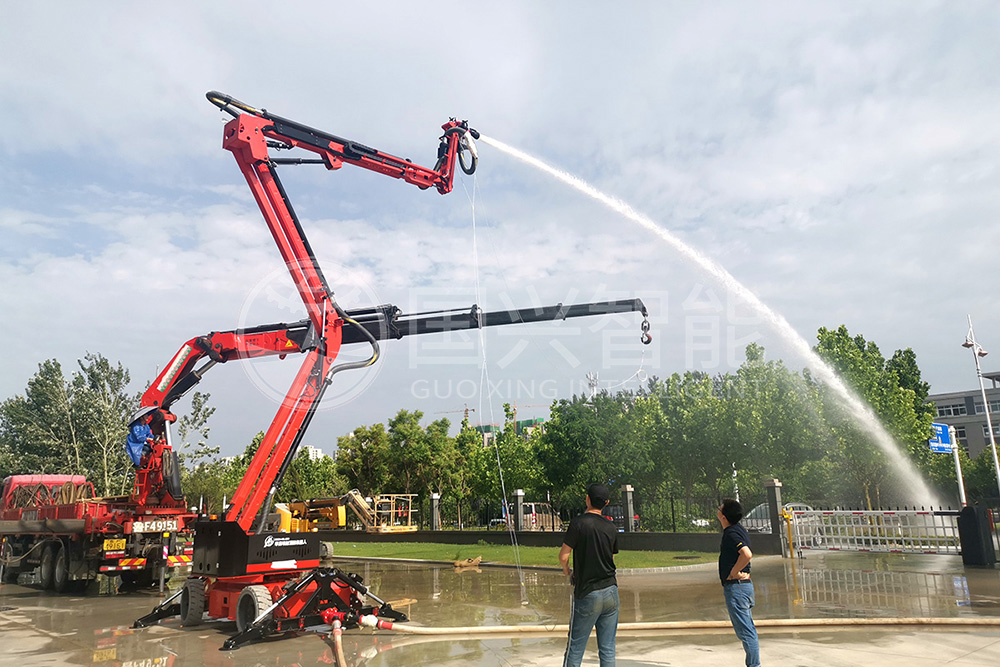
Confined fires require massive amounts of cooling agent. Unmanned units deliver sustained water or foam directly to the heat source. They do not need to retreat for air. For massive commercial vehicle fires, departments often deploy specialized equipment. A High Firefighting Robot model is uniquely positioned here. It handles high-angle cooling effortlessly. It can deliver high-expansion foam over the tops of burning semi-trucks. This overhead reach is critical. It suppresses cargo fires rapidly.
Smoke management is just as critical as flame suppression. Toxic smoke pathways block victim extraction. Many robotic units feature integrated turbine systems. These turbines act as massive fans. They push fresh air into the tunnel. They drive superheated gases away from trapped civilians. This forced ventilation drops the ambient temperature. It clears visual pathways for rescue teams to enter safely.
Tunnels become cluttered quickly during an incident. Disabled vehicles block the roadways. Debris from spalling concrete litters the path. Advanced units utilize front-mounted plow blades. They physically push debris out of the way. They can ram disabled passenger cars to the side. This heavy clearance capability opens vital access paths. It allows backup units and supply lines to advance smoothly.
You must evaluate true operational time under extreme temperatures. A label claiming "heat resistant" is practically useless. You need hard data. Demand specific testing data on internal component cooling systems. Ask how the unit performs at 500°C and above. Many units use external water curtains to protect their chassis. If the water supply drops, the unit might melt. You must know exactly how long the internal batteries survive high heat. A good unit will operate for several hours while under a constant thermal load.
Signal loss is a massive risk in concrete tunnels. Concrete and steel rebar block standard radio-frequency (RF) signals. If you lose connection, the unit becomes a heavy roadblock. Compare standard RF limitations against advanced solutions. Mesh network nodes work well. The robot drops signal repeaters as it drives forward. Physical tethering systems offer another approach. A fiber-optic cable guarantees zero-latency control. You must choose a communication method matched to your specific tunnel depth.
A flat showroom floor does not mimic a tunnel environment. Assess the chassis carefully. It must navigate rail ties and steep gradients. It will crawl over shattered concrete and melted tires. Look at the track design. Steep stairs and debris can cause a machine to throw a track. If it loses a track, the mission ends immediately. Look for deep-tread, high-tension continuous tracks. They offer the necessary traction for chaotic, uneven surfaces.
Consider the physics of pulling a fire hose. A charged, five-inch supply line is incredibly heavy. Contrast the unit's water output capacity against this required drag force. The robot must pull this charged line hundreds of meters into a tunnel. If the chassis lacks sufficient torque, it cannot advance. High flow rates mean nothing if the unit cannot drag the hose to the fire. Always calculate the maximum drag weight before purchasing.
Table 1: Robot Evaluation Framework
Evaluation Category | Marketing Claim | Field Reality Test |
|---|---|---|
Thermal Endurance | "Withstands high heat" | Must provide continuous operation logs at 500°C for at least 2 hours. |
Signal Integrity | "Long-range wireless" | Requires mesh-node dropping or fiber-tether for deep concrete penetration. |
Mobility | "All-terrain tracks" | Must climb 30-degree stairs and cross railway ties without track derailment. |
Drag Force | "High flow capacity" | Must demonstrably pull 300 meters of charged supply line on an incline. |
Getting the unit to the scene presents a major logistical challenge. You cannot simply throw a ,1000kg machine into the back of a standard truck. You must evaluate transport trailers carefully. Deployment times matter. How fast can your crew unload the machine? Once on site, it must travel from the portal to the fire. If the transport vehicle cannot get close due to traffic, the robot must drive further. This consumes battery life. You must plan for these deployment bottlenecks actively.
Robotic units change tactical operations completely. They do not replace your firefighters. Instead, they require specialized tactical training. Operators need extensive cross-training. They must learn to navigate using a two-dimensional screen. Driving blindly through smoke via thermal imaging takes practice. Furthermore, the rest of the crew must manage hose-drag logistics. They must feed the line smoothly as the unit advances. You must rewrite your SOPs to integrate this workflow safely.
Failing to assign a dedicated spotter for the supply line.
Assuming joystick controls translate easily without screen-navigation drills.
Deploying the unit without coordinating ventilation fan timing with the incident commander.
The post-fire reality is harsh. High heat degrades sensitive equipment. Sensors melt. Rubber tracks blister. Waterproof seals bake and crack. You must outline the expected maintenance budget before acquiring a unit. The downtime required to keep the unit field-ready is significant. You need proprietary parts on hand. You should schedule immediate post-deployment teardowns. Keeping the machine operational requires a dedicated, ongoing financial commitment from the department.
You must match robot capabilities to your specific structural mandates. A highway tunnel requires different features than a subterranean metro line. Road tunnels often see large commercial fuel fires. They need massive foam output. Rail transit systems feature narrow tracks and high-voltage third rails. They demand narrow chassis designs and insulated tracks. Look to frameworks like the NFPA standards for guidance. They outline specific response requirements for different tunnel types. Always align your technical specifications with these mandates.
Do not buy a unit based on a video. Recommend requesting on-site demonstrations inside your actual infrastructure. Drive the machine down your specific tunnel. Test the radio signal depth yourself. Demand references from similar municipalities. Call them and ask about their breakdown rates. Review independent, third-party burn-test data. This data proves the thermal survival claims. You need objective evidence before signing a procurement contract.
Firefighting robots are no longer experimental novelties. They are proven risk-mitigation tools for critical infrastructure. They provide unmatched thermal endurance and reconnaissance capabilities in environments where human survival is impossible. The chimney effect and EV thermal runaway make manual entry too dangerous. Remote-first strategies save lives.
However, the right investment requires careful scrutiny. You must look past flashy marketing features. Prioritize reliability, signal integrity, and robust post-sale vendor support. A machine that loses signal or throws a track during a deployment is a liability, not an asset.
We encourage all stakeholders to audit their current tunnel response SOPs immediately. Identify your specific operational gaps. Request technical specification sheets from tier-one manufacturers today. Begin the capability-matching process now, so your teams are prepared for the worst-case scenario tomorrow.
A: Concrete and rebar absorb standard radio waves. To overcome this, advanced robots use drop-nodes to build a mesh network. They physically drop signal repeaters as they advance. Other units rely on specialized low-frequency radios. For guaranteed zero-latency control, many departments use physical fiber-optic tethers attached to the supply line.
A: They cannot instantly extinguish a chemical thermal runaway. However, they are vital for management. They provide the sustained, high-volume cooling necessary to absorb the heat. This continuous cooling prevents the fire from spreading to surrounding vehicles. It also keeps the concrete tunnel structure from spalling and collapsing.
A: Robots do not carry their own water tanks due to weight limits. They are supplied by heavy hoses. They draft water directly from integrated tunnel standpipes. Alternatively, they drag charged supply lines behind them. These lines connect to traditional fire apparatus positioned safely outside the tunnel portal.