
Views: 0 Author: Site Editor Publish Time: 2026-08-28 Origin: Site


In complex industrial, tunnel, or warehouse fires, toxic smoke and extreme heat—not just the flames—are the primary barriers to successful intervention. They remain the leading cause of firefighter casualties worldwide. We often see visibility drop to absolute zero within seconds during these intense and chaotic scenarios.
Standard ventilation techniques often fall short in deep-seated or structurally compromised environments. Positive-pressure fans placed at distant entrances simply cannot penetrate twisting corridors or massive subterranean facilities. Furthermore, human crews cannot safely carry heavy ventilation equipment into active hot zones where structural collapse is imminent.
Integrating specialized Firefighting Robots equipped with high-capacity smoke exhaust systems bridges this tactical gap. They accelerate safe entry while aggressively protecting human personnel from lethal hazards. You will discover exactly how these advanced machines operate beneath the smoke layer. We will also explore how to evaluate and deploy them effectively for your specific high-risk facility.
Tactical Advantage: A Smoke Exhaust Firefighting Robot utilizes high-velocity fans and water mist to simultaneously clear toxic smoke, reduce ambient temperatures, and prevent flashovers.
Human-Robot Collaboration: These units do not replace personnel; they act as force multipliers, clearing safe entry corridors for human crews.
Evaluation Focus: Procurement should prioritize mobility over debris, remote signal stability in concrete structures, and verified airflow capacities (CFM/m³/h).
Implementation Reality: Successful adoption requires aligning the robot's physical dimensions and power logistics with the facility's specific terrain and standard operating procedures (SOPs).
Fire dynamics in complex structures create environments hostile to standard tactical approaches. Incident commanders constantly face a critical bottleneck: the inability to ventilate spaces fast enough to permit safe search and rescue. We must examine exactly why traditional methods falter when the environment becomes highly pressurized and structurally precarious.
Enclosed spaces rapidly accumulate dense, toxic, and combustible gases. Facilities like subway tunnels, chemical plants, and underground parking garages lack natural ventilation points. As synthetic materials burn, they release massive volumes of hydrogen cyanide, carbon monoxide, and phosgene gas. This thick chemical soup plunges visibility to zero. Human crews lose their sense of direction entirely. We rely on visual cues to locate victims and find the seat of the fire. When toxic smoke fills an enclosed cavern, standard visual navigation becomes impossible. You simply cannot fight what you cannot see.
The buildup of superheated gases drastically increases the risk of flashovers and backdrafts. Thermal layering occurs when extreme heat gets trapped near the ceiling. As this radiant heat intensifies, it bakes every combustible surface in the room. When temperatures cross a critical threshold, everything ignites simultaneously. This flashover phenomenon creates an immediate death zone for any personnel trapped inside. Human entry is delayed because firefighters must cool the gas layer from a distance. You cannot advance a hose line safely while superheated smoke threatens to engulf the entire compartment in flames.
Traditional positive-pressure ventilation (PPV) fans placed at entryways lose efficacy deep within complex structures. These fans blow air from the outside in. However, air pressure drops rapidly as it travels around corners, down stairwells, or through long corridors. Standard fans cannot be safely advanced by human crews during active combustion. If a tunnel stretches for hundreds of meters, a fan at the entrance does practically nothing for the crews fighting the fire at the deep end. The tactical gap requires bringing the fan directly to the hot zone, which is exactly what autonomous units achieve.
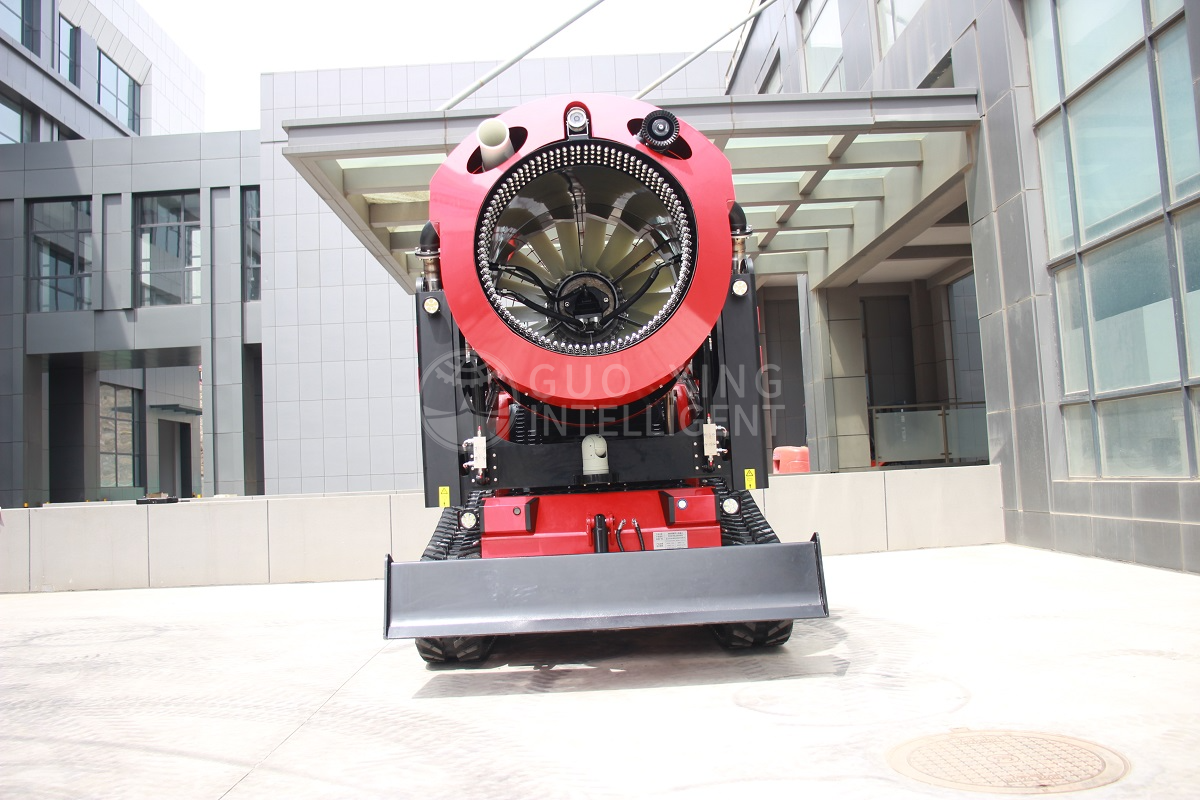
Modern incident response demands specialized tools built for specific hazards. A Smoke Exhaust Firefighting Robot solves the penetration problem by bringing industrial-grade ventilation directly into the danger zone. They leverage brute mechanical force alongside sophisticated environmental controls.
These units deploy industrial-grade turbine fans directly into the hot zone to aggressively displace smoke and toxic gases. Instead of relying on weak air currents from a distant doorway, the robot positions its turbine right at the critical chokepoint. They generate massive airflow volumes, often measured in tens of thousands of cubic meters per hour. This localized pressure manipulates the flow path of the fire. By overpowering the fire's natural draft, they force smoke out through designated exhaust vents. We see a rapid clearing of the space, allowing human teams to assess the structural integrity.
Ventilation alone can sometimes feed oxygen to a fire. To counter this, these robots combine exhaust fans with atomized water mist rings. This dual-action scrubbing system transforms the tactical approach. When the fan blows, it disperses microscopic water droplets into the superheated air.
The fine mist instantly absorbs latent heat, dropping ambient temperatures dramatically.
The water droplets bind with water-soluble toxic particulates in the smoke.
Gravity pulls these heavy, saturated particles to the floor.
The air becomes cooler, cleaner, and significantly less explosive.
This integrated misting process prevents sudden flashovers. It actively conditions the atmosphere rather than simply pushing toxic air around.
Utilizing thermal imaging and obstacle avoidance, these robots navigate zero-visibility environments. An operator located hundreds of meters away safely pilots the machine. They use onboard cameras that pierce through thick black smoke by reading heat signatures. Sensors detect fallen beams, abandoned vehicles, or hazardous drops. This allows operators to position the exhaust payload exactly where structural flow paths require it. You gain the ability to conduct precision ventilation in areas totally inaccessible to a human walking blindly.
Robotic technology in emergency response aims to elevate human performance, not eliminate it. These machines act as specialized squad members. They take on the highest-risk environmental conditioning tasks so human crews can focus on life-saving interventions.
By pushing heat and smoke out of primary access routes, the robot allows human firefighters to advance hoses safely. They conduct search-and-rescue with improved visibility and drastically reduced heat stress. Imagine a warehouse filled with burning plastics. The robot drives down the central aisle, operating its turbine and misting ring. It creates a cool, visible tunnel through the smoke. Firefighters follow closely behind this mechanical shield. They conserve the air in their SCBA tanks because they are not fighting extreme heat every step of the way.
The deployment keeps human operators outside the immediate blast or collapse radius while maintaining active ventilation and fire suppression. Structural collapse happens without warning during deep-seated industrial fires. Chemical explosions pose an ever-present threat. By sending the robot ahead, we ensure the most vulnerable personnel remain in the cold zone. If the roof caves in, a machine is lost. The human crew goes home safely. This calculated risk transfer is the primary objective of robotic integration.
Onboard sensors provide incident commanders with real-time telemetry to make evidence-based tactical decisions before committing human crews. These units carry gas detection suites, millimeter-wave radar, and thermal cameras. They act as forward scouts.
They detect dangerous spikes in explosive gas concentration.
They identify the structural layout hidden behind the smoke.
They monitor ambient temperature drops to confirm when flashover danger has passed.
You no longer have to guess what conditions exist deep inside a factory. The robot streams the precise data required to trigger an aggressive interior attack.
Selecting the right equipment requires a deep understanding of your operational environment. Marketing brochures often highlight top speeds or theoretical maximums. However, practical application demands rigorous scrutiny of mobility, durability, and signal retention. We outline the crucial metrics below.
Tracks vs. Wheels: Continuous heavy-duty tracks are mandatory for navigating fallen debris, fire hoses, and stairs. Wheeled units often struggle with traction in wet, unstructured environments. When structural members fail, the floor becomes a jagged landscape. Tracks distribute weight evenly and climb over obstacles seamlessly.
Center of Gravity: The addition of a heavy exhaust turbine requires a exceptionally low center of gravity. You must prevent tipping on uneven terrain. A top-heavy machine will capsize on a debris pile, rendering it useless during a critical deployment.
Self-Cooling Mechanisms: The robot must feature a self-spraying water curtain system to protect its own circuitry and hydraulic lines from radiant heat. Without this, the machine will melt before it reaches the target zone.
IP Ratings & Ingress Protection: Total protection against high-pressure water jets and fine particulate dust is non-negotiable. Fire grounds are flooded, muddy, and dirty. The internal electronics must remain sealed in a vacuum-tight, IP67 or IP68 rated enclosure.
You must carefully evaluate the trade-offs between battery limitations under heavy mechanical load, the operational restrictions of a tethered power supply, and the oxygen demands of combustion engines in smoke-filled environments.
Power Delivery Analysis
System Type | Typical Operational Duration | Primary Strengths | Crucial Limitations |
|---|---|---|---|
Lithium-Ion Battery | 2 to 4 hours | Zero emissions, silent operation, minimal maintenance. | Performance drops in extreme heat; limited run-time under heavy turbine load. |
Tethered Cable | Unlimited | Continuous operation, no battery swaps required. | Cable snagging risk; severely limits mobility range in complex layouts. |
Internal Combustion | 4 to 8 hours (fuel dependent) | High sustained power output for massive turbines. | Requires oxygen to run; stalls in oxygen-deprived smoke zones. |
Control Range: Verify non-line-of-sight (NLOS) control reliability. Standard radio frequencies degrade heavily in steel-reinforced concrete tunnels and petrochemical plants. You must ensure the remote control console maintains a solid handshake with the unit through thick concrete walls. Requesting specific decibel-milliwatts (dBm) penetration data from the manufacturer ensures you do not lose control exactly when you need it most.
Purchasing the hardware is only the first phase. Integrating heavy machinery into rapid response protocols introduces logistical hurdles. You must adapt your standard operating procedures to maximize this new capability without slowing down initial interventions.
Heavy Firefighting Robots require specialized transport trailers and ramp setup. This physical logistics chain must be factored into standard response times. A unit sitting on a trailer ten miles away provides no tactical value. Departments must designate dedicated tow vehicles and drill relentlessly on rapid offloading. Time spent unchaining the robot is time the fire spends growing.
High-velocity turbines and hydraulic tracks require rigorous preventative maintenance. Neglect leads to operational failure during critical incidents. Bearings must be greased, track tension must be calibrated, and sensors must be wiped clean after every use. A specialized team must take ownership of the machine's mechanical readiness. They ensure the unit starts perfectly every single time the alarm sounds.
Operators must be trained not just on piloting the robot, but on tactical ventilation theory. Driving the machine is the easy part. Understanding air flow paths is the challenge. Operators must avoid inadvertently pushing fire toward victims or into unburned fuel packages. Improperly placed positive pressure can accelerate fire spread. Command staff and operators must share a unified understanding of fluid dynamics in structural fires.
Define your primary use cases immediately. A machine designed for an open warehouse behaves differently than one built for a subway tunnel. Request a vendor site assessment to test signal penetration in your actual facilities. Require a live-fire or heavy-smoke demonstration on your specific terrain. This proves the hardware can handle your exact operational reality before you commit to integration.
Implement specialized tools for specific hazards: Integrating autonomous ventilation systems directly mitigates the most lethal aspects of modern firefighting by cooling spaces and clearing visibility.
Focus on verifiable metrics: Look beyond top-line marketing specifications to evaluate real-world limitations. Scrutinize track mobility, signal retention through concrete, and rapid deployment logistics.
Prioritize human safety over hardware: Treat these units as highly advanced shields. They absorb the heat, toxic exposure, and collapse risks so your human personnel can safely execute their objectives.
Commit to rigorous training: Ensure your operators deeply understand tactical ventilation theory to prevent catastrophic fire spread during high-pressure deployments.
A: Standard firefighting robots are primarily mobile water/foam monitors designed for direct fire suppression. Smoke exhaust models are built around high-capacity turbine fans (often with secondary water mist capabilities) specifically engineered to manipulate air flow, clear toxic gases, and lower ambient heat.
A: Yes, provided they are equipped with thermal imaging cameras (TIC), millimeter-wave radar, or LIDAR sensors that allow remote operators to navigate without optical visibility.
A: Enterprise-grade models feature automatic fail-safes. If the signal is lost due to structural interference, the robot will automatically halt, maintain its current suppression/exhaust function, or attempt to retrace its path until the signal is re-established.
A: For their exhaust function, no. However, to utilize their self-cooling systems and water mist integration, they must be connected to a charged hose line from a standard fire engine or hydrant.