
Views: 0 Author: Site Editor Publish Time: 2026-06-23 Origin: Site


Extreme industrial and municipal fires present immense challenges. Off-the-shelf robotics often fail here. They cannot handle the severe operational thresholds of petrochemical plants, nuclear facilities, or aviation hubs. Standard commercial models routinely melt, stall, or lose connectivity under pressure.
Sourcing specialized equipment demands a major shift in strategy. You must move past evaluating isolated features. Instead, you need to assess vendor engineering agility. You must verify their compliance rigor. You also need to guarantee long-term integration support. Partnering closely ensures operational success during critical incidents.
This article provides a transparent, evidence-based framework. We will help you evaluate vendors and mitigate implementation risks. You will learn how to structure a successful procurement process effectively. We map out exactly what distinguishes a reliable manufacturer from a basic assembler.
First responders encounter diverse and unpredictable hazards daily. We must categorize the specific use cases demanding custom engineering. High-risk chemical storage facilities pose unique explosive threats. Underground transit systems trap intense heat and toxic smoke. Lithium-ion battery facility fires burn exceptionally hot and reignite easily. Wildland-urban interfaces feature rugged, impassable terrain. These environments rapidly destroy standard equipment.
Commercial-grade models consistently fall short during severe incidents. They often lack sufficient hose-towing capacity. A standard robot cannot drag a fully charged five-inch supply line over debris. They usually lack explosion-proof housing. An errant spark triggers secondary explosions in volatile atmospheres. Furthermore, standard radio frequencies degrade quickly inside heavy structural fires. Signal loss leaves the machine stranded inside the hot zone.
Procurement teams must establish strict success criteria for custom builds. A successful deployment must directly lower human risk exposure. It must maintain uninterrupted suppression flow under specific local hazard conditions. You cannot compromise on these two core requirements. The machine serves as a resilient extension of the strike team.
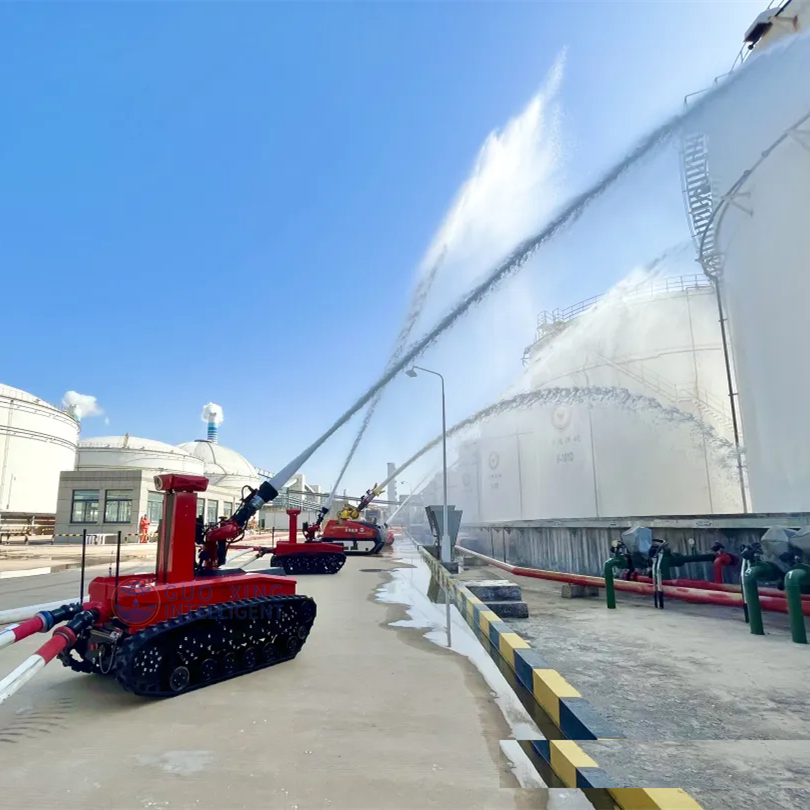
Assessing vendor capabilities requires looking behind the marketing brochure. Evaluating a Custom Firefighting Robot Manufacturer means scrutinizing their production philosophy. You must determine if they control the core architecture. True manufacturers engineer their chassis, drive trains, and proprietary software in-house. Mere assemblers bolt together third-party parts. This difference heavily impacts long-term reliability.
| Evaluation Metric | In-House Engineering | Component Assembly |
|---|---|---|
| System Integration | Seamless communication between drive train and sensors. | Prone to software conflicts and hardware bottlenecks. |
| Customization Limits | Can alter chassis dimensions and weight distribution. | Limited to swapping external bolt-on accessories. |
| Long-term Support | Direct access to source code and legacy schematics. | Dependent on third-party vendors surviving. |
High-hazard environments demand strict compliance and certification rigor. You must identify non-negotiables before drafting specifications. Look for IP68 ratings ensuring complete water and dust ingress protection. Demand ATEX or IECEx certifications for explosive atmospheres. Require MIL-STD testing for vibration and drop durability. A machine lacking these certifications becomes a liability.
Always demand testing transparency from your shortlisted vendors. Request verifiable data concerning thermal endurance. Ask for battery degradation rates at extreme temperatures. Check the structural load limits on the chassis. Trustworthy vendors gladly provide unedited trial footage. They supply raw testing logs instead of highly produced promotional videos.
Evaluate the supply chain and lifecycle support thoroughly. Your department will use this asset for a decade or more. Assess the manufacturer’s ability to guarantee parts availability. Confirm they offer continuous firmware updates. Ensure they provide rapid local servicing over a 10-to-15-year lifecycle. Downtime during fire season is unacceptable.
Procuring a special application firefighting robot involves matching hardware to specific threats. Chassis and mobility systems form the foundation. You must evaluate tracked versus wheeled designs. Tracked models excel at stair-climbing capabilities and debris-clearing power. Wheeled models often offer higher top speeds on flat pavement. Evaluate traction against your specific operational terrain.
Towing capacity remains a critical, often overlooked metric. A machine must tow heavy, water-filled supply lines without stalling. Frictional drag increases exponentially as the hose snakes around corners. The drive train must generate massive low-end torque. Insufficient torque renders the suppression system useless.
Payload modularity dictates tactical flexibility. You must customize suppression agents for specific local threats. High-volume water and foam monitors handle petrochemical blazes. Dry chemical systems extinguish specialized industrial fires. Positive Pressure Ventilation (PPV) fans clear toxic smoke from subterranean tunnels. The chassis must accept these varying payloads seamlessly.
Sensor arrays and telemetry must move beyond basic optical cameras. Zero-visibility smoke renders standard lenses blind.
Communication redundancy prevents catastrophic mission failure. Signal loss represents reality inside concrete and steel structures. Evaluate mesh networking capabilities extending signal range. Require tethered communication fallbacks using reinforced fiber-optic lines. Demand fail-safe "return-to-base" protocols. If the controller dies, the machine must autonomously retreat to a safe zone.
Deploying advanced robotics introduces significant adoption risks. A specialized machine is only as effective as its operator. We must acknowledge the training gap immediately. Reading a manual does not prepare someone for a multi-alarm fire. You must implement rigorous, scenario-based training. This prevents cognitive overload during active, chaotic incidents.
Maintenance and readiness hurdles present another major challenge. Post-incident decontamination requires meticulous care. Corrosive chemicals and soot destroy delicate sensors. You must establish strict battery management protocols. Lithium-ion power cells require balanced charging and climate-controlled storage. Routine diagnostic checks keep the unit response-ready at all times.
Tactical integration often faces skepticism from veteran personnel. Change management is crucial here. Do not frame the robot as a replacement for human firefighters. Present it as an advanced specialized tool. This tool requires updated Standard Operating Procedures (SOPs). Emphasize how it handles the deadliest tasks. It takes the heat so the strike team stays safe.
Moving from a Request for Information (RFI) to procurement requires strict logic. Drafting the Request for Proposal (RFP) sets the baseline. Include specific technical specifications and performance benchmarks. Specify exact flow rates, torque minimums, and thermal endurance times. These hard numbers quickly filter out unqualified vendors. Vague RFPs attract inadequate commercial platforms.
You must mandate a Proof of Concept (PoC) or field trial. Localized testing exposes theoretical claims. Design a stress test mimicking your facility’s absolute worst-case scenario. Follow these essential steps for a successful field trial:
Evaluating vendor performance during these trials is revealing. Watch how their engineers handle sudden breakdowns. Observe their troubleshooting speed. A vendor struggling during a controlled trial will vanish during an actual crisis. Select partners demonstrating resilience and transparency.
Partnering to build specialized robotic equipment represents a long-term operational commitment. It is never a simple, one-off equipment purchase. You are integrating a complex ecosystem into your suppression strategy. This requires dedicated training, rigorous maintenance, and continuous vendor collaboration.
Always prioritize rigorous engineering over theoretical, unproven tech features. Flashy autonomous marketing means nothing if the tracks melt. Demand transparent limitations from your vendor. A trustworthy partner tells you exactly what their machine cannot do. Build a robust support infrastructure locally to ensure continuous readiness.
Initiate a formal operational audit of your specific facility hazards today. Document your exact terrain, heat, and chemical challenges. Use this audit to draft a comprehensive RFI. You will attract serious engineering partners ready to protect your personnel.
A: Timelines vary based on customization depth. Engineering consultations and blueprint approvals usually take four to eight weeks. Manufacturing, assembly, and rigorous stress testing require an additional three to six months. Expect a total lead time of five to eight months from initial contract signing to final site delivery.
A: Yes, many high-end robotic chassis feature modular payload decks. Manufacturers engineer these decks to accept standard fire department couplings. You can usually mount your existing water monitors, foam inductors, or dry chemical nozzles. Verify thread compatibility and weight limits during the engineering consultation phase.
A: Reliable systems feature programmed fail-safe protocols. Upon losing radio contact, the unit immediately halts movement and shuts off active water flow to conserve pressure. Advanced models utilize basic autonomous retreat functions. They follow their own breadcrumb trail backwards until they re-establish connection with the operator's control unit.
A: Standard models are not natively ATEX certified. Manufacturers build explosive-proof variants only upon explicit request. Achieving ATEX certification requires sealing all electrical housings, removing spark risks from the drive train, and utilizing specialized wiring. You must clearly demand this certification in your initial Request for Proposal.