
Views: 0 Author: Site Editor Publish Time: 2026-09-22 Origin: Site


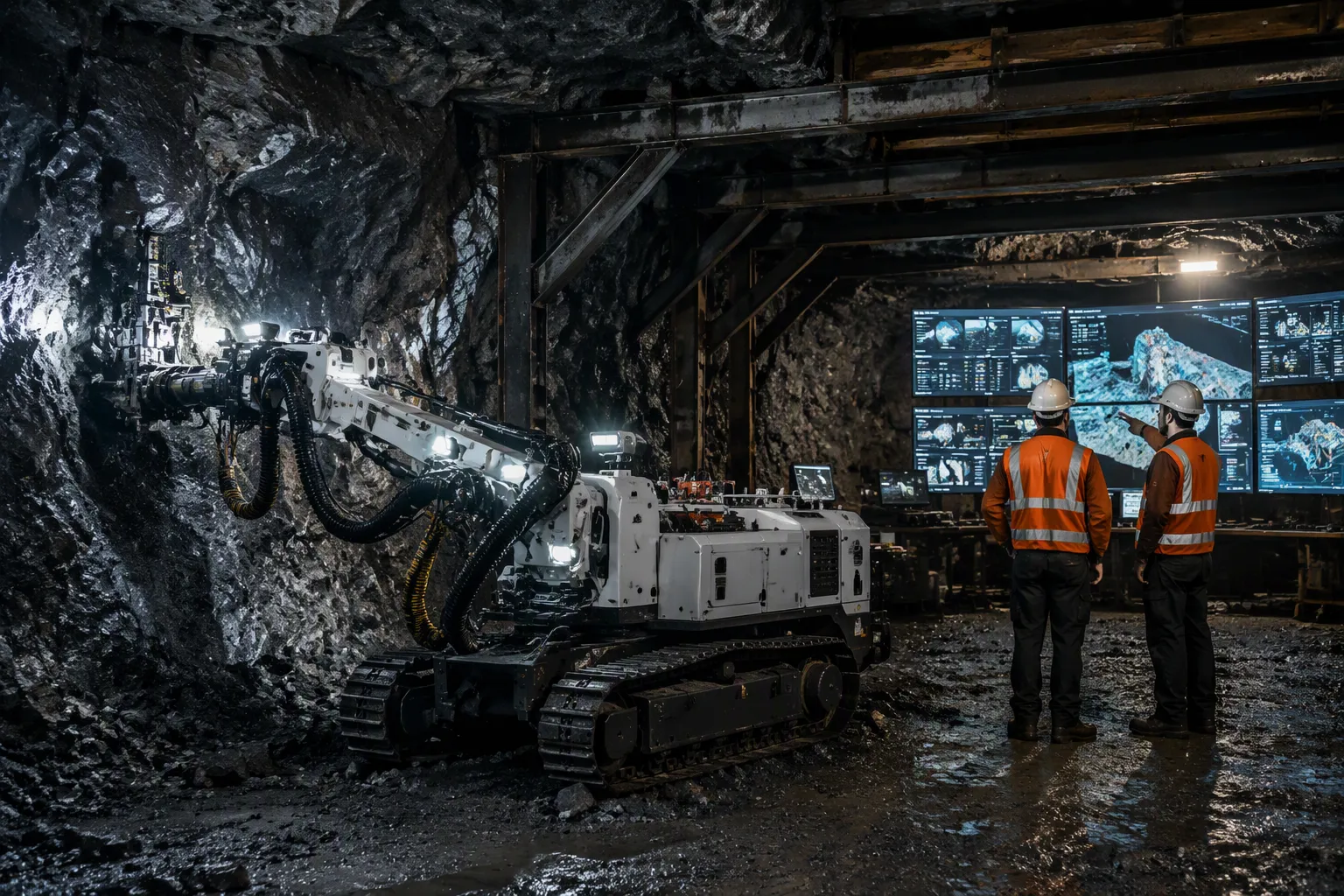
2026 marks a critical inflection point for coal mine robot deployment. The global mining robotics market will grow substantially this year. The global coal mine inspection robot market expands steadily, driven by stricter safety rules. Five trends define this shift: autonomous haulage, ai in mining for hazard detection, coal mine inspection robot systems, digital twins, and edge computing. This segment leads investment, while mine inspection robot platforms replace workers in dangerous zones. AI powers real-time risk assessment and 24/7 monitoring. The coal mine inspection robot market rewards early adopters with lower costs and better outcomes. These technologies reshape how mines operate worldwide.
Autonomous haulage systems cut costs by 20-30% and reduce safety incidents by 50%.
AI-powered hazard detection robots use computer vision and LiDAR for real-time risk assessment.
Coal mine inspection robots complete dangerous inspections in 20-30 minutes, not 60-90.
Digital twins and edge computing boost throughput by 15% at mines like Rio Tinto's Gudai-Darri.
Predictive maintenance reduces unplanned downtime by up to 60% using on-board sensors and AI.
Robotics-as-a-service models lower upfront costs and make automation accessible.
Australia, China, and India lead adoption through government mandates and targets.
Early adopters gain competitive advantage with safer, more efficient operations.
Autonomous haulage stands as the largest segment of the global mining robotics market in 2026, which grows at 10.5% CAGR. This technology removes human drivers from haul trucks and lets fleets run continuously across open-pit operations.
Komatsu leads globally by fleet size. Its AHS platform logged over 5 billion tons moved autonomously as of early 2026, with deployments across Australia, Chile, Canada, and the US. Caterpillar holds the largest market share through its Cat Command for hauling system on 793, 797, and 798 AC trucks. Hitachi Construction Machinery presented its LANDCROS Autonomous Haulage Solution at CONEXPO 2026. Epiroc and ASI Mining offer a retrofit approach via the Mobius platform, which automates existing trucks including older Komatsu and Cat models.
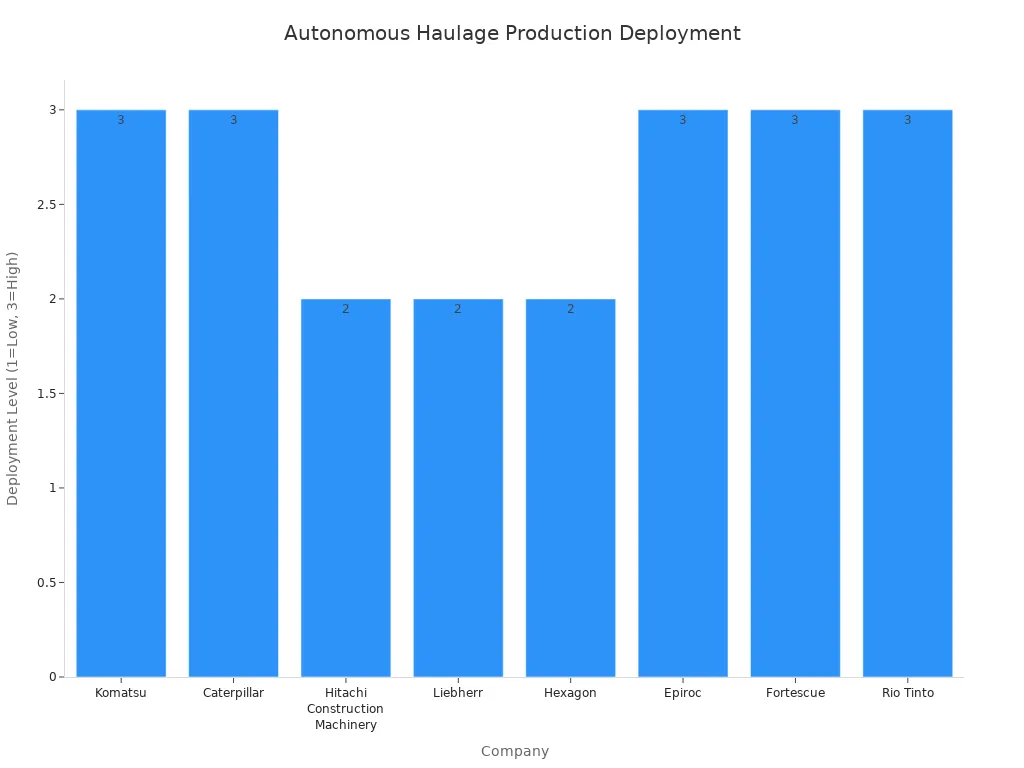
Mining companies design most new large projects around driverless fleets. Asia Pacific holds roughly 42.9% of the 2026 market, with China at about 34.6% within that region. Rio Tinto operates 250+ autonomous trucks in Pilbara. Guanghui Energy runs 500 autonomous trucks at Baishihu Open-Pit Coal Mine.
Komatsu customers achieved operating cost reductions of $0.50 to $0.62 per ton, with cumulative savings potentially reaching $600 million. Autonomous trucks deliver 20% higher productivity than conventional trucks, 10–15% fuel savings, and 25% longer tire life. Safety incidents drop by 50% across autonomous operations. These vehicles work reliably in dust storms and temperatures of +40–50 °C, where human operators face fatigue and heat stress.
ISO 23725:2024 defines the interface between Fleet Management Systems and Autonomous Haulage Systems in surface mining. This standard specifies how systems communicate, exchange messages, and transfer mine maps and dispatching information. Open architecture and OEM-agnostic autonomy systems integrate across different truck platforms without proprietary dependencies. Drive-by-wire retrofitting adds autonomous capability to existing vehicles. AI-powered 360º perception combines real-time environmental awareness with onboard decision-making. Behavior prediction helps autonomous trucks anticipate human driver actions and maintain smoother interactions in shared environments. Integrated fleet orchestration links vehicle behavior, dispatch, and traffic management into a unified system. This coordination reduces bottlenecks at intersections, loading zones, and dump areas.
The mining industry has moved beyond tentative AI experimentation. A surge in technology financing and M&A activity in 2026 confirms that ai in mining now drives core operations. Companies deploy ai across seven key domains: intelligent equipment maintenance, proactive hazard identification, automated machinery, real-time health surveillance, immersive safety training, comprehensive safety insights, and predictive environmental monitoring. Machine learning models analyze operational data to forecast equipment failures before they cause unplanned stoppages. This predictive capability keeps machinery in peak condition and improves safety outcomes across sites.
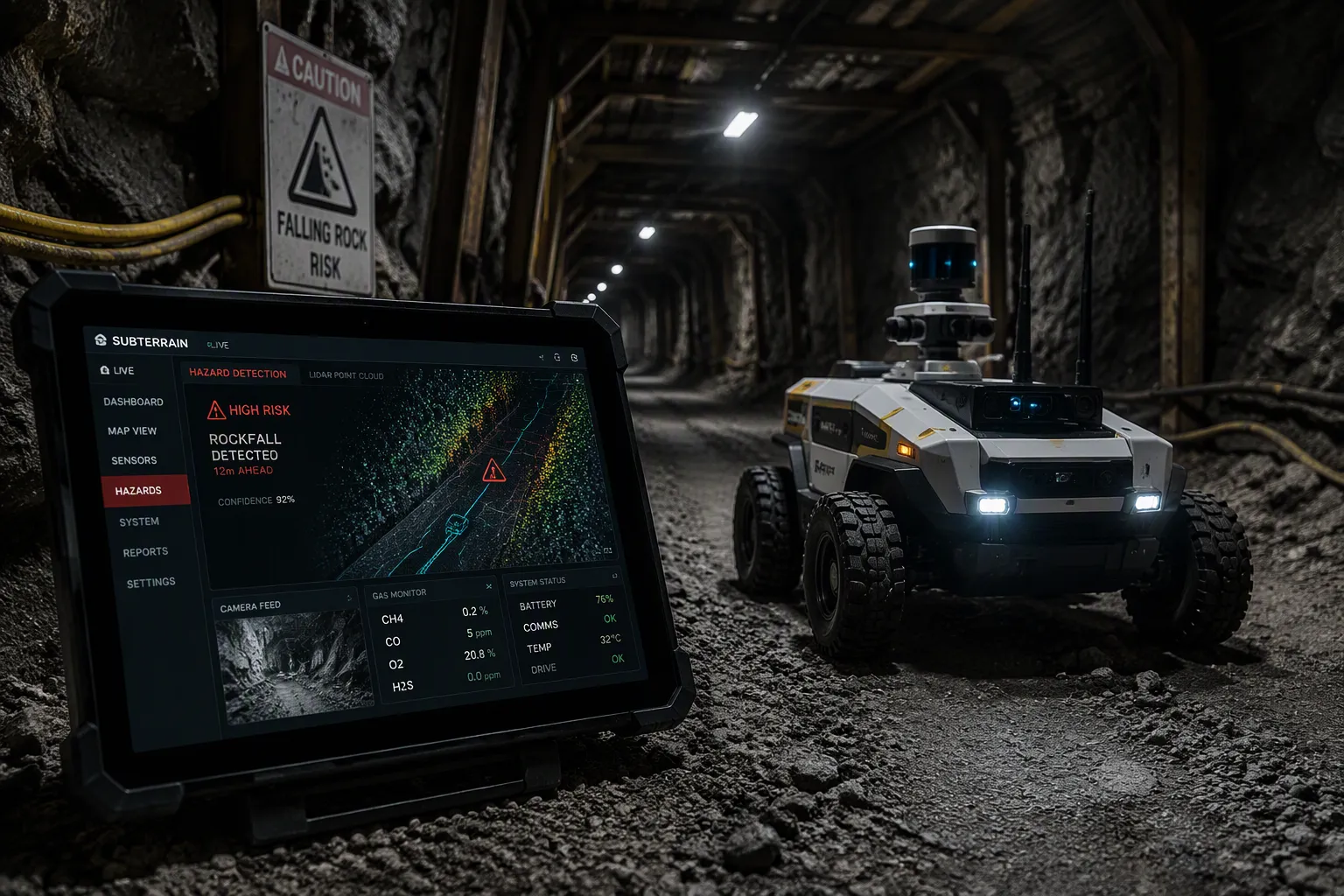
Hazard detection robots combine computer vision with radar, LiDAR, UWB, GNSS, and vehicle telemetry. This sensor fusion architecture reduces uncertainty and improves confidence in safety decisions. Real-time edge processing performs inference on-site using platforms like NVIDIA Jetson, achieving low latency without cloud dependency. Contextual risk reasoning enriches raw detections with shift rosters, machine status, and geofencing data to differentiate normal activity from critical hazards.
Progressive escalation triggers a sequence of responses: awareness, advisory warning, audible alert, critical warning, and machine intervention such as slowing or stopping equipment. LiDAR provides spatial information for slope, rockfall, and structural monitoring. This complements computer vision for a complete view of changing site conditions. The system supports methane leak detection and gas leak detection by processing sensor data to identify unusual patterns before they become critical.
Autonomous robots conduct gas monitoring missions into longwall tailgate entries, bleeders, and goaf edges where methane accumulation and spontaneous combustion risks exist. These machines eliminate the need for personnel entry into hazardous underground environments. The coal mine inspection robot carries multi-gas detectors for methane, carbon monoxide, hydrogen, and oxygen deficiency, plus thermal imaging for hot-spot detection. Navigation relies on LiDAR and inertial systems.
Inspections that would require a two-person crew a significant time are completed faster without any personnel entering the hazard zone. Real-time data transmission enables immediate anomaly detection. Gas concentrations, thermal anomalies, and structural issues are flagged within seconds. The system automatically creates corrective work orders and notifies teams, reducing response time significantly. Coal mines using this mine inspection robot technology document a significant increase in gas monitoring spatial resolution and a measurable reduction in spontaneous combustion events through earlier detection. This represents a significant advance in automated mining safety for underground coal mines.
Remote operations centers allow teams in centralized locations to manage equipment, monitor production, and coordinate activities across multiple mine sites in real time. This approach reduces the number of workers needed in high-risk environments. Connected cameras and radar devices provide continuous operational visibility even when few personnel are physically on-site. AI-powered analytics are applied to continuously collected visual data to detect early signs of equipment wear or performance issues.
IoT sensors embedded across vehicles, processing equipment, conveyor systems, and environmental monitoring infrastructure generate continuous streams of real-time data. Operators analyze this data to identify inefficiencies or bottlenecks as they happen. Automated solutions trigger alerts when abnormal activity is detected, allowing workers to focus on coordination and response. Together, these integrated systems support 24/7 monitoring by combining centralized remote control, continuous sensor data, and AI-driven anomaly detection. This integration of ai in mining operations creates a comprehensive safety technology framework for modern underground automation.
The global coal mine inspection robot market is projected to grow steadily from 2026 to 2033. This steady expansion reflects the mining industry's urgent need to remove workers from hazardous underground environments. The coal mine inspection robot market benefits from stricter process-safety management and rapid digital transformation across major mining regions. The broader explosion-proof inspection robot market, which includes coal mining as a core segment, grows at a strong pace from 2026 to 2032. This acceleration signals strong momentum for the coal mine inspection robot market.
The global coal mine inspection robot market is expanding. Recurring software subscription fees bundled with robot sales boost margins for vendors. Underground coal mines account for a significant revenue share. Open-pit coal mines also contribute. Key drivers for the coal mine inspection robot market include gas leak detection, structural integrity checks on roofs and pillars, and search-and-rescue operations in hazardous atmospheres. Mandatory mine safety acts and digital twin integration for predictive maintenance further propel the coal mine inspection robot market.
Regional dynamics shape the coal mine inspection robot market. Asia-Pacific leads through government mandates for smart coal mines and "fewer people, safer mines" policies. China drives adoption through state-backed programs. India expands at a notable pace via Coal India's modernization. North America grows strongly, driven by MSHA regulations and automation to reduce worker exposure. Europe focuses on retrofit solutions and methane leak detection. Turkey emerges as a fast-growing market in the Middle East and Africa region, with explosion-proof certification requirements driving demand for specialized robots.
A national competition in 2026 showcases coal mine robot innovations designed for "Less Manned, Unmanned" scenarios. This event accelerates the coal mine inspection robot market by demonstrating practical applications. Participants deploy explosion-proof inspection robots for rail-mounted routes along mine roadways. These robots use autonomous navigation, multi-sensor fusion, and ai-based anomaly recognition. Thermal imaging and gas detection capabilities allow the mine inspection robot to identify methane leaks and spontaneous combustion risks. Private 5G networks and edge computing enable real-time data transmission. The competition highlights how the coal mine inspection robot market rewards early adopters with proven safety outcomes.
Unmanned aerial vehicles gain traction for coal exploration and prospecting. Drones conduct high-wall stability assessment and blast-hole verification in open-pit operations. Volumetric mapping and ai-driven geotechnical analysis remove personnel from landslide-prone zones. The mine inspection robot market increasingly incorporates aerial platforms alongside ground-based systems. These UAVs support the coal mine inspection robot market by extending inspection coverage to areas inaccessible by rail-mounted robots. The coal mine inspection robot market continues to evolve as ai capabilities improve anomaly detection accuracy. The coal mine inspection robot market will expand further as safety regulations tighten worldwide.
The mining sector now adopts edge computing, digital twins, and robotic fleets as core elements of Mining 4.0. These technologies transform raw data into operational intelligence. Digital twins create virtual replicas of equipment and geology. Edge computing processes data on-site. Together, they enable data-led, autonomous operations across coal mines.
Digital twins build virtual replicas of physical mining assets. These replicas use real-time data, physics-based models, and ai to simulate system behavior under different conditions. Operators test scenarios before committing to real-world changes. This approach supports smarter production planning and reduces operational risk.
Mechanism | How It Supports Real-Time Simulation and Predictive Scheduling |
|---|---|
Scenario simulation | Models mining system behavior under different conditions using real-time data, physics-based models, and ai |
Predictive maintenance planning | Analyzes equipment data continuously to trigger automatic alerts and schedule repairs |
Process simulation and optimization | Simulates drilling, blasting, loading, and transport to evaluate outcomes before implementation |
Real-time monitoring and control | Provides a live view of operations for rapid adjustments and scenario testing |
Data-driven decision-making | Integrates IoT, ai, and machine learning to generate real-time insights for smarter planning |
Predictive maintenance stands out as a high-value application. The system monitors equipment health continuously. It forecasts failures and schedules repairs automatically. This capability prevents unexpected breakdowns and improves operational efficiency. Teams also simulate changes in processing parameters without interrupting production. They test reagent dosing and power constraints virtually. This supports continuous optimization across the mine site.
Edge computing moves data processing closer to the source. It eliminates the long round-trip to centralized cloud servers. That round-trip can introduce significant latency. Such delays are too slow for critical mining workloads. On-site processing delivers near-instantaneous response times. Field employees receive actionable intelligence immediately.
This speed matters in mining operations. A system disruption could lead to major environmental disasters. Fast, on-site decision-making becomes essential. Edge computing processes large volumes of data from IoT devices in real time. Organizations make immediate decisions about critical operations. The ai in mining runs inference at the edge using platforms like NVIDIA Jetson. This achieves low latency without cloud dependency. The ai detects anomalies and triggers alerts within seconds. This architecture supports autonomous operations in remote and underground environments.
Rio Tinto's Gudai-Darri mine demonstrates the combined value of these technologies. The operation achieved a significant throughput gain through digital twin and edge computing integration. The mine uses ai to optimize scheduling and equipment deployment. Autonomous trucks and drills feed data into the digital twin continuously. The system adjusts plans in real time based on current conditions.
These results show measurable returns for early adopters. The ai in mining reduces downtime and improves resource allocation. Mines that deploy digital twins and edge computing gain a competitive advantage. They respond faster to changing conditions. They schedule maintenance more effectively. They reduce waste across drilling, blasting, and transport processes. The technology stack delivers both operational and financial benefits.
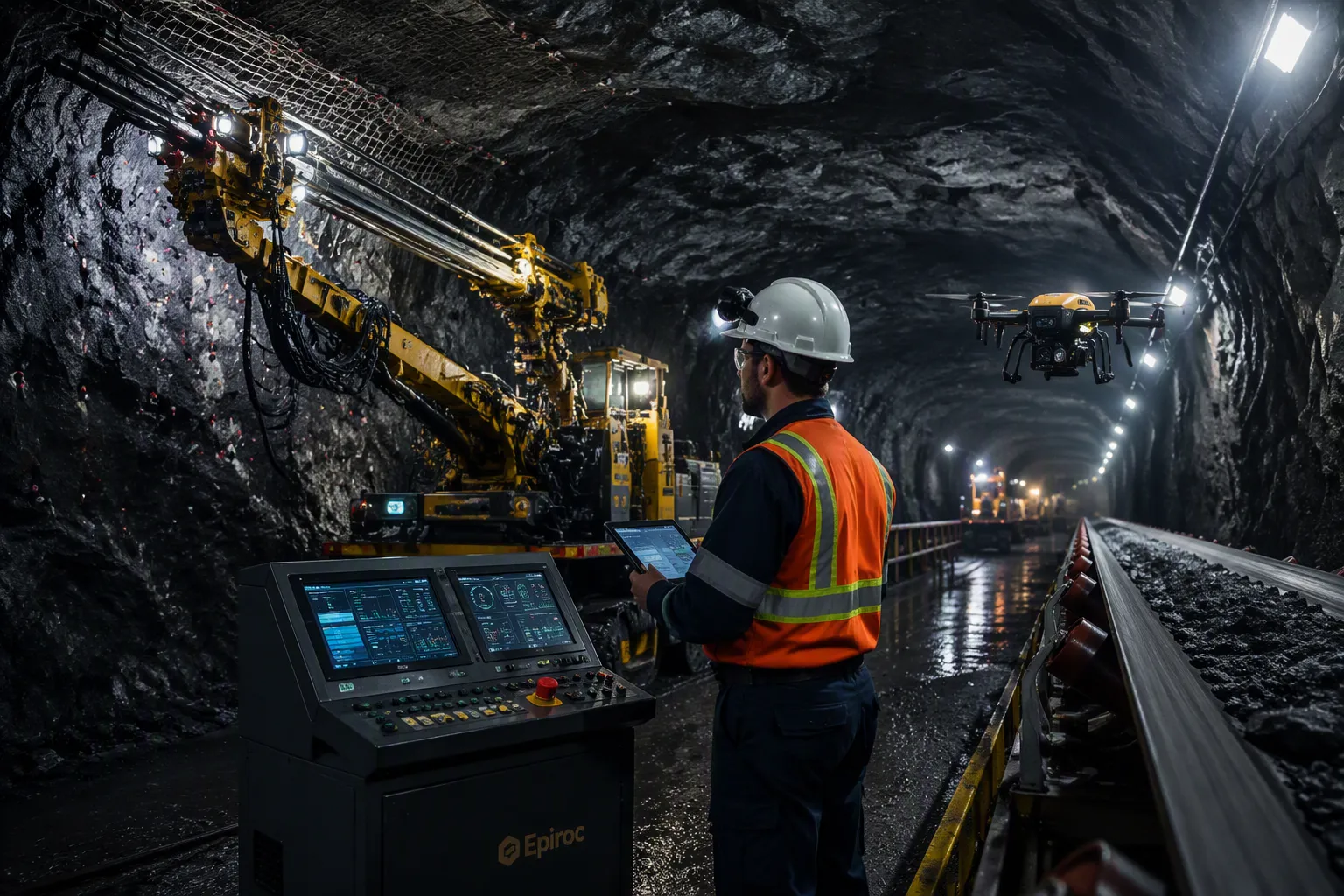
Robotic systems now handle maintenance tasks that once required manual labor and production stops. Automated drilling, conveyor inspection drones, and sensor-based monitoring keep equipment running longer. These technologies reduce unplanned downtime across coal operations. The workforce shifts from equipment operators to data analysts who interpret ai outputs and coordinate responses.
Sandvik and Epiroc both report high uptime on their 2026 automated drilling and bolting models. These machines handle roof bolting and face drilling without direct human control. The equipment operates in underground conditions where roof falls and gas pockets create constant danger. Automated bolting systems install support structures faster than manual crews. The machines use sensors to detect rock conditions and adjust drilling parameters in real time. This capability reduces the risk of injury from falling rock and equipment failures.
The shift toward automation changes workforce requirements. Mines need fewer operators at the face and more technicians who maintain robotic systems. Data analysts monitor performance metrics and schedule interventions before failures occur. This transition demands new training programs and partnerships with technical colleges.
Conveyor belt inspection drones enable continuous monitoring without production stops. Belt crawlers ride on moving belts, drones fly alongside operating conveyors, and fixed sensors monitor continuously during production. Only detailed splice inspections require brief stops.
Yes. Belt crawlers ride on moving belts, drones fly alongside operating conveyors, and fixed sensors monitor continuously during production. Only detailed splice inspections require brief stops.
The performance gains are substantial. Manual inspection detected issues at a low rate. Robotic inspection raised that detection rate significantly. Unplanned stops and annual belt failures decreased sharply.
UAVs fly along conveyor routes capturing thermal and visual imagery of belt surfaces, structures, idlers, and transfer points. They access elevated sections without scaffolding. Thermal imaging detects bearing hot spots. 4K visual inspection covers structure and supports. Transfer point and chute condition assessment happens in real time. Spillage and buildup detection triggers immediate alerts.
A peer-reviewed study implemented and field-tested a UAV integrated with a thermal imaging camera for inspecting belt conveyor rollers in a mining port. Using a signal processing technique, the system automatically identified roller failures. The authors note that the teleoperated UAV approach improved the inspection procedure with quantifiable benefits in precision, mobility, and productivity.
On-board sensors feed continuous data to ai systems that predict equipment failures before they happen. This predictive maintenance approach reduces unplanned downtime significantly. The ai in mining analyzes vibration, temperature, and performance data to identify patterns that precede breakdowns. Machine learning models improve over time as they process more operational data.
The results extend beyond downtime reduction. Studies show significant reduction in downtime, elimination of unexpected breakdowns, and reduction in maintenance costs.
The coal mine inspection robot and mine inspection robot systems integrate with these predictive platforms. The coal mine robot collects data during routine inspections. The mine inspection robot feeds that data into ai models. The coal mine inspection robot then triggers maintenance work orders automatically. This integration creates a closed loop where robotic inspection and ai-driven analysis work together. The safety benefits compound as fewer workers enter hazardous zones and equipment fails less often.
Australia remains a global benchmark for driverless haulage and remote operations centers. New South Wales and Queensland have introduced mandates requiring remote operation of equipment in high-risk underground zones. These policies push mine operators toward faster robotic deployment. Rio Tinto runs one of the world's largest driverless haul truck fleets in the Pilbara. This demonstrates the proven scalability of driverless technology in coal and iron ore operations. The Queensland mining regulations include provisions for tele-remote operation of continuous miners and shuttle cars in gassy mines. New South Wales follows a similar path through its Work Health guidelines for mines. Operators must demonstrate remote operation capability for longwall faces and development headings. These frameworks create a compliance-driven market for coal mine inspection robots and haulage systems. Operators who delay face rising penalties and higher insurance premiums. The regulatory environment in Australia sets a global standard for mandated mine technology adoption.
MSHA recorded fatalities in FY2024, intensifying pressure on operators to deploy robotic systems that reduce human exposure to hazards. The regulatory updates address proximity detection, collision avoidance, and remote operation standards for underground coal mines. These guidelines accelerate capital allocation toward advanced mining systems. MSHA now requires proximity detection systems on continuous mining machines in underground coal operations. Canada presents a different picture. Only a small share of Canadian enterprises had adopted robotics as of 2022. This signals a large untapped opportunity amid rising labor costs and an aging workforce. Canadian mining companies face labor shortages in remote northern operations. U.S. coal operators now prioritize investment in remote operation centers and inspection robots to meet compliance deadlines. The regulatory push creates a clear ROI case for ai-driven safety systems that monitor gas levels and structural integrity in real time. Companies that integrate ai analytics with remote operations centers gain faster anomaly detection and reduced response times.
China and India lead the scale-up through state-backed automation targets. China's smart coal mining project in the northwest set a record with many driverless trucks operating safely alongside manned vehicles. This proves mixed fleets function at scale in challenging environments. India drives mechanization through Coal India's modernization programs. Labor shortages and workplace hazard concerns push demand for robotic loaders, haulage systems, and inspection drones. Both countries set ambitious targets for driverless fleets. China supports this goal with ai-driven fleet control and private LTE/5G networks in underground mines. Indian operators now deploy robotic systems for predictive maintenance and hazard detection in coal handling operations. The Indian Ministry of Coal mandates digital transformation across state-owned mining enterprises. These national policies create the fastest-growing regional market for mining robotics. The Asia-Pacific region positions itself as the leader in technology adoption through government directives rather than market forces alone.
Mining companies face multiple barriers when adopting robotics. High capital costs limit access. Workforce skill gaps slow deployment. Legacy infrastructure creates integration problems. Strategic planning and emerging business models help operators overcome each obstacle.
Barrier | How the Industry Addresses It in 2026 |
|---|---|
High capital investment | Pilot projects, strategic alliances with technology providers, and R&D investment |
Regulatory uncertainty | Engagement with mining authorities for proactive compliance |
Technological limitations in extreme conditions | Customized solutions and ai, IoT, and Industry 4.0 integration |
Integration with legacy systems | Specialized expertise, strategic alliances, and interoperability improvements |
Workforce skill gap | Training programs for managing and troubleshooting robotic systems |
Environmental challenges | Customized solutions and comprehensive risk management plans |
The upfront cost of robotic systems blocks adoption. Robotics-as-a-service models remove this barrier. Companies pay a fixed monthly fee instead of purchasing equipment outright. Usage-based pricing ties costs to actual operations. Outcome-based pricing links fees to results such as units produced. These models reduce financial risk for adopters.
Industry experts explain the logic behind this shift:
By adopting a RaaS model, we make automation more accessible to fill labor gaps, while mitigating financial risk for our customers. Customers experience both short- and long-term savings, as well as faster deployments.
Companies describe a practical pathway for mining organizations. Rather than requiring a full fleet replacement, companies start with a retrofit of existing vehicles to autonomous operation. This hybrid approach lets organizations keep owned assets while experiencing autonomy benefits. As confidence grows, they license autonomous-ready vehicles without purchasing the asset. This progression from retrofit to full RaaS licensing lowers barriers for companies with large fleets. ai-powered performance monitoring helps RaaS providers optimize equipment uptime and predict maintenance needs.
Future mines need fewer operators but more technicians and data analysts. The workforce skill gap represents a serious barrier. Companies invest in training programs for managing, maintaining, and troubleshooting robotic systems. Partnerships with technical colleges provide a pipeline for new talent.
Internal reskilling programs help existing workers transition. Operators learn to manage ai-driven systems instead of controlling equipment manually. Maintenance staff train on robotic diagnostics and repair. These programs address the shortage of skilled personnel while retaining institutional knowledge.
Most coal mines operate with legacy equipment installed over decades. Replacing entire fleets costs too much. Phased retrofits offer a practical alternative. Companies add sensors, controllers, and connectivity to existing machines. Middleware solutions bridge old and new systems.
These approaches manage technological complexity. Specialized expertise and strategic alliances help mines integrate ai platforms with existing infrastructure. Interoperability improvements through Industry 4.0 standards reduce friction. Machine learning models analyze operational data from legacy systems to predict failures. The transition keeps mines producing while advancing automation. Edge-based ai analytics process data locally for faster decisions without cloud dependency.
Three trends dominate 2026: autonomous haulage reduces costs by 15%, AI-driven safety transforms detection. The coal mine inspection robot market expands steadily, rewards early adopters, drives innovation, grows, and leads this shift. Coal mine inspection robot removes danger. Another coal mine inspection robot detects methane gas. Mine inspection robot technology improves safety. Mine inspection robot solutions protect personnel. Mine inspection robot reduces incidents significantly. A coal mine inspection robot patrols hazard zones. The coal mine robot market accelerates. AI powers operations. AI enables maintenance. AI detects hazards. AI improves outcomes. AI in mining creates safer conditions. 2026 marks a tipping point. Early adopters gain competitive advantage. Coal mining evolves into a safer industry.
Autonomous haulage systems lead the market. They represent the largest segment of the global mining robotics market. These systems reduce haulage costs by 15% and cut safety incidents by 50%.
The global coal mine inspection robot market grows steadily from 2026 to 2033. Underground coal mines account for a significant revenue share. Stringent safety regulations drive this steady expansion.
Inspection robots complete hazardous zone checks faster than manual crews. Gas monitoring spatial resolution increases significantly. Response time drops substantially.
Digital twins create virtual replicas of equipment and geology for predictive scheduling. Edge computing processes data on-site, eliminating cloud delays. Rio Tinto's Gudai-Darri mine achieved a significant throughput gain using this technology stack.
Predictive maintenance reduces unplanned downtime significantly. Studies show substantial reduction in downtime and elimination of unexpected breakdowns. On-board sensors feed continuous data to AI systems that forecast failures before they occur.
Australia leads through government mandates in New South Wales and Queensland. China and India set state-backed targets for autonomous fleets. North America responds to MSHA regulatory updates with increased investment in inspection robots.
Robotics-as-a-service models remove upfront purchase costs. Companies pay fixed monthly fees or usage-based pricing. Phased retrofits add autonomy to existing vehicles without replacing entire fleets. This hybrid approach lowers financial barriers for mine operators.