
Views: 0 Author: Site Editor Publish Time: 2026-09-25 Origin: Site


Did you know refinery fires can burn at temperatures exceeding 1,000°C? Such extreme heat pushes standard firefighter turnout gear far past its thermal limits. Manual intervention becomes incredibly dangerous. Traditional response methods put personnel at immense risk. They frequently lack the precision required to suppress volatile chemical blazes effectively. Enter the automated robotic responder. As a critical investment for modern petrochemical facilities, these highly durable machines are fundamentally transforming industrial emergency response. In this comprehensive guide, we will explore the tactical choice between water and foam payloads. We will also highlight the strategic advantages of specialized elevated equipment and analyze real-world insights to demonstrate proven return on investment.
The petrochemical threat landscape presents some of the most complex emergency response scenarios in the industrial sector. Refineries process and store vast quantities of hydrocarbon fuels, pressurized vessels, and volatile chemicals. When a fire occurs in this environment, responders face extreme radiant heat and toxic smoke plumes. They also confront the severe risk of a Boiling Liquid Expanding Vapor Explosion.
Human physical limitations make manual intervention highly problematic under these conditions. Standard protective gear withstands high temperatures for only short durations. The radiant heat flux from a large-scale storage tank fire can exceed safety thresholds hundreds of feet away. This prevents human crews from getting close enough to apply extinguishing agents effectively. Furthermore, the sheer physical exhaustion of wrestling with heavy, high-pressure hose lines in high-stress environments drastically reduces operational efficiency.
From an asset protection standpoint, investing in robotic suppression technology is not merely a safety compliance measure. Engineers design these machines to operate in environments that would be fatal to humans. They safeguard millions of dollars in highly specialized infrastructure. Ensuring a rapid, precise, and continuous response allows facilities to mitigate the risk of a localized ignition cascading into a total plant failure.
Looking at recent shifts in industrial safety, the global market is witnessing a distinct transition toward automated suppression systems. Current industry analyses indicate that modern refineries are increasingly abandoning manual, fixed-monitor setups. Instead, facility managers are adopting highly mobile, dual-agent robotic platforms. Stricter occupational safety regulations and a growing emphasis on minimizing human exposure to carcinogenic smoke drive this shift. The increasing scale of mega-refineries demands higher flow rates and faster deployment times than human crews can safely provide. Manufacturers are now integrating advanced telemetry and thermal diagnostics. This ensures the next generation of automated responders can independently assess fire behavior and optimize payload delivery in real-time.
Selecting the correct suppression agent is the most critical tactical decision in industrial firefighting. Applying the wrong payload fails to extinguish the blaze. It can even cause the fire to spread rapidly across the containment area.
In the context of hydrocarbon fires, water is rarely used to extinguish the primary flames. Water is denser than most petrochemicals. It sinks below the burning fuel and boils instantly. This reaction potentially causes a dangerous boil-over effect that scatters burning oil. However, water plays an indispensable role in cooling and exposure protection. When a storage tank ignites, the immediate priority is cooling adjacent tanks and structural supports. Continuous, high-volume water application prevents steel from weakening. It stops the fire from spreading via radiant heat. Modern robotic systems also utilize water mist or fog capabilities. A finely dispersed water fog absorbs massive amounts of heat and knocks down toxic gas clouds before they ignite.
To extinguish an oil or solvent fire, the fuel source must be physically isolated from oxygen. Aqueous Film-Forming Foam and alcohol-resistant foams become strictly necessary here. Foam solutions feature a lower specific gravity than the hydrocarbon fuel. This allows them to float on the surface. The foam creates a thick, continuous blanket that smothers the fire. It cools the surface of the fuel and suppresses the release of flammable vapors. Depending on the hazard, operators calibrate the payload to deploy low, medium, or high-expansion foams. This tailors the blanket thickness to the specific chemical involved.
| Suppression Agent | Primary Function | Best Used For | Key Risk if Misused |
|---|---|---|---|
| Water Solid Stream | Cooling & Exposure Protection | Cooling adjacent steel structures, piping, and unignited tanks. | Can cause boil-over if applied directly into heavy hydrocarbon pool fires. |
| Water Fog or Mist | Heat Absorption & Gas Mitigation | Knocking down toxic vapor clouds and reducing ambient heat. | Ineffective at penetrating deep-seated fires or thick fuel layers. |
| Aqueous Film-Forming Foam | Smothering & Vapor Sealing | Direct application onto burning hydrocarbon or solvent pools. | Can degrade quickly if applied forcefully, breaking the vapor seal. |
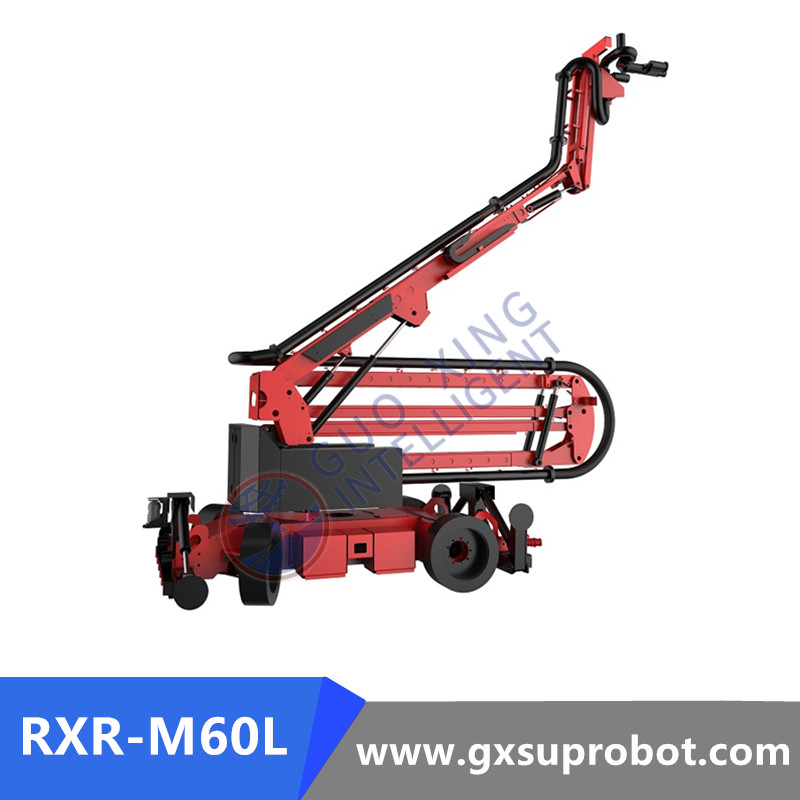
One of the most significant challenges in petrochemical fire suppression is verticality. Modern facilities feature towering distillation columns, massive bulk storage tanks, and elevated pipe racks. When a fire erupts at the top of a 12-meter storage tank, ground-level streams face severe physical limitations. The extreme heat generates massive thermal updrafts. These powerful columns of rising hot air easily deflect standard suppression streams. They break apart the foam before it ever reaches the fuel surface.
This specific operational pain point is resolved by utilizing a 15M High Firefighting Robot. Specialized units are equipped with a heavy-duty hydraulic boom. This mechanism elevates the primary monitor 15 meters into the air.
Consequently, this elevation provides immense tactical superiority. Instead of fighting gravity and thermal updrafts from the ground, the machine executes a top-down attack. Raising the nozzle above the lip of the burning storage tank allows the system to apply the foam blanket directly and gently onto the fuel surface. This maximizes vapor suppression. Furthermore, the elevated boom allows the monitor to bypass ground-level containment bunds and complex pipework. It ensures a clear, unobstructed line of sight to the core of the inferno.
When evaluating capital investments in emergency response equipment, procurement managers must look beyond basic functionality. Industrial environments demand industrial-grade specifications. Here is what engineers look for when specifying a firefighting robot for hazardous zones.
Operating electronic equipment in a refinery carries the inherent risk of igniting ambient flammable gases. Any suppression machine deployed in these zones must possess rigorous explosion-proof certifications. This ensures the unit is intrinsically safe. Its internal motors, battery compartments, and telemetry electronics are hermetically sealed. They cannot generate a spark capable of acting as an ignition source.
Industrial fires consume fuel at an astonishing rate. They require overwhelming suppression force to achieve knockdown. Decision-makers should evaluate units capable of high-volume output. A standard industrial unit typically delivers 80 liters per second. Concurrently, the throw distance is vital. A robust system projects an effective stream 80 to 100 meters away. This allows the unit to maintain a safe standoff distance from potential blast zones while still delivering the payload effectively.
The efficacy of a remote-controlled system relies entirely on the quality of its telemetry. Industrial units feature long-range, interference-resistant control systems. Operators can command the unit from up to 1 kilometer away. High-definition thermal imaging cameras are essential. They enable operators to see through thick, black hydrocarbon smoke to identify the fire core. Integrated multi-gas detection sensors provide real-time data to the command center. They warn of invisible toxic gas accumulations before they reach lethal concentrations.
To fully grasp the operational value of robotic suppression systems, safety officers must look beyond theoretical specifications. Examining a documented Firefighting Robot Case provides empirical evidence. It shows how these machines perform under the extreme stress of an actual industrial emergency.
Consider a historical scenario involving a mid-sized oil refinery. During routine transfer operations, a mechanical failure in a pipeline manifold led to a significant crude oil leak. A subsequent spark ignited the vapor, resulting in a rapidly expanding hydrocarbon pool fire. The thermal radiation immediately threatened an adjacent 15-meter-tall storage tank filled with highly volatile naphtha. Human intervention was deemed statistically unsafe due to the immediate explosion risk.
The incident commander deployed an industrial-grade crawler unit. Operated from a mobile command center situated 500 meters away, the operator utilized the integrated thermal imaging. Thick, toxic smoke completely obscured the visual spectrum. However, thermal sensors allowed the operator to pinpoint the exact core of the blaze. They also detected the rising temperature of the adjacent naphtha tank steel shell. The all-terrain crawler tracks easily navigated over deployed fire hoses, scattered debris, and concrete containment bunds.
Specifically, the tactical execution required a phased dual-agent approach. First, pumping water at a rate of 80 liters per second, the machine directed a continuous cooling stream onto the adjacent naphtha tank. This absorbed the radiant heat and kept internal pressures below the critical failure threshold. Once structural integrity was secured, the operator remotely switched the payload manifold to deploy foam. The continuous, heavy application of medium-expansion foam successfully separated the hydrocarbon fuel from atmospheric oxygen. It suppressed the vapor release entirely.
The empirical data from this deployment highlighted a flawless outcome. There were zero human casualties. Full fire knockdown occurred within 45 minutes. The rapid response prevented a catastrophic chain reaction that would have resulted in hundreds of millions of dollars in infrastructure loss.
Procurement managers often face a significant hurdle when evaluating robotic suppression systems regarding initial capital expenditure. These machines require a substantial upfront investment compared to standard hoses and personal protective equipment. However, evaluating this equipment through the lens of risk mitigation paints a completely different financial picture.
In the petrochemical sector, the loss of a single distillation column or storage tank costs tens of millions of dollars in direct replacement costs. This does not include the environmental fines associated with uncontrolled chemical runoff. A robotic unit that successfully prevents one localized fire from becoming a facility-wide catastrophe pays for its initial cost exponentially.
Furthermore, industrial insurance premiums for refineries are calculated based on rigorous risk assessment models. Facilities implementing advanced, automated fire suppression technologies demonstrate a proactive approach to risk mitigation. Many insurers offer substantial premium reductions for sites equipped with intrinsically safe, high-capacity suppression platforms. Ultimately, the rapid deployment and aggressive suppression capabilities of a remote unit minimize collateral damage. This ensures business continuity and allows the facility to resume production significantly faster.
Purchasing the hardware is only the first step in upgrading a refinery safety infrastructure. Facility managers must seamlessly integrate the equipment into existing standard operating procedures to maximize effectiveness.
The transition from manual firefighting to remote operation involves a specific learning curve. Emergency response personnel must undergo rigorous training. They need to master telemetry, maneuverability, and payload management. Operators learn how to interpret thermal imaging data accurately. They also manage the physics of high-pressure water and foam trajectories under pressure.
In addition, these complex electromechanical systems sit idle for long periods but must function flawlessly at a moment notice. Establishing a strict maintenance schedule is non-negotiable. Crucially, payload systems require meticulous attention. After any deployment involving foam, internal manifolds and nozzles must be thoroughly flushed with clean water. This prevents coagulation that could block fluid pathways during the next emergency.
The physical location where the machine is housed directly impacts deployment speed. The unit should not be stored in a remote warehouse miles away from the danger zones. Instead, it must be strategically positioned in a climate-controlled staging area near high-risk assets. Placing it near tank farms or catalytic cracking units ensures rapid mobilization the moment an alarm sounds.
Refinery fires demand highly specialized, heavy-duty responses. Water cools structures efficiently, and foam completely smothers hydrocarbon flames. However, delivering these payloads manually remains exceptionally dangerous. A remote-controlled robotic system safely delivers both agents with pinpoint precision. It keeps human responders far out of harm way.
Elevated models provide unmatched tactical advantages. They overcome the vertical challenges inherent in petrochemical facilities. Preserving critical infrastructure and ensuring operational continuity means this equipment protects lives daily while preventing massive financial ruin.
For procurement managers and safety officers looking to modernize their emergency response capabilities, immediate action is required. Evaluate your site specific hazards and choose a robotic platform that matches your flow rate and elevation requirements. To explore specialized industrial solutions, review the technical parameters and find the perfect match for your facility at GX Sup Robot today.
Yes. Most industrial-grade robotic platforms are equipped with highly advanced dual-agent monitors and specialized manifold systems. These internal mechanisms allow operators to seamlessly transition between pumping water for structural cooling and deploying foam for smothering hydrocarbon fires. All of this is controlled remotely without needing to reconfigure the machine manually.
Refineries often feature tall storage tanks and elevated pipe networks. A standard ground-level monitor struggles to shoot foam over the lip of a tall burning tank. The trajectory is frequently disrupted by massive thermal updrafts. An elevated boom raises the nozzle above ground-level obstacles. This provides a crucial top-down attack angle that safely and effectively blankets the fuel surface.
High-quality refinery robots are strictly built with explosion-proof certifications. Their motors, batteries, and internal electronics are housed in heavy-duty, sealed enclosures. These enclosures are designed to contain any internal electrical spark. This ensures the unit will never act as an ignition source in combustible atmospheres.
Depending on the specific model and the operational environment, operators safely control the unit from distances ranging from 300 meters to over 1 kilometer away. Advanced radio telemetry and signal repeaters maintain a strong connection. This keeps human operators completely outside the blast radius and toxic smoke plumes.
Real-world applications and empirical data are well documented by specialized manufacturers, industrial insurance boards, and occupational safety organizations. Reviewing a documented case study showcases detailed timelines of how these machines utilize thermal imaging to navigate heavy smoke, cool adjacent tanks, and extinguish main blazes. This provides critical justification for procurement.
Routine maintenance involves checking battery health, inspecting crawler tracks for debris, and verifying telemetry connections. Most importantly, after deploying foam, the internal piping and nozzles must be aggressively flushed with clean water. This critical step prevents sticky residue buildup that could clog the system during future deployments.
Heavy hydrocarbon fires produce dense, black smoke that completely blocks human vision. Thermal imaging allows the remote operator to see through the smoke. The operator can locate the hottest core of the fire immediately. This allows them to direct the water or foam stream exactly where it is needed without guessing, significantly accelerating the knockdown process.