
Views: 0 Author: Site Editor Publish Time: 2025-02-21 Origin: Site


Modern Firefighting Robots combine mobility, remote control, fire suppression, environmental sensing, and protective technologies. They are designed to enter locations affected by extreme heat, toxic gases, dense smoke, explosion risks, or restricted access while operators remain at a safer distance.
Different robots are built for different missions. An explosion-proof robot may be used in a petrochemical plant, while a lifting robot may direct water toward elevated structures. Understanding these technologies helps buyers select equipment that matches their real emergency-response requirements.
The chassis determines where a firefighting robot can travel, how much equipment it can carry, and whether it can remain stable while operating a fire monitor.
Tracked Firefighting Robots distribute their weight across a larger ground-contact area. This improves traction on debris, mud, ramps, stairs, and uneven industrial surfaces.
Tracks also allow some robots to turn within limited spaces. They are useful in tunnels, factories, warehouses, mining areas, and damaged structures where ordinary wheeled vehicles may struggle.
Four-wheel-drive robots can offer higher speed and efficient movement across industrial roads and open facilities. GUOXING’s RXR-MC100BGD uses a four-wheel-drive platform designed for demanding industrial environments.
The best chassis depends on terrain, access width, obstacle height, slope, speed, payload, and hose-dragging requirements.
Remote control allows operators to drive the robot, aim the fire monitor, observe the scene, and monitor equipment status without entering the immediate danger zone.
Modern systems may transmit:
Real-time video
Thermal images
Gas readings
Robot position
Operating status
Alarm information
Fire-monitor direction
GUOXING models such as the RXR-MC100BGD and RXR-MC80BD support remote-control distances of up to 1,000 meters under specified conditions.
Actual communication performance may be affected by steel structures, walls, tunnels, electromagnetic interference, and terrain. Buyers should evaluate the real site rather than relying only on the maximum stated distance.
The fire monitor is the main suppression system on many Firefighting Robots. It directs water or foam toward the fire while operators control it remotely.
Important specifications include:
Water or foam flow
Working pressure
Maximum range
Horizontal rotation
Elevation angle
Nozzle pattern
Compatibility with the water supply
For example, the GUOXING RXR-MC80BD is listed with an 80 L/s water-and-foam monitor. The RXR-M150GD provides a large-flow configuration for demanding fires.
Higher flow is not automatically better. The facility’s pumps, hoses, couplings, and water supply must support the selected monitor.
Petrochemical plants, fuel-storage facilities, chemical factories, and hazardous-material warehouses may contain flammable gases or vapors. Electrical equipment that is not properly protected could create an ignition risk.
Explosion-proof Firefighting Robots use protected electrical, mechanical, and control components intended for hazardous environments. The GUOXING Firefighting Robot range includes explosion-proof models for industrial applications.
A robot’s explosion-proof rating must match the classification of the operating site. “Explosion-proof” should never be treated as a general guarantee for every hazardous atmosphere.
Dense smoke often makes normal vision ineffective. Infrared thermal cameras detect heat differences and can help operators identify fire sources when visible-light cameras cannot provide a clear image.
Thermal imaging supports:
Fire-source location
Hot-spot detection
Fire-spread assessment
Monitor aiming
Cooling verification
Safer route planning
Thermal images should be interpreted together with visible video and environmental data. Reflective surfaces, steam, barriers, and distance may affect what the camera detects.
Industrial fires may release toxic gases or create oxygen-deficient conditions. Selected GUOXING robots can monitor gases such as oxygen, carbon dioxide, carbon monoxide, hydrogen sulfide, methane, and ammonia.
Remote gas monitoring helps emergency teams determine whether:
Personnel can enter safely
Breathing equipment is required
Ventilation should be increased
Evacuation zones should change
Combustible gas is accumulating
Robot-mounted sensors support, rather than replace, the facility’s complete gas-monitoring system. Sensors also require calibration, maintenance, and protection against contamination.
Fire scenes may contain fallen objects, pipes, walls, vehicles, or damaged machinery. Obstacle-detection sensors help identify objects in the robot’s path and reduce collision risk.
Depending on the model, obstacle avoidance may use distance sensors, cameras, or other detection equipment. It is especially useful when smoke reduces visibility or the operator cannot see the robot directly.
These systems improve operation but do not eliminate the need for human control. Smoke, water spray, reflective objects, and debris may affect sensor performance.
Electronics, batteries, motors, cameras, and communication equipment may be damaged by extreme heat. Many Firefighting Robots therefore use water-mist or water-curtain systems to cool the body.
Self-cooling sprays create a protective layer around the robot, reducing heat exposure while it approaches the fire. This technology can extend operating time, but it does not make the robot immune to unlimited temperatures.
Operators must maintain water flow, monitor equipment status, and withdraw the robot when conditions exceed its specifications.
Some fires occur above ground level, on industrial structures, storage systems, or large buildings. A standard low-mounted fire monitor may not reach the required angle.
The GUOXING RXR-YM100000D lifting firefighting robot uses a lifting articulated arm with a maximum height of approximately 15 meters. Its upper arm can rotate and work with the fire monitor to direct water toward elevated locations.
The robot also uses hydraulic outriggers to improve stability during lifting operations.
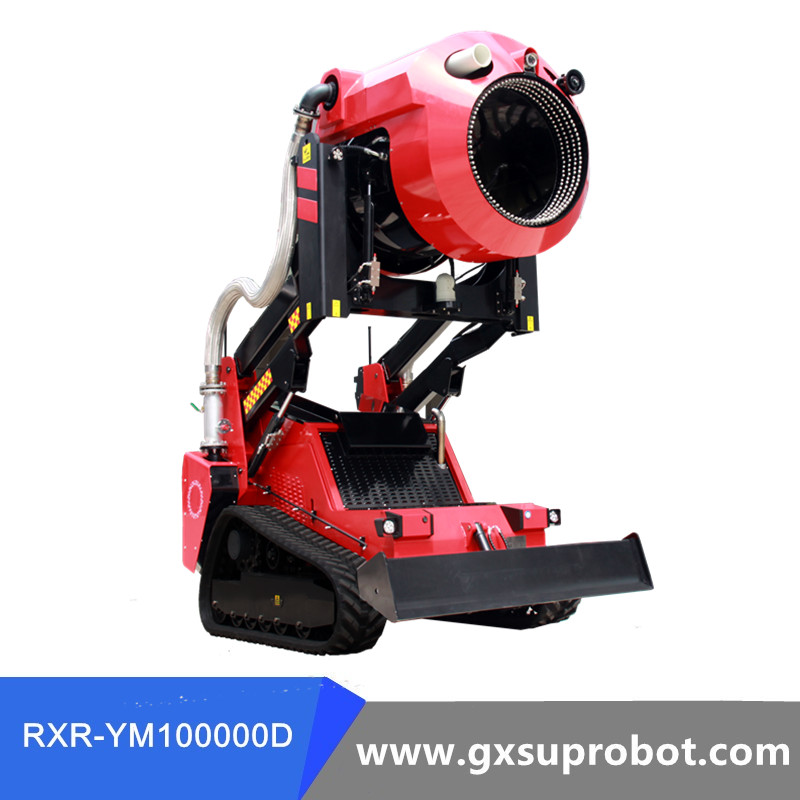
Smoke can block visibility, reduce oxygen, spread toxic substances, and delay rescue. Smoke-exhaust Firefighting Robots use powerful fans to move smoke and support ventilation.
Depending on their configuration, they may also combine ventilation with water mist. These robots can be useful in tunnels, underground facilities, large buildings, and industrial spaces with limited natural ventilation.
Smoke movement must be carefully planned because incorrect ventilation can redirect heat and smoke toward people or unaffected areas.
Modern Firefighting Robots may use batteries, diesel engines, or combined power systems.
Electric robots can provide low-speed control and are suitable for many enclosed or industrial environments. Their operating time depends on battery capacity, payload, terrain, and equipment use.
Diesel-powered robots can support longer or more demanding missions. The GUOXING RXR-M150GD uses a diesel-powered tracked platform designed to tow hoses and carry a large-flow fire monitor.
Power selection should consider operating time, ventilation, maintenance, noise, emissions, and site restrictions.
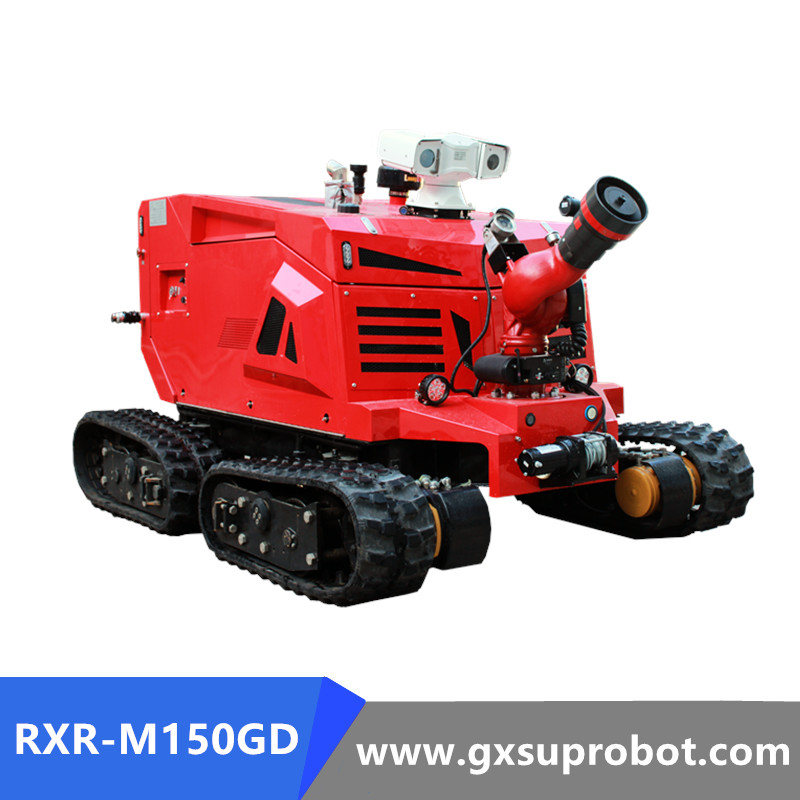
A firefighting robot must often pull one or more charged hoses. This creates considerable resistance, particularly over long distances or rough terrain.
The drivetrain, traction, motor power, and chassis stability must support the required hose load. The hose route should also avoid sharp corners, machinery, and obstacles that could restrict movement.
The robot’s fire monitor, supply hose, pump, fittings, and water source must be evaluated as one complete system.
| Technology | Main function | Safety benefit |
|---|---|---|
| Tracked or 4WD chassis | Crosses difficult terrain | Reduces human entry into unstable areas |
| Remote control | Operates the robot from a distance | Separates personnel from hazards |
| Thermal imaging | Detects heat through smoke | Improves fire-source identification |
| Gas detection | Monitors hazardous atmospheres | Supports safer entry decisions |
| Explosion-proof design | Protects equipment in classified areas | Reduces ignition risk |
| Fire monitor | Applies water or foam | Enables remote suppression |
| Self-cooling | Protects the robot from heat | Extends operation near the fire |
| Lifting system | Reaches elevated targets | Reduces risky manual positioning |
| Smoke exhaust | Supports ventilation | Improves visibility and access |
Not every facility needs every available feature. Buyers should begin with a site-risk assessment.
Consider:
Types of fire and stored materials
Explosion-proof requirements
Terrain and access width
Required water or foam flow
Fire-monitor range
Gas-detection requirements
Thermal-imaging needs
Communication distance
Operating time
Hose-dragging distance
Required lifting height
Maintenance and training resources
A petrochemical facility may prioritize explosion protection and gas detection. A tunnel may need tracks, thermal imaging, communication support, and smoke exhaust. A large warehouse may place greater emphasis on long-range suppression and continuous cooling.
Shandong Guoxing Intelligent Technology Co., Ltd. develops special robots for high-risk and complex environments. Its products include Firefighting Robots, petroleum and petrochemical robots, coal mine robots, power-grid robots, tracked platforms, and customized systems.
GUOXING offers explosion-proof, tracked, four-wheel-drive, diesel-powered, lifting, high-reach, and smoke-exhaust firefighting solutions. Different models combine mobility, remote control, fire suppression, thermal imaging, gas monitoring, and protective technologies.
The correct configuration should be selected according to the actual environment rather than simply choosing the robot with the greatest number of features.
Modern Firefighting Robots combine several technologies to operate safely and effectively in hazardous environments. Mobile chassis systems provide access, remote controls keep operators at a safer distance, thermal cameras improve visibility, and gas sensors provide environmental information.
Explosion-proof construction supports operation in flammable atmospheres, while fire monitors deliver water or foam remotely. Self-cooling, obstacle avoidance, hose-towing systems, lifting arms, smoke-exhaust equipment, and reliable power systems further expand the robot’s capabilities.
No single configuration is suitable for every emergency. The best Firefighting Robot is one whose mobility, suppression, sensing, communication, protection, and power technologies match the hazards and emergency plan of the site.
Common technologies include remote control, mobile chassis systems, thermal imaging, gas detection, fire monitors, obstacle avoidance, explosion protection, and self-cooling.
Some models may offer optional autonomous navigation or obstacle avoidance, but many firefighting operations remain under human control.
Thermal imaging helps operators locate heat sources and hot spots when smoke limits normal visibility.
No. Explosion-proof capability depends on the model. The robot’s rating must match the site’s hazardous-area classification.
Selection should be based on fire hazards, terrain, required flow, sensing needs, communication range, operating time, and applicable safety standards.