
Views: 0 Author: Site Editor Publish Time: 2025-02-21 Origin: Site


Industrial fires can expose emergency teams to extreme heat, toxic gases, dense smoke, chemical leaks, explosions, and structural collapse. Petrochemical plants, fuel-storage facilities, hazardous-material warehouses, tunnels, and manufacturing plants are particularly difficult to enter safely.
Firefighting Robots improve industrial safety by allowing emergency teams to inspect hazardous areas and apply water or foam remotely. Equipped with mobile platforms, cameras, gas sensors, fire monitors, and self-cooling systems, they can perform dangerous frontline tasks while firefighters remain outside the immediate hazard zone.
These robots do not replace firefighters. Instead, they reduce personnel exposure, improve situational awareness, and support safer emergency decisions.
Industrial fires frequently involve several hazards at the same time:
Flammable liquids and gases
Toxic or oxygen-deficient atmospheres
Extreme heat and radiant energy
Dense smoke and poor visibility
Chemical leakage
Potential explosions
Unstable structures
Confined or obstructed spaces
Conditions may change rapidly as the fire spreads or storage vessels become heated. Responders entering the scene may have limited information about the fire source, gas concentration, structural condition, and safest access route.
Firefighting Robots can enter these environments first, transmit real-time information, and begin suppression without immediately exposing personnel to danger.
Firefighting Robots are remotely controlled or partially autonomous machines designed to support fire suppression, reconnaissance, monitoring, and emergency response.
Depending on the model, they may include:
Tracked or four-wheel-drive chassis
Water and foam fire monitors
Thermal and visible-light cameras
Toxic and combustible gas sensors
Wireless remote control
Obstacle avoidance
Lighting and alarms
Self-cooling water spray
Explosion-proof construction
Fire-hose towing capability
The GUOXING Firefighting Robot range includes solutions for industrial fires, petrochemical facilities, tunnels, hazardous spaces, and other complex emergency environments.
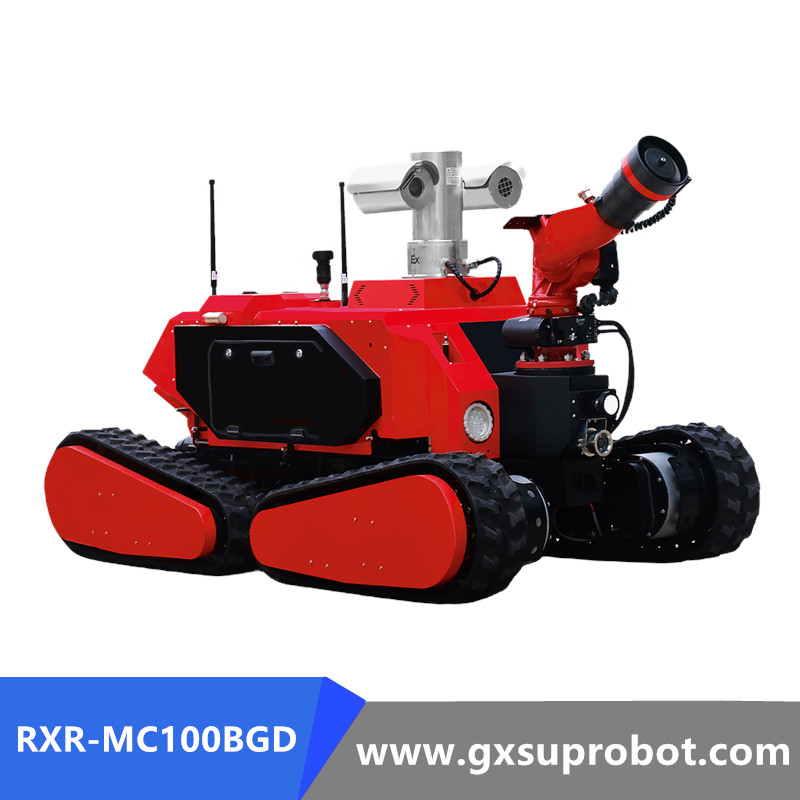
The most important benefit of Firefighting Robots is physical separation. Instead of requiring firefighters to approach intense heat, unstable structures, or potentially explosive materials, a robot can move closer while operators remain at a safer location.
The GUOXING RXR-MC100BGD, for example, supports wireless control from a distance of up to 1,000 meters under specified operating conditions. Operators can remotely control its movement, observe the scene, and operate the fire monitor.
Remote operation is especially useful when:
Explosive gases may be present
Chemical containers are involved
Smoke prevents safe human entry
Structural stability is uncertain
Heat levels are extremely high
Continuous suppression is required
The robot takes the most exposed position while firefighters manage water supply, rescue planning, and incident control from outside the immediate danger zone.
Petrochemical plants, oil facilities, fuel-storage sites, and chemical warehouses may contain flammable gases or vapors. Electrical equipment that is not designed for these conditions could become an ignition source.
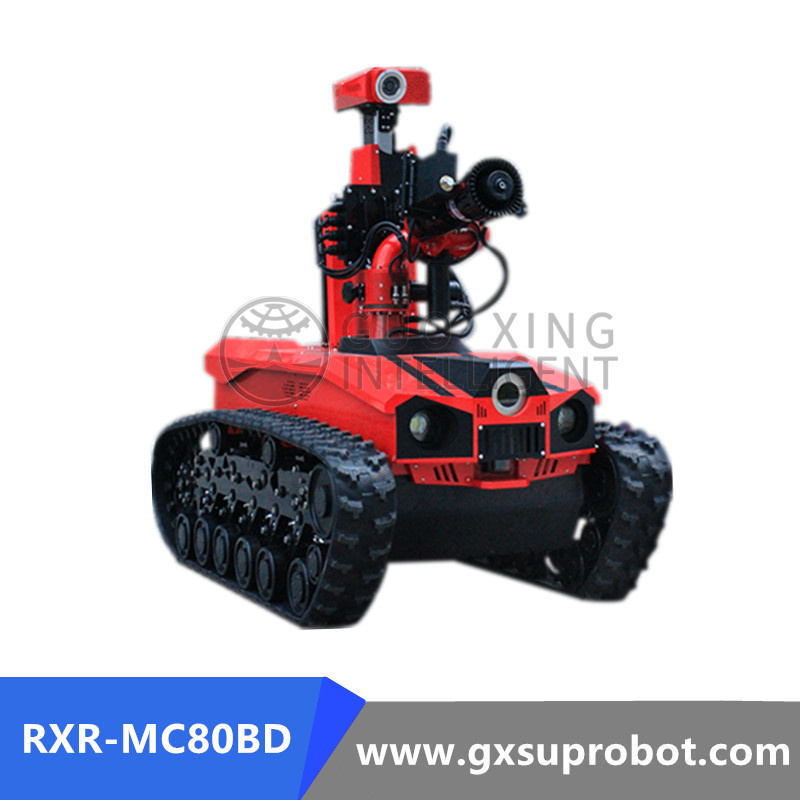
Explosion-proof Firefighting Robots are designed to operate in hazardous environments. GUOXING models such as the RXR-MC100BGD and RXR-MC80BD feature explosion-proof configurations.
Explosion-proof construction does not mean that a robot can operate without limits. Its certification, protection rating, technical specifications, and operating conditions must match the hazard classification of the site.
When properly selected, an explosion-proof robot can support firefighting where direct human entry would involve a high risk of explosion, toxic exposure, or oxygen deficiency.
Dense smoke can hide flames, obstacles, damaged machinery, and escape routes. Normal cameras may provide limited information in these conditions.
Selected Firefighting Robots use infrared thermal imaging to identify heat sources and temperature differences. Thermal and visible images can help responders:
Locate the main fire area
Detect remaining hot spots
Observe the direction of fire spread
Aim water or foam accurately
Evaluate suppression results
Plan safer firefighter access
Real-time image transmission also gives incident commanders a clearer understanding of conditions inside the hazard zone.
Industrial fires may release toxic or combustible gases. Oxygen levels can also fall in tunnels, underground facilities, and other confined spaces.
Selected GUOXING robots can collect information about oxygen, carbon dioxide, carbon monoxide, hydrogen sulfide, methane, and ammonia. This allows emergency teams to assess atmospheric conditions remotely.
Gas information can help determine:
Whether personnel can enter
What respiratory protection is required
Whether evacuation distances should change
Whether ventilation is needed
Whether explosion risk is increasing
Robot-mounted sensors support the site’s wider gas-monitoring plan and reduce the need to send a person into an unknown atmosphere first.
Firefighting Robots can carry remotely operated fire monitors for applying water or foam. Operators can adjust the direction and elevation of the monitor while viewing the fire through the control system.
The GUOXING RXR-MC80BD is listed with an 80 L/s water-and-foam monitor and a water range of more than 85 meters under specified conditions. The RXR-MC100BGD provides a higher-flow configuration for demanding industrial incidents.
Remote suppression is valuable for fires involving:
Fuel and oil
Chemical processing equipment
Industrial warehouses
Storage tanks
Manufacturing machinery
Tunnels and underground facilities
It reduces the need for firefighters to operate a hose line directly beside intense heat or potentially explosive materials.
Industrial incidents may require water or foam to be applied continuously for an extended period. Human crews working near the fire can experience heat stress, fatigue, and reduced visibility.
A robot can remain in a stable position and continue spraying while connected to the water supply. It may also cool nearby tanks, containers, or machinery, helping reduce the risk of fire spread or heat-related equipment failure.
Firefighting Robots still require supervision, reliable hose connections, adequate water supply, and equipment monitoring. Their advantage is that they can remain in the exposed position while responders coordinate the operation from farther away.
Industrial fire scenes may contain debris, cables, pipes, ramps, standing water, and damaged infrastructure. Ordinary vehicles may be unable to reach the fire.
Tracked and four-wheel-drive Firefighting Robots are designed to improve mobility on difficult terrain. Depending on the model, they can climb slopes, cross obstacles, wade through water, and tow charged fire hoses.
The RXR-MC100BGD uses a four-wheel-drive platform and includes obstacle-avoidance and anti-collision functions. The RXR-MC80BD can cross difficult ground while pulling fire hoses toward the operating area.
This mobility reduces the need for firefighters to carry heavy equipment through unstable or obstructed environments.
Cameras, motors, electronics, and communication systems may fail when exposed to excessive heat. Selected GUOXING models use a water-spray self-cooling system to protect the robot body.
A protective water curtain helps reduce heat exposure and supports continued operation near the fire. Operators must still observe the robot’s temperature limits, maintain water flow, and withdraw it when conditions exceed its specifications.
| Industrial environment | Main hazards | Safety contribution |
|---|---|---|
| Petrochemical plants | Flammable gas, toxic smoke and explosions | Remote suppression, gas detection and thermal monitoring |
| Oil and fuel storage | Large flames and heated tanks | Long-range water or foam application |
| Chemical facilities | Toxic materials and chemical leakage | Reduces immediate human exposure |
| Warehouses | Rapid fire spread and structural instability | Remote observation and continuous suppression |
| Tunnels | Smoke, heat and restricted access | Enters confined routes and transmits images |
| Manufacturing plants | Machinery, fuel and obstacles | Improves access while protecting personnel |
The correct robot should be selected according to the hazards, terrain, access conditions, and available firefighting resources of the site.
Firefighting Robots are most effective when integrated into a professional emergency-response plan.
Human responders remain responsible for assessing the incident, establishing safety zones, selecting the extinguishing agent, managing the water supply, conducting rescues, and deciding when personnel can enter.
The robot provides remote mobility, visual information, gas data, and suppression capability. Combining these functions with human judgment can make industrial firefighting safer and more controlled.
Determine whether combustible gases, fuel vapors, chemicals, or other explosive hazards may be present. Confirm that the explosion-proof rating matches the site requirements.
Check the required water or foam flow, working pressure, range, rotation, and elevation. The facility’s pumps and water supply must support the selected monitor.
Consider slopes, obstacles, access width, ground conditions, hose-dragging distance, and wading requirements. Select a platform suitable for the terrain.
Decide whether the application requires thermal imaging, visible-light cameras, gas detection, obstacle avoidance, lighting, or alarms.
Confirm the required remote-control and video-transmission distance. Buildings, steel structures, and underground spaces may affect wireless communication. Operating time must also support the expected mission.
Operators should understand remote control, fire-hose connection, emergency shutdown, inspection, and safe deployment. Regular testing helps ensure that the robot is ready before an emergency occurs.
Firefighting Robots improve safety in high-risk industrial environments by reducing the need for personnel to enter areas exposed to explosions, toxic gases, intense heat, smoke, and structural instability.
They can approach the fire, transmit images, monitor gases, identify heat sources, and apply water or foam while emergency teams remain at a safer distance. Explosion-proof construction, mobile platforms, thermal cameras, self-cooling systems, and remote fire monitors make them particularly valuable in petrochemical plants, warehouses, tunnels, and manufacturing facilities.
Firefighting Robots do not replace firefighters. They reduce frontline exposure, improve situational awareness, and support more controlled emergency operations. When properly selected, maintained, and integrated into an emergency plan, they can make industrial firefighting safer and more effective.
They support remote fire suppression, reconnaissance, thermal monitoring, gas detection, cooling, and emergency response in hazardous environments.
Selected explosion-proof models are designed for hazardous environments. Their certification and protection rating must match the site classification.
No. They support firefighters by entering dangerous areas, collecting information, and applying water or foam remotely.
Selected GUOXING models can monitor several toxic and combustible gases, helping teams assess conditions before personnel enter.
Common locations include petrochemical plants, fuel-storage facilities, chemical factories, warehouses, tunnels, power facilities, and manufacturing sites.