
Views: 0 Author: Site Editor Publish Time: 2026-09-29 Origin: Site


Industrial fires in hazardous zones risk human lives daily. This grim reality drives a massive shift toward unmanned tactical response. However, purchasing highly advanced technology inevitably fails if the fundamental water supplies mismatch. A remote-controlled monitor is fundamentally a delivery system. Without the correct pressure or flow, even the most sophisticated automated chassis becomes useless on the fireground.
In this comprehensive guide, we dive deep into the exact technical specifications required to seamlessly integrate remote suppression technology with your existing infrastructure. By bridging the gap between mechanical engineering and hydraulic reality, facility safety engineers and fire chiefs can ensure maximum extinguishing efficiency while safeguarding their investments.
When evaluating automated response vehicles, procurement committees often gravitate toward flashy specifications like camera resolution, mobility, and remote-control range. Yet, the synergy between the existing water infrastructure and the machine internal plumbing is the true foundation of operational success. An unmanned crawler cannot suppress a chemical fire if its umbilical cord—the water supply—is fundamentally flawed.
Deploying suppression equipment that is incompatible with your hydraulic reality introduces severe operational hazards. If a high-capacity monitor is starved of water, the system experiences a drastic reduction in throw distance. The source simply cannot provide the required liters per second. Consequently, the water stream fails to penetrate the thermal updraft of the blaze. Operators are then forced to drive the unit dangerously close to radiant heat zones, risking total destruction of the equipment. Furthermore, insufficient water flow triggers severe pump cavitation when a fire engine drafts from a limited municipal source to supply the unit.
Conversely, forcing excessive pressure beyond the manufacturer specified limits creates immediate mechanical risks. Over-pressurization frequently causes supply hoses to rupture violently. It damages internal manifold valves and creates extreme nozzle recoil. Should the rearward thrust generated by a high-pressure stream exceed the traction limits of the crawler tracks, the unit may lose stability. It could slide backward across wet debris or even tip over.
Smart procurement views these tactical vehicles as dynamic extensions of existing fire protection systems. Aligning a model specifications with current infrastructure capabilities maximizes the commercial return on investment. For instance, a petrochemical facility might purchase a high-capacity unit. If they only possess a pump capable of delivering half the required flow during peak demand, the organization has essentially burned capital on unusable capacity. By strictly utilizing verified flow test data, organizations sidestep the need for multi-million-dollar water pump upgrades or extensive underground pipe retrofitting.
To achieve rapid extinguishment, decision-makers must untangle the distinct but interconnected roles of volumetric flow rate and operating pressure. Together, these two metrics define the cooling capacity and the physical reach of the suppression agent.
Flow rate measures the volume of water delivered over a specific period. This metric directly dictates the cooling power of the stream. A higher volume absorbs significantly more heat. This is a critical factor when suppressing Class B flammable liquid fires or cooling adjacent unignited storage tanks.
Facility engineers cannot rely on outdated blueprints. They must conduct physical flow tests using calibrated pitot gauges on their hydrants to determine the true sustained water flow available during an emergency.
To simplify the selection process, engineering teams use specific benchmarks to match environmental hazards with hydraulic output. The table below illustrates the standard correlation between facility types and required robot specifications.
| Application Scenario | Typical Water Source | Required Flow Rate | Recommended Equipment Match |
|---|---|---|---|
| Municipal & Underground Parking | Standard Urban Hydrants | 30 to 50 Liters per Second | Nimble, dual-inlet electric crawlers |
| Logistics & Manufacturing | Industrial Loop Systems | 60 to 80 Liters per Second | Standard heavy-duty automated monitors |
| Petrochemical & LNG Terminals | Dedicated High-Volume Pumps | 80 to 120+ Liters per Second | Explosion-proof ATEX certified units |
While flow rate governs cooling capacity, operating pressure dictates the trajectory, stream shape, and physical reach. It is the driving force behind the water momentum.
It is vital to distinguish between static pressure, which is the resting pressure in pipes when valves are closed, and residual pressure. Residual pressure is the active pressure remaining in the system while water is flowing. A high-performance Firefighting Robot generally demands a specific residual pressure at the inlet. For example, achieving an 80-meter throw distance typically requires an optimal operating pressure of 8 bar at the machine manifold. Should the residual pressure drop below this optimal threshold, the stream breaks apart prematurely into an ineffective mist. This completely fails to reach the seat of the fire.
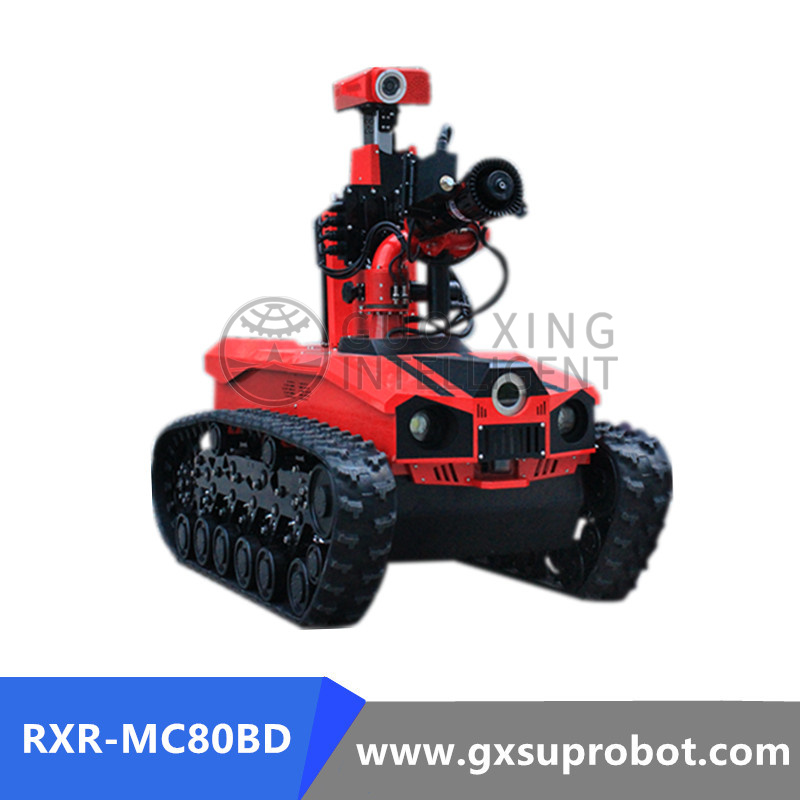
The origin of your water fundamentally alters tactical deployment strategies. Each source exhibits unique hydraulic characteristics. These must be factored into the engineering analysis long before a purchase order is signed.
Municipal hydrants are tethered to the broader city water grid. Their output fluctuates wildly based on the time of day, neighborhood demand, and the diameter of aging underground mains. Standard urban hydrants reliably output only 30 to 60 liters per second. Therefore, heavy-duty industrial units cannot be directly hooked to them without starving the monitor.
In contrast, industrial fire hydrants located within factory perimeters are often fed by private, high-capacity loop systems. These can supply upwards of 100 liters per second. Despite this high volume, direct hydrant connections frequently lack the raw pressure required to push water through hundreds of meters of hose. This necessitates an intermediary pressure boost.
Aviation hangars and massive logistics centers typically rely on fixed fire pumps drawing from colossal static water tanks. Engineered to strict NFPA or EN standards, these systems are robust but finite. When matching equipment to a fixed pump, engineers must scrutinize the pump performance curve. The system must sustain the required flow rate for the entire duration of the expected deployment. This calculation heavily factors in other systems, like ceiling sprinklers, that will inevitably activate and cannibalize the same water reserve.
During most tactical operations, unmanned units do not connect directly to a hydrant. Instead, fire brigades utilize a mobile fire engine as a vital intermediary. The engine drafts water from a hydrant, utilizes its powerful onboard centrifugal pump to massively boost the pressure, and forces the water through supply lines to the remote crawler. This configuration empowers pump operators to precisely manipulate the inlet pressure reaching the machine, effectively neutralizing friction loss over long distances.
The physical characteristics of the hose infrastructure act as the umbilical cord for any automated suppression vehicle. This directly dictates its hydraulic performance on the ground.
Supply lines range from nimble 65mm attack lines to massive 125mm large diameter hoses. A smaller hose is highly maneuverable around warehouse racking but severely restricts high-volume flow. Conversely, a massive hose moves staggering amounts of water but acts like a dead weight. It proves incredibly difficult to drag across debris-littered concrete.
Procurement managers must strictly verify the inlet coupling sizes. Mid-range units frequently feature dual inlets, allowing them to draw from two separate lines simultaneously to hit target flow rates without excessive drag. Ensuring the machine manifolds natively match your department standard threads eliminates the need for restrictive adapters that trigger turbulent pressure drops.
Friction loss is the inevitable reduction in pressure caused by water violently rubbing against the interior rubber lining of the hose. The longer the lay and the higher the velocity, the more severe the loss. Because these machines are designed to penetrate deep into hazardous zones, they routinely drag hundreds of meters of hose.
If a monitor requires 10 bar to achieve maximum throw, the fire engine operator cannot simply set their discharge gauge to 10 bar. They must calculate the friction loss of the entire hose lay. If the drag through a 100-meter line eats up 3 bar of pressure, the engine must pump at 13 bar to compensate. Facility pumps must possess the overhead capacity to overcome this mathematical reality without exceeding the burst pressure ratings of the hoses themselves.
The landscape of industrial fire protection is rapidly evolving beyond isolated equipment purchases. Analyzing recent industry shifts reveals a massive push toward IoT-enabled, data-driven hydraulic integration. Modern facility managers are no longer satisfied with static nameplate capabilities. Instead, there is a growing demand for smart pump systems that communicate in real-time with remote suppression monitors.
Specifically, this trend emphasizes dynamic flow matching and digital twin modeling. As municipal water grids experience unpredictable pressure drops due to aging infrastructure, modern automated chassis are being equipped with adaptive baffle nozzles. These nozzles automatically adjust to fluctuating water supplies, maintaining stream reach even when pressure dips. Furthermore, forward-thinking fire brigades are integrating hydraulic modeling software to simulate flow rates before deployment. This ensures that the water supply network can sustain the immense draw of unmanned systems without causing catastrophic pressure failures in adjacent safety zones.
Standard suppression equipment performs admirably in timber yards and logistics centers. However, matching hydraulic capacity is merely one piece of the puzzle when navigating the volatile atmospheres of heavy industry.
In environments dominated by oil refineries, LNG terminals, and facilities choked with combustible dust, the very air can be explosive. A conventional unit utilizes exposed electrical motors, standard relays, and unshielded battery arrays. In a Zone 1 hazardous atmosphere, a microscopic spark from a track motor or a short circuit triggered by high-pressure water spray can act as an ignition source. This initiates a catastrophic secondary explosion. Introducing massive volumes of water via an uncertified machine is an unacceptable, potentially fatal risk.
To safely project high-capacity water streams into these volatile arenas, engineering teams deploy specialized builds. Utilizing a certified Explosion Proof FireFighting Robot guarantees that the delivery mechanism itself does not become a hazard.
These specialized units feature Exd flameproof enclosures. Every single electrical component is hermetically sealed within heavy-duty metal casings. For instance, top-tier models achieve an explosion-proof class of Ex d ib IIB T4 Gb, engineered to contain internal sparks and completely isolate them from the external atmosphere. Building upon this, they are structurally reinforced to absorb the violent recoil of 80 to 120 liters per second monitors without compromising their grounding systems. Safety engineers must cross-reference ATEX or IECEx certifications with their facility specific hazard classification to ensure total compliance, alongside verifying an IP67 waterproof rating to survive contaminated water runoff.
Procuring automated fire suppression technology is a major capital investment demanding rigorous engineering analysis. Bypassing a structured evaluation often leads to acquiring units that underperform during critical emergencies. Follow this systematic approach to guarantee infrastructure integration.
The foundational step is conducting a real-time audit. Do not trust decades-old building schematics. Measure three critical metrics, including maximum static pressure, residual operating pressure, and sustained flow rate. Utilize inline flow meters over a 60-minute test to ensure the source can deliver the required volume without depleting static reserves. This raw data forms the absolute baseline for your procurement specifications.
Analyze the specific fire loads present in your operational environment. Different materials possess varying heat release rates. For standard warehouses, reviewing the baseline specifications helps establish the minimum throw distance required to reach high rack storage while maintaining a safe standoff from collapse zones. Conversely, chemical plants facing rapidly spreading liquid fires demand massive, immediate water application and specialized foam induction capabilities.
A frequently overlooked detail is the physical connection between the facility hose lines and the machine inlet manifold. Global firefighting standards vary wildly. Verify that the machine inlets natively match your existing hose inventory. While adapters exist, they introduce potential failure points and increase critical setup time during an escalating emergency.
The operational theater dictates the necessary mechanical shielding. If the unit will operate in areas prone to flammable gases or combustible dust, mandate intrinsically safe designs in your tender documents. Ensure the chassis also carries a robust ingress protection rating to survive total submersion in foam runoff.
Even with a methodical approach, safety committees frequently fall into technical traps that cripple the effectiveness of their investment. Avoiding these engineering miscalculations is vital.
The most prevalent error is the nameplate fallacy. A facility manager might purchase a massive 100 liters per second monitor simply because their main fire pump is technically rated for that volume. They disastrously fail to account for the fact that during an actual blaze, indoor sprinkler systems and wall-mounted hose reels will simultaneously activate. This heavily cannibalizes that same pump. The actual residual flow available for the remote unit may plummet to 50 liters per second, completely starving the nozzle and destroying the stream integrity.
Decision-makers often evaluate a machine mobility based solely on its unladen dry weight. In reality, the unit must drag its own water supply across complex terrain. Water is exceptionally heavy. A single 100-foot section of large diameter hose filled with water weighs nearly half a ton. Picture a machine trying to pull that dead weight through thick mud and industrial debris. If the procured chassis lacks the low-end motor torque and aggressive track traction required, it will become hopelessly immobilized the moment the lines are charged.
Assuming that the pressure measured at the fire pump will be the exact pressure delivered to the machine inlet is a critical oversight. Friction loss eats away at hydraulic power. Engineers must meticulously calculate the anticipated pressure drop based on the expected deployment distance and hose diameter. This ensures the pump has the overhead capacity to over-pressurize the line at the source.
Matching your water supply to your tactical equipment is not merely a recommendation. It is the absolute prerequisite for operational success. A profound synergy between a facility hydraulic infrastructure and a machine mechanical engineering ensures safe, effective, and continuous automated firefighting.
Data-driven procurement protects human lives, shields facility assets, and prevents catastrophic secondary disasters. Whether your threat profile calls for a nimble municipal crawler or a heavily armored Explosion Proof FireFighting Robot, always audit your water capacity before issuing a purchase order. By consulting with hydraulic engineering experts and relying on hard flow-test data, you guarantee that your frontline technology will perform flawlessly when the sirens sound. For specialized configurations that perfectly match your facility hydraulic profile, explore the advanced lineup at Guoxing Intelligent to secure your industrial assets.
Yes, many high-capacity tactical units feature dual or even triple water inlets on their rear manifolds. This multi-inlet design is an engineering necessity, allowing the machine to draw from multiple hoses simultaneously to meet massive flow rate requirements. Operating multiple lines significantly reduces the friction loss that would occur if the same volume of water were forced through a single, smaller diameter hose. These inlets are typically equipped with internal clappered check valves, ensuring that if one hose bursts, pressurized water does not flow backward out of the compromised inlet.
Operating below the specified hydraulic requirements severely compromises the machine survivability. If the pressure is too low, the water monitor will suffer a drastically reduced throw distance, preventing the stream from penetrating the fire thermal column. More dangerously, inadequate pressure prevents the nozzle from producing a dense, wide fog pattern. This fog acts as a critical thermal shield, protecting internal electronics from radiant heat. Without it, the machine is forced dangerously close to the flames, risking total mechanical failure.
Not necessarily. Explosion-proof builds are exclusively engineered for highly volatile environments characterized by flammable gases, combustible vapors, or suspended explosive dust. These environments require ATEX or Class I Division 1 certifications to ensure the machine cannot generate a spark. For a standard logistics warehouse storing non-volatile materials, a conventional automated unit with high ingress protection ratings for water resistance is perfectly sufficient and far more cost-effective.
The rearward thrust, or nozzle reaction force, generated by high-pressure streams is immense and increases exponentially with flow rate. To counteract this constant rearward push, these machines are engineered with an exceptionally low center of gravity and heavy-duty continuous tracks. The sheer weight of the chassis, combined with specialized electromagnetic braking systems, anchors the unit. When the monitor opens, the tracks lock into the terrain, utilizing ground friction to absorb the recoil and prevent the machine from sliding backward.
Yes, modularity is a defining feature of modern automated suppression systems. Many units come equipped with easily interchangeable nozzles to accommodate varying hydraulic capabilities. Automatic nozzles are highly recommended, as they contain internal spring mechanisms that dynamically adjust the baffle to maintain consistent pressure and reach, even if the municipal water supply fluctuates. Alternatively, smooth bore nozzles can be equipped for environments where maximum reach and deep penetration are prioritized over wide fog-cooling capabilities.
Calculating friction loss requires knowing the hose diameter, the length of the hose lay, and the target volumetric flow rate. Engineers use standard hydraulic formulas where friction loss increases alongside the square of the flow rate. For remote monitors, you must calculate the total pressure drop across hundreds of meters of hose and add that figure to the machine required inlet pressure. The resulting number dictates the exact discharge pressure the fire pump or engine must generate at the source to ensure the nozzle operates effectively.
Static pressure is the baseline pressure measured in a closed water system when no water is flowing. It indicates the potential energy of the supply. Residual pressure is the active, working pressure measured at the hydrant or pump while water is actively discharging. When evaluating a water supply for an automated monitor, residual pressure is the only metric that matters. It represents the true hydraulic force available to push water through the hoses and out of the nozzle during an active suppression operation.