
Views: 0 Author: Site Editor Publish Time: 2026-09-15 Origin: Site


In emergency rescue and industrial inspection, chassis failure equates to mission failure. Off-the-shelf hobbyist platforms cannot handle debris, steep gradients, or heavy sensor payloads. When lives or critical infrastructure are at risk, hardware reliability becomes your absolute priority. You cannot afford unexpected breakdowns in the field.
Engineering teams waste months trying to modify light-duty platforms for extreme environments. They frequently encounter severe thermal throttling under heavy loads. Track derailment plagues these modified systems. You also face frustrating integration bottlenecks when adding external hardware. These continuous delays cripple development timelines.
This guide provides a proven framework for evaluating your options. We help you shortlist a reliable manufacturing partner based on verifiable performance. You will learn how to assess integration readiness and long-term mechanical stability. By following these guidelines, you can build a robust foundation for your autonomous systems.
Consumer-grade robotics platforms often look impressive on paper. They work well on flat warehouse floors. However, they collapse under the immense stress of disaster zones and rugged industrial sites. You must understand their mechanical limitations before deploying them.
Wheeled platforms struggle immensely with unstructured terrain. They sink rapidly into mud and loose gravel. Light tracked systems often slip when attempting to climb stairs. Debris easily jams poorly designed drivetrains. To survive, your robot needs aggressively treaded, self-tensioning tracked systems. These advanced tracks distribute weight evenly over unstable rubble. They prevent the robot from becoming stuck during critical missions. High-friction environments demand purpose-built track geometry.
Heat destroys standard electric motors. Operating at low speeds while delivering high torque generates massive thermal output. This happens frequently when robots carry robotic arms, heavy LiDAR units, and thermal cameras up steep grades. Standard platforms lack adequate heat dissipation. They overheat and shut down mid-mission. We see this thermal throttling constantly in modified hobbyist platforms. Industrial platforms solve this by using specialized gearboxes and active cooling strategies. They sustain high torque outputs without burning out motor coils.
Industrial inspections in pipes and mines require fully sealed drive trains. Rescue missions involving fires and floods expose robots to extreme environmental hazards. Standard IP54 ratings fail quickly under sustained exposure to heavy dust and spraying water. Water ingress shorts out motor controllers instantly. Fine dust destroys exposed bearings. You must demand IP67 or higher ratings for these environments. The drive systems must withstand temporary submersion and repel abrasive particulates effectively.
Common Mistakes to Avoid:
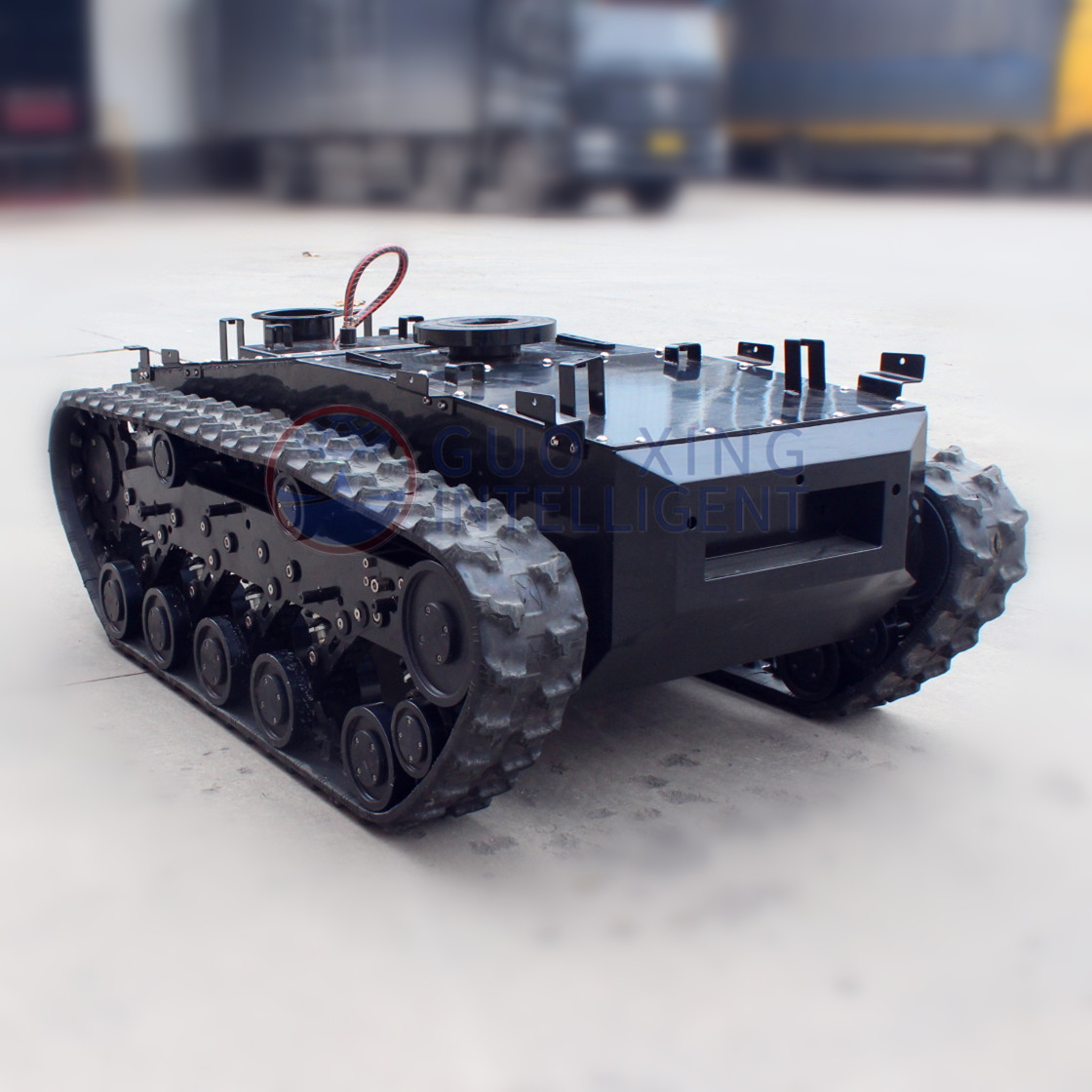
Selecting the right hardware architecture defines your project's ceiling. If the base lacks mechanical integrity, the smartest navigation software cannot save the mission. You must evaluate the chassis systematically.
Suspension design dictates how well the robot absorbs shock. It directly impacts sensor stability. LiDAR and cameras require a stable base to function properly. You generally choose between Christie and Matilda suspension designs.
| Suspension Type | Primary Benefit | Best Use Case |
|---|---|---|
| Christie Suspension | Excellent shock absorption at higher speeds. | Open terrain and rapid response scenarios. |
| Matilda Suspension | Superior load distribution and low center of gravity. | Climbing stairs and navigating dense rubble. |
Ground clearance is another vital metric. Low ground clearance leads to high-centering on rocks or debris. The robot becomes stranded instantly. Ensure the chassis offers sufficient clearance to pass over typical field obstacles.
Do not rely on peak torque figures. Peak torque only lasts for a few seconds. You must evaluate continuous torque ratings instead. Continuous torque determines if the robot can climb a long staircase without failing. You must also factor in the total weight of your primary payloads. Manipulator arms, heavy PTZ cameras, hazard sensors, and victim transport gear add massive weight. A robust chassis handles these dynamic loads without compromising its maneuverability.
Hazardous environments demand stable power systems. Traditional lithium-ion batteries pose fire risks when punctured. We recommend LiFePO4 (Lithium Iron Phosphate) battery chemistry. It offers superior thermal stability and safety in disaster zones. The Battery Management System (BMS) must be highly reliable. It protects the cells from over-discharge and extreme temperatures. Furthermore, continuous 24/7 disaster response operations require hot-swappable batteries. Teams cannot wait hours for the robot to recharge. They must swap power packs in seconds and deploy again.
Hardware strength means nothing if your software cannot communicate with it. Integration bottlenecks destroy project timelines. A professional chassis must serve as an open, accessible platform for your engineering team.
Your top-level navigation algorithms must communicate flawlessly with the chassis motor controllers. Industry-standard interfaces are strictly required. You need CAN bus or RS232/RS485 connectivity. CAN bus offers exceptional noise immunity in electrically noisy industrial environments. It guarantees real-time command execution. Avoid systems relying on fragile USB connections or undocumented serial protocols.
Closed-box control systems lock you into proprietary ecosystems. They limit your ability to innovate. Instead, demand comprehensive support for ROS and ROS2. The manufacturer should provide open-source SDKs and transparent API documentation. This allows your developers to integrate advanced SLAM and obstacle avoidance algorithms immediately. Transparent software architecture significantly reduces your development timeline.
Adding external sensors usually creates power management headaches. Many teams resort to strapping secondary battery arrays onto the robot. This adds unnecessary mass and ruins the center of gravity. A professional chassis provides integrated payload power distribution.
Regulated power directly from the main chassis battery simplifies your electrical architecture drastically.
Finding a trusted manufacturing partner requires due diligence. Marketing brochures often exaggerate capabilities. You must demand hard engineering data before making a purchasing decision.
Does the supplier provide raw testing data? Marketing claims hold no weight in the field. Ask for concrete numbers regarding drawbar pull. Request documented incline limits under maximum payload. Demand data on thermal throttling during continuous operation. A reliable Heavy-Duty Robot Chassis Supplier willingly shares these engineering reports. They prove their equipment works through rigorous physical testing.
Every project has unique mechanical requirements. You might need wider tracks for snow or a specific mounting hole pattern for a custom robotic arm. Evaluate the supplier's ability to modify chassis dimensions. Can they adjust motor gear ratios? Can they alter the mounting deck without resetting the entire production timeline? A capable manufacturer handles these minor customizations swiftly.
Examine the supplier’s reliance on third-party components. Many companies simply assemble parts bought from various overseas vendors. This leads to unpredictable lead times and quality control issues. Look for a partner who manufactures the core chassis internally. In-house production guarantees consistent quality. It also ensures reliable 4–8 week lead times for custom orders. You secure your project schedule by choosing vertically integrated manufacturers.
Downstream deployment in public spaces or heavily regulated industrial sectors requires strict compliance. Uncertified robots cannot operate in refineries or public disaster zones. Check for valid CE and FCC certifications. Verify their ISO compliance standards. These certifications prove the hardware meets global safety and electromagnetic interference guidelines.
Deploying heavy machinery in chaotic environments introduces significant risk. You must plan for mechanical failures. Understanding how the hardware fails helps you mitigate those risks during the design phase.
Track derailment ends missions instantly. This typically occurs during zero-radius turns on high-friction surfaces like concrete or jagged rubble. The lateral forces pull the track off the guide wheels. How does the supplier design their track tensioners? Do they use active spring tensioning or passive bolts? Deep guide wheel grooves and active tensioners are mandatory. They prevent thrown tracks during aggressive maneuvering.
In a rescue scenario, engineers cannot send the chassis back to the factory. Repairs must happen on-site, often in terrible weather conditions. Evaluate the modularity of the entire design. Can your technicians swap drive motors in the field? Are the motor controllers easily accessible? Can they replace damaged track segments in under 30 minutes? A great rescue and inspection robot chassis prioritizes rapid field serviceability. It uses quick-disconnect cables and standardized hex bolts throughout.
Engineers often make dangerous assumptions regarding payload limits. They assume the flat-ground payload capacity holds true at maximum incline. This is mathematically incorrect. The center of gravity shifts dramatically on a 30-degree slope. The motors must fight gravity differently. Always request accurate derating curves from the manufacturer. These charts show exactly how weight limits decrease as the slope angle increases. Understanding these curves prevents catastrophic motor stalling on stairs.
Selecting a highly capable tracked platform represents a critical investment in your project's foundation. The chassis directly dictates your maximum payload limits. It determines your environment compatibility and heavily influences your overall speed to market. A robust base allows your software team to focus entirely on autonomy rather than troubleshooting hardware failures.
Take these actionable next steps to secure your hardware:
Contact our engineering team today with your specific payload and terrain requirements. We will provide a customized feasibility assessment and a detailed quote to jumpstart your project.
A: It typically ranges from 50kg to over 300kg. This depends heavily on track width, motor wattage, and suspension design. You must always verify this capacity under dynamic, moving conditions rather than just static loads. Request derating curves to understand how inclines affect the total carrying capacity.
A: Yes. Leading suppliers provide comprehensive ROS and ROS2 packages. They also offer direct CAN bus communication. This architecture allows seamless, direct integration with standard autonomous navigation stacks like Nav2. It completely eliminates the need for proprietary navigation software.
A: Off-the-shelf configurations usually ship in 1-2 weeks. Structural modifications or custom payload power distributions typically extend lead times to 4-8 weeks. This timeline depends largely on the supplier's in-house manufacturing capabilities and current production queue.
A: Kevlar-reinforced rubber tracks offer the highest performance. When paired with aggressive steel or rubber cleats, they provide an excellent balance. They deliver superior traction on loose debris, dampen vibrations for sensitive sensors, and resist tearing on sharp rubble.