
Views: 0 Author: Site Editor Publish Time: 2026-11-20 Origin: Site


When tackling massive industrial blazes, hazardous chemical spills, or complex structural fires, human responders face unimaginable risks. Extreme radiant heat and toxic fumes create an environment where human survival is measured in seconds. Enter the modern water monitor fire fighting robot. This rugged, remote-controlled machine is engineered specifically to push into the hot zone where human crews simply cannot go. Extinguishing a complex chemical fire is rarely as straightforward as just spraying water. Different combustible materials demand entirely different suppression agents to prevent catastrophic escalation.
This operational reality raises a critical technical question. How exactly does this unmanned unit seamlessly manage high-pressure fluid streams while simultaneously regulating the precise mixture of fire-retardant foam? We will break down the internal mechanics, fluid dynamics, and smart control systems that enable these machines to act as highly adaptable, dual-threat response units. Whether you are a facility safety manager, a municipal procurement officer, or a frontline industrial engineer, grasping these underlying technologies is crucial. Understanding the fluid mechanics inside these robots is the first step in deploying an effective hazard response fleet.
The landscape of industrial firefighting is undergoing a massive technological transformation. Recent market data shows a sharp pivot toward autonomous suppression in petrochemical sectors. This shift is driven heavily by increasingly stringent occupational safety regulations and the growing complexity of modern hazardous material storage. As facilities scale up their production of highly volatile compounds, the potential blast radiuses and thermal outputs of accidental fires have expanded. They now far exceed the safe operational limits of traditional human firefighting tactics.
Consequently, there is a surging demand for smart suppression equipment integrated with real-time Internet of Things telemetry and advanced fluid dynamics modeling. Fire departments and corporate safety boards no longer view robotics as experimental novelties. Instead, they recognize them as standard, mandatory assets for high-risk environments. The ability to empirically control foam dosing and water flow from a kilometer away aligns perfectly with the global industry objective. The goal is simple but critical: achieve maximum suppression efficacy while reducing human casualty rates to absolute zero.
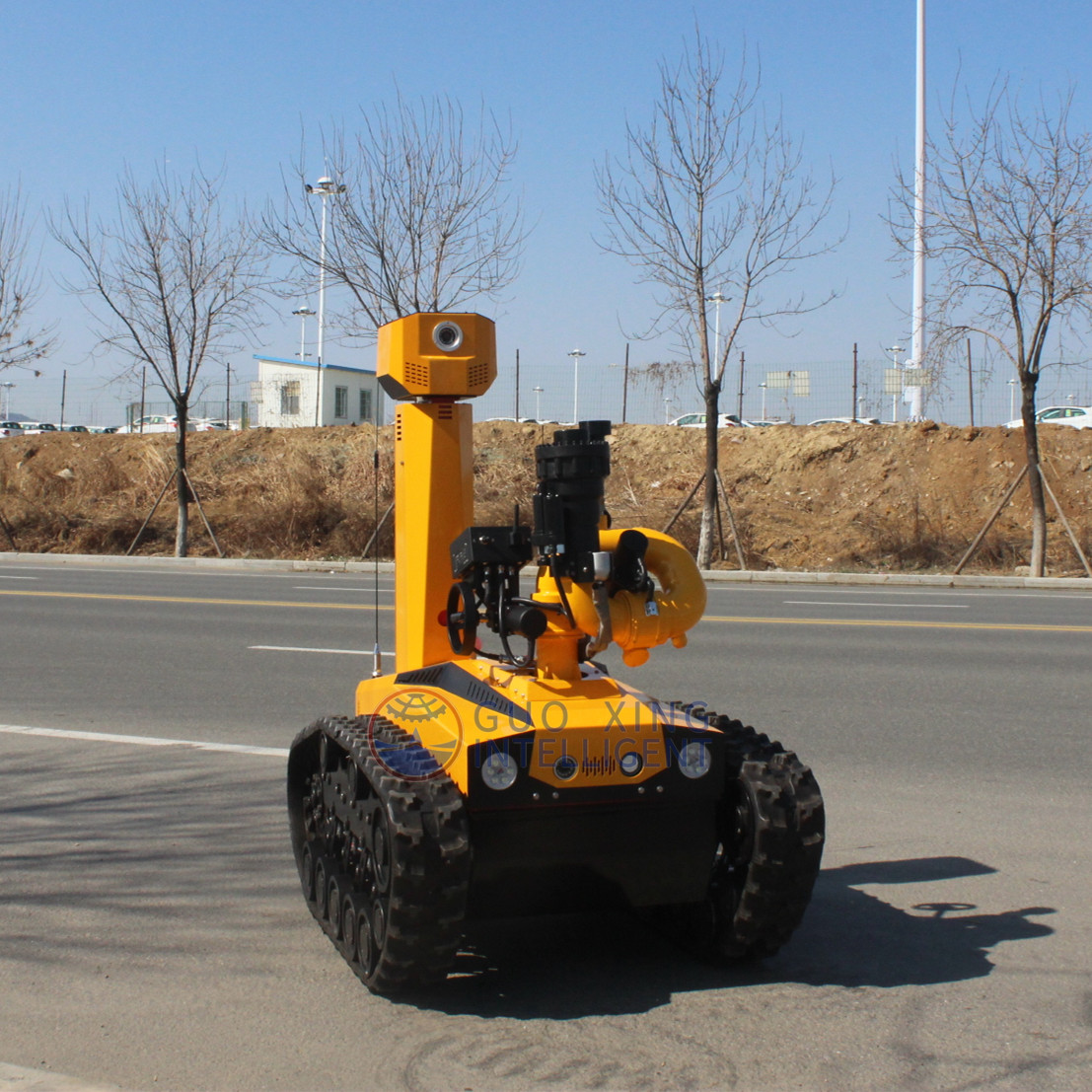
To comprehend how these automated systems manipulate fluid dynamics under extreme conditions, we must first examine their physical architecture. Functioning as a highly mobile, armored delivery system, a fire fighting monitor robot rests on a heavy-duty, heat-resistant chassis. Every component is meticulously engineered to withstand severe thermal radiation while maintaining precise mechanical tolerances.
Navigating through twisted steel, smoldering debris, and ascending industrial staircases requires superior traction. Industrial-grade robots utilize heavy-duty tracked chassis to maintain grip on slick, chemical-covered terrain. Stability is a critical engineering requirement here. Consider a unit operating at 80 liters per second. The reactive force generated by this high-pressure monitor can easily exceed several thousand newtons. A robust foundation is absolutely necessary to prevent the machine from flipping during a sudden pressure surge.
The monitor itself refers to the articulating robotic arm and the terminal nozzle assembly. Unlike standard handheld fire hoses, this armored assembly features heavy-duty electric or hydraulic actuators. These actuators pan and tilt the nozzle with pinpoint accuracy. Inside lies a specialized piping manifold. It is designed to handle both highly corrosive foam concentrates and high-volume water flows without degrading the internal metallurgy over time.
At the operational heart of the unit sits a computerized control module housed in a waterproof, thermally insulated enclosure. Relying on a Programmable Logic Controller, this electronic brain receives encrypted wireless signals from the operator console. It translates those signals into immediate mechanical actions, such as opening proportional valves or engaging auxiliary dosing pumps.
Before any chemical agent enters the suppression process, the robotic system must establish absolute control over the baseline water supply. Typically supplied via large-diameter drag hoses connected to a staging fire engine or a pressurized industrial hydrant network, the water rushes into the internal intake manifold of the robot.
The machine regulates this massive volume of water using automated butterfly or ball valves. When an operator adjusts the flow dial on the remote interface, electric servo motors incrementally adjust these internal valves. This precise mechanical actuation allows the machine to scale its output dynamically. Responders can dial it down to a conservative spray for delicate cooling tasks. Alternatively, they can open the valves completely to deliver a massive deluge exceeding 80 liters per second.
Beyond raw volume, manipulating the geometric shape of the expelled stream is fundamental to tactical firefighting. The terminal nozzle features internal shaping baffles and an adjustable outer mechanical sleeve. When the sleeve constricts, it forces the water into a solid, high-velocity straight stream. This configuration minimizes aerodynamic drag, allowing the stream to physically penetrate deep into the thermal updraft of a fire. Conversely, retracting the sleeve forces the water against a deflector to create a wide fog pattern. This conical mist rapidly absorbs ambient heat. It creates a protective thermal shield for the robot itself and gently cools adjacent storage tanks.
When emergency teams confront petrochemical pool fires, applying pure water is often counterproductive. Water is heavier than most liquid fuels, causing the burning hydrocarbons to violently splash and spread. This dangerous scenario dictates the immediate use of fire-retardant foam. The robotic system must introduce raw, highly viscous foam concentrate into the primary water stream at a highly specific and consistent ratio.
From a mechanical engineering standpoint, the most prevalent and reliable method for this proportioning is the inline eductor. This component relies entirely on fluid dynamics. As high-pressure water rushes through a deliberately narrowed section of the internal piping, the fluid velocity increases. This causes a localized drop in pressure known as the Venturi effect. This natural vacuum automatically draws the sticky liquid foam concentrate from an onboard storage tank directly into the rushing water stream. Because the vacuum strength correlates directly with water velocity, the mixing ratio remains remarkably stable even during unexpected hydrant pressure fluctuations.
More advanced industrial units utilize active electronic dosing systems. Digital flow sensors continuously measure the exact volume of water passing through the main manifold. The onboard computer processes this data in real-time. It calculates the precise volume of concentrate required and commands a positive-displacement pump to inject it directly into the line. This active method ensures a mathematically perfect mixture regardless of hose kinks or elevation changes.
However, mixing the raw concentrate with water only creates a foam solution. To generate the actual physical bubbles required to smother a fire, ambient air must be mechanically introduced. Specialized aeration ports on the nozzle aggressively suck in surrounding air as the pressurized solution exits. This mechanical churning turns the liquid into a thick, cohesive blanket that suppresses flammable vapors and starves the fire of oxygen.
In a rapidly evolving fireground scenario, operational requirements can change in a matter of seconds. An operator may need to utilize a water fog pattern to cool an adjacent volatile storage tank. Moments later, they must pivot the monitor to blanket a spreading fuel spill with foam. The internal architecture of the robot is engineered to handle this transition without requiring a system shutdown.
The remote control console features a dedicated toggle interface. When the operator switches to foam mode, the internal logic controller instantly transmits a signal to open the motorized concentrate intake valve. It simultaneously engages the proportioning system. The mechanical latency between the command and the introduction of foam at the nozzle is typically measured in mere milliseconds.
Toggling back to pure water triggers an equally rapid response. The controller immediately closes the foam intake valve. The continuous, high-pressure flow of pure water moving through the manifold acts as an automatic, natural flush. It aggressively clears the internal piping, baffles, and nozzle of any residual, sticky foam resin within seconds. This rapid self-cleaning capability makes the remote-controlled unit highly reliable in multi-hazard environments.
Analyzing the mechanical control of these suppression agents clarifies exactly why industrial facility managers are integrating this technology into their standard operating procedures. The ability to deploy both water and foam remotely addresses specific, high-risk operational gaps.
In the oil and gas sector, a ruptured storage tank can instantly generate a massive pool fire. A remote unit can be driven directly into the extreme heat zone. The operator initially deploys a wide water fog to cool adjacent pressurized tanks. This is a critical step in preventing a catastrophic Boiling Liquid Expanding Vapor Explosion. Once the surrounding infrastructure is thermally stabilized, the operator seamlessly switches to foam mode to systematically smother the burning hydrocarbon pool.
Furthermore, certain industrial chemicals react violently or produce toxic gas when exposed to pure water. A remote-controlled water cannon robot allows hazardous materials responders to apply the correct suppression agent from a safe standoff distance. This operational range often extends up to a kilometer away. This capability keeps human personnel completely isolated from toxic inhalation hazards and potential blast radiuses.
Even in large-scale commercial warehouse fires involving dense fuel loads like plastics or packed paper, this dual functionality shines. By engaging the proportioning system to add a very small percentage of Class A foam concentrate, the robot alters the physical properties of the water. The foam acts as a wetting agent, significantly reducing the surface tension of the water. This allows the fluid to soak deep into smoldering, tightly packed materials rather than simply running off the surface.
When evaluating these automated safety tools for corporate procurement or municipal deployment, decision-makers must look beyond basic mobility. You must scrutinize the hydraulic and electronic specifications. Abstract features mean nothing on the fireground; you need concrete performance metrics. Below is a core comparison standard to guide your selection.
| Core Feature | Standard Municipal Requirement | Industrial / Heavy-Duty Specification |
|---|---|---|
| Flow Capacity | 40 to 60 liters per second | 80 liters per second or higher for massive cooling demands. |
| Chassis & Recoil Management | Wheeled or light tracked chassis | Heavy-duty tracked chassis with automated mechanical braking to counteract extreme recoil forces. |
| Proportioning Accuracy | Basic inline eductor | Electronic positive-displacement dosing system capable of maintaining exact 1 percent, 3 percent, or 6 percent ratios under fluctuating pressures. |
| Remote Telemetry Range | 150 to 300 meters line-of-sight | 800 to 1000 meters with encrypted, interference-resistant frequencies and low-latency video feedback. |
| Self-Protection Systems | Basic heat-resistant paint | Dedicated water-curtain system spraying a continuous protective mist over the chassis to shield internal electronics. |
A dual-agent fire suppression system is a complex integration of mechanical engineering, fluid dynamics, and electronic control. While built to withstand physical impacts, their internal fluid-handling components require meticulous care. Maintaining these machines is about ensuring absolute operational readiness when a catastrophic hazard occurs.
The chemical properties of fire-retardant foam concentrates present a significant maintenance challenge. Highly viscous polymers can rapidly degrade internal plumbing if left unchecked. As water evaporates, the concentrate dries into a hardened, sticky resin. This resin can seize automated butterfly valves and clog delicate Venturi pathways. Standard operating procedures dictate a mandatory pure water flush for a minimum of five to ten minutes immediately following any deployment. This continuous flow acts as a mechanical purge, stripping corrosive agents from the manifold.
Additionally, the precision of the robotic monitor relies entirely on its electronic feedback loops. Heavy vibrations and extreme temperature fluctuations can cause delicate flow sensors to drift from their baseline calibration. Annual diagnostic testing and recalibration of all flow sensors and valve actuators by certified technicians are essential to maintain foam proportioning accuracy.
Finally, maintaining the mobility chassis is just as crucial as maintaining the plumbing. The tracked undercarriage requires regular inspection for mechanical wear and proper tensioning. High-temperature, water-resistant grease must be applied to drive sprockets to prevent corrosion from constant exposure to chemical agents.
The engineering behind advanced monitor robots is a marvel of modern fluid dynamics and robotic automation. By utilizing advanced inline proportioners, automated valves, and intelligent remote control systems, these machines effortlessly toggle between high-volume water cooling and precision foam blanketing. For high-risk industries and modern emergency response teams, investing in a highly capable automated suppression unit is no longer just a luxury. It is a critical, life-saving necessity. By thoroughly understanding how these internal systems function, safety managers can confidently deploy these tools to mitigate catastrophic damage and keep human personnel out of harm's way.
If your facility handles volatile chemicals, high-density fuel loads, or complex structural risks, you cannot afford to rely solely on traditional manual firefighting. Upgrade your hazard response fleet with industrial-grade, dual-agent robotic systems. Visit https://www.gxsuprobot.com today to explore high-performance tracked monitor robots tailored to your specific safety requirements and operational flow rates.
Most advanced industrial monitor robots are engineered to be highly versatile. They are compatible with a broad spectrum of fire-retardant foams, including standard Aqueous Film Forming Foam, Alcohol-Resistant concentrates, and various Class A wetting agents. However, the internal proportioning system must be properly calibrated for the specific specific gravity and viscosity of the intended concentrate to prevent severe under-proportioning.
Unlike traditional self-contained fire trucks, these robots act as mobile delivery nozzles. They drag heavy-duty, high-pressure fire hoses connected to a primary water source, such as a pressurized municipal fire hydrant or a standard fire engine positioned safely outside the hazard zone. Foam concentrate is either drawn from a small integrated onboard tank or pumped through a secondary drag hose connected directly to a bulk foam tender truck.
Recognizing the risk of signal loss in extreme industrial environments, manufacturers engineer these robots with robust automated fail-safe protocols governed by the onboard logic controller. If the robot detects a complete loss of signal, it will immediately execute an emergency halt procedure, locking the tracks in place. Depending on programmed safety protocols, it will typically maintain its current spray pattern for continuous cooling or slowly close the intake valves to conserve suppression agents.
There is a significant difference in the ballistic trajectory due to fluid dynamics. A straight, solid stream of pure water has high mass and density, allowing an industrial robot operating at 80 liters per second to effectively project it up to 80 or 90 meters. Finished foam, being a highly aerated mechanical mixture, has a much lower density and is highly susceptible to air friction and wind shear. Under optimal pressure, a thick foam blanket stream will typically experience a reduced maximum reach of 60 to 70 meters.
Despite the complex internal engineering, the user experience is designed to be exceptionally straightforward. The remote control utilizes intuitive joystick controls and clear toggle switches. All complex mathematical calculations, such as adjusting dosing pump speeds to match fluctuating water pressures, are handled autonomously by the internal computer of the robot. Training primarily focuses on tactical positioning and recognizing the appropriate situations to utilize specific spray patterns.
In systems utilizing a basic Venturi eductor, severe drops in inlet water pressure can weaken the vacuum effect, potentially leading to a leaner foam mixture. However, modern industrial robots equipped with active electronic dosing systems circumvent this issue entirely. Flow sensors detect the drop in water volume and instantly command the injection pump to adjust its output, ensuring the 3 percent or 6 percent ratio remains mathematically perfect regardless of pressure spikes or drops.
Yes, but it requires specific engineering adaptations. High-quality robots are equipped with internal automated drain valves that purge residual water from the manifold the moment the main supply is shut off, preventing ice expansion from cracking the pipes. Additionally, the foam concentrates used must be specifically formulated for low-temperature environments to prevent the resin from gelling and clogging the proportioning system before it reaches the nozzle.