
Views: 0 Author: Site Editor Publish Time: 2026-11-25 Origin: Site


Investing in automated emergency response equipment is a major decision for any municipality, petrochemical plant, or industrial facility. These machines save lives. They enter hazardous environments where human personnel cannot safely tread. However, procurement teams often face a massive hurdle. The sheer volume of technical data can easily overwhelm buyers. Choosing the wrong model risks operational failure during critical moments. How do you know if a unit will actually perform in your specific environment? You need to decode these metrics properly. In this comprehensive guide, we break down every technical parameter. From flow rates and chassis types to remote control ranges, you will learn how to confidently read a specification sheet and make an informed purchasing decision.
Key Takeaways
The emergency response sector is currently undergoing a massive technological shift. Recent market data indicates a rapid move away from basic remote-controlled monitors toward fully integrated, AI-assisted tactical platforms. Industrial facilities are no longer just looking for a mobile nozzle. They demand multi-functional units equipped with toxic gas sensors, thermal imaging, and autonomous obstacle avoidance. Furthermore, heavy-duty diesel platforms are seeing a surge in demand within the petrochemical sector. Facility managers realize that battery limits can severely hinder multi-day suppression efforts. This trend underscores a vital point. Buyers must look beyond basic flow rates and scrutinize sensor integration and sustained endurance metrics.
A specification document is not just a list of arbitrary numbers. It serves as a strict blueprint of the machine's operational limits. Procuring equipment without thoroughly analyzing this technical data often leads to costly mismatches. Imagine deploying a lightweight, battery-operated, low-clearance unit to combat a massive outdoor petrochemical blaze. The result is predictable. The machine will likely stall on rough terrain. It might lack the necessary cooling capacity or run out of power long before the flames are suppressed. Understanding the specification sheet ensures you match the equipment's capabilities to the anticipated thermal load and environmental hazards.
Beyond the immediate environment, tactical compatibility is essential. A rescue machine does not operate in a vacuum. It must seamlessly integrate with your existing municipal or industrial infrastructure. The document details inlet sizes, required water pressure, and coupling types. If the intake specifications do not match your facility's fire hydrants, hose diameters, or water pump systems, the unit becomes tactically useless. For safety directors, this data is the ultimate tool for justifying Return on Investment. It allows stakeholders to objectively compare bids from different manufacturers. You strip away marketing fluff and focus purely on empirical engineering performance.
The primary function of any emergency response machine is delivering suppression agents directly to the seat of a fire. Therefore, flow rate is the leading indicator of cooling capacity. It is typically measured in Liters per second or Gallons per minute. In real-world scenarios, a higher flow rate translates to a faster reduction in ambient temperatures. For standard municipal applications or warehouses, a low to medium flow is usually sufficient. Conversely, heavy industrial applications, chemical plants, and large-scale fuel storage facilities demand massive output. You need flow rates exceeding 100 Liters per second to overcome severe heat release rates. When evaluating a heavy-duty fire extinguishing robot, matching its output to the combustible materials on your site is critical. For instance, top-tier industrial models like the RXR-M120D deliver a staggering 120 Liters per second flow rate, ensuring rapid temperature knockdown in refinery settings.
Equally important is the throw distance. This defines the maximum range the water or foam can be projected from the monitor. This specification directly impacts operator safety. In environments prone to Boiling Liquid Expanding Vapor Explosions, a longer throw distance allows the operator to suppress the fire while keeping the machine outside the immediate blast radius. High-performance units routinely achieve throw distances of 85 meters for water and 80 meters for foam.
Many specification sheets also list parameters for dual-purpose monitors. When reviewing these capabilities, pay close attention to the expansion ratio. A high-quality spec sheet will detail whether the monitor supports low, medium, or high-expansion foam. This dictates how effectively the system can smother liquid hydrocarbon fires by mixing foam concentrate with air and water.
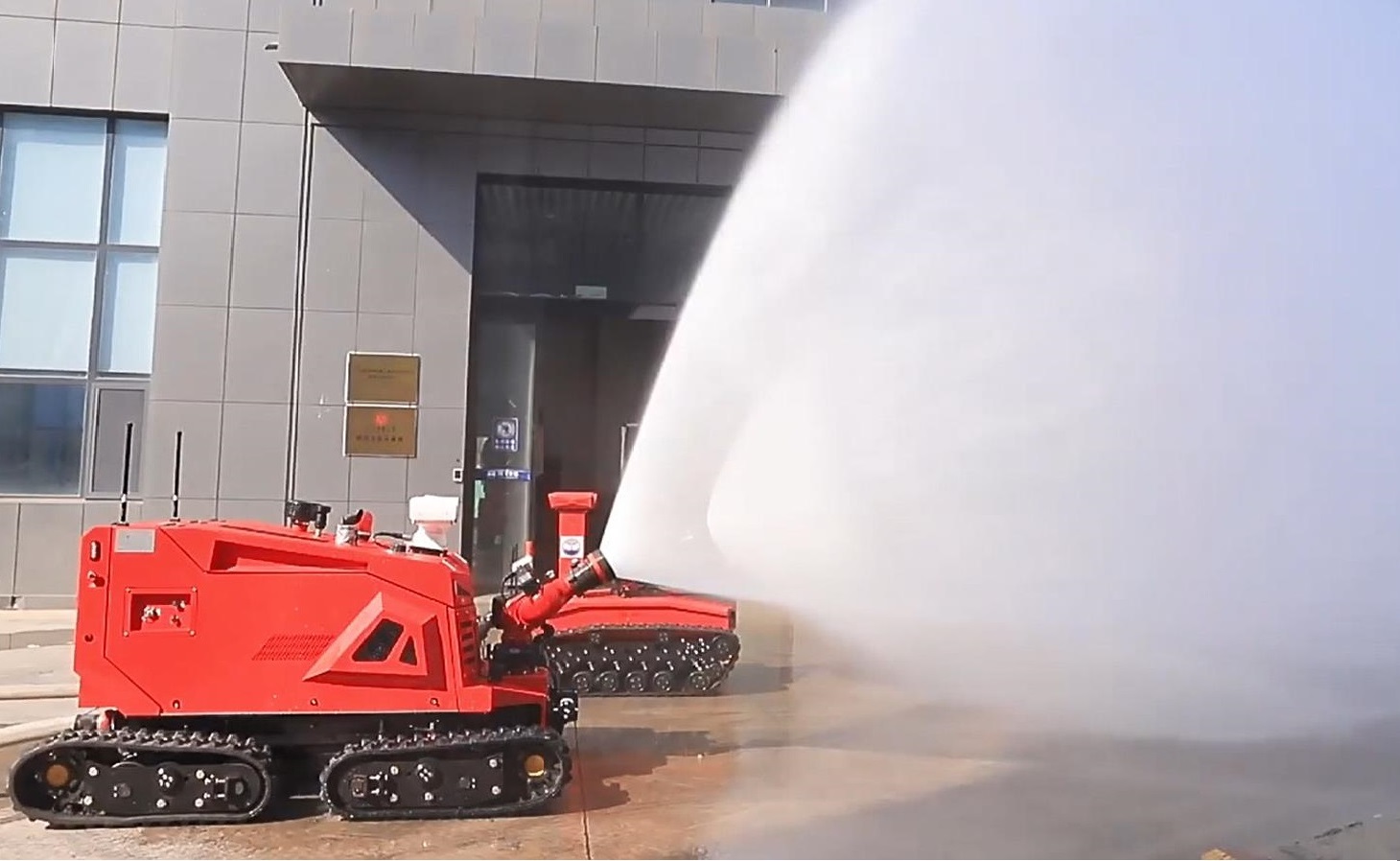
Raw extinguishing power means little if the machine cannot physically reach the hazard zone. The chassis dictates exactly where the unit can go. Manufacturers typically offer two main drive configurations. Tracked crawler chassis distribute weight over a larger surface area to provide high-traction grip. This design makes them ideal for climbing stairs, crossing deep mud, and navigating through collapsed warehouses filled with smoldering debris. On the other hand, a four-wheel-drive wheeled chassis generally offers faster deployment speeds. They provide better maneuverability on flat, paved industrial yards or airport runways.
When reviewing mobility, gradeability is a metric you cannot ignore. Expressed in percentages or degrees, it indicates the steepest incline the machine can ascend safely. If your facility features multi-story infrastructure, steep loading ramps, or uneven outdoor terrain, verifying a climbing angle of at least 30 degrees is essential. You should also check the side slope or roll angle specification. This reveals the unit's resistance to tipping over when driving across an incline.
Finally, look at ground clearance. This is the distance between the lowest point of the undercarriage and the ground. High clearance prevents the machine from getting high-centered on rubble. Complementing this are the obstacle clearance height and the trench-crossing width. These numbers ensure your investment will not get stuck in a drainage ditch before it even reaches the flames.
The power source you choose dictates the endurance, maintenance schedule, and operational environment of the machine. For extended outdoor operations, diesel engines remain the favored choice. When reading diesel specs, focus on engine horsepower and torque ratings. High torque is absolutely required for dragging heavy, water-filled hoses across a mud-slicked industrial yard. A robust Fire Fighting Robot utilizing a high-output diesel engine provides the distinct benefit of rapid refueling. Models like the RXR-M150GD boast powerful engines that allow for near-continuous operation during multi-day forest or refinery fires where battery charging infrastructure is nonexistent.
In contrast, electric models rely on high-capacity lithium-ion or lead-acid battery packs. The key metrics to scrutinize here are Amp-hours and system voltage. Higher ratings generally equate to longer run times. Electric units produce zero emissions and operate with minimal noise. This makes them the superior, and often mandatory, choice for indoor environments such as subways, high-rack warehouses, and confined spaces where diesel exhaust would create a deadly secondary hazard.
Regardless of the power source, always differentiate between continuous working time and standby time on the spec sheet. Continuous working time indicates how long the machine can operate under maximum load while driving and spraying simultaneously. Standby time simply refers to how long the unit can remain powered on while stationary. Always plan your tactical response based on the continuous working time.
Modern rescue robotics rely heavily on remote control systems to keep human operators out of the hot zone. The communication range is a critical safety metric. It is usually divided into Line of Sight and Non-Line of Sight. A 1000-meter line of sight range means the signal travels that far in an open field without obstructions. This serves as a standard benchmark for high-risk industrial fires. However, in a dense petrochemical plant with massive steel structures blocking radio waves, the non-line of sight range will be significantly shorter. Understanding this limitation is vital for operator positioning.
Today's specification sheets are moving beyond purely mechanical numbers. They highlight sophisticated environmental sensors. Look for built-in toxic gas detectors capable of measuring carbon monoxide, hydrogen sulfide, or combustible gases. Ambient heat sensors and obstacle avoidance radar are also becoming standard. These data points feed real-time telemetry back to the operator's console.
To operate effectively, clear visibility is paramount. Specs for pan-tilt-zoom cameras should be reviewed for high-definition resolution. More importantly, thermal imaging capabilities are now considered mandatory. They allow operators to see through thick, black smoke to identify the hottest parts of the fire or locate trapped personnel.
Firegrounds are exceptionally hostile. The technical data will reveal exactly how much punishment the machine can withstand before its electronics fail. Ingress Protection ratings define the enclosure's defense against dust and water. An IP67 rating means the unit is completely dust-tight and can survive temporary immersion in water up to one meter. Given that these machines operate under high-pressure water streams and in heavily flooded areas, IP67 should be viewed as the absolute minimum acceptable standard. For industrial applications, IP68 continuous submersion protection is highly preferable.
To survive near the core of a fire, the equipment must combat extreme radiant heat. The specification sheet will detail a self-spraying cooling system, often called a water curtain. This feature diverts a small portion of the water supply to spray a protective mist over the chassis. It creates a thermal barrier that prevents tracks, hydraulic hoses, and internal electronics from melting. Always check the maximum ambient operating temperature limit to ensure the unit will not shut down when things get critical.
Furthermore, if your facility processes volatile chemicals or hydrocarbons, explosion-proof certifications are mandatory. These ratings guarantee that the electrical components will not generate an accidental spark. A single spark could ignite a combustible atmosphere and trigger a secondary explosion.
Bigger is not always better. The physical footprint of the machine impacts how it is stored, transported, and ultimately deployed. You must cross-reference the dimensions on the spec sheet with your facility's physical constraints. Measure your narrowest maintenance doors, warehouse aisles, security gates, and stairwells. If the unit is too wide to fit through a critical access point, it cannot protect that sector.
Overall weight is another logistical hurdle. Heavy-duty industrial models can weigh well over 1,000 kilograms. This weight provides excellent stability when discharging water at high pressures. However, it severely impacts transportation. You must determine if your current emergency response vehicles can transport this payload, or if you need to invest in a specialized heavy-duty trailer.
Perhaps the most frequently overlooked specification is the towing capacity or dragging force. A machine must pull its own water supply. You need to calculate the weight of a fully charged, water-filled fire hose over the distance you expect the unit to travel. If the rated dragging force is too low, the machine will quickly become immobilized by the dead weight of its own lifeline. Top-tier diesel models easily deliver dragging forces exceeding 10,000 Newtons, allowing them to pull hundreds of meters of charged hose without stalling.
Understanding individual metrics is only half the battle. Utilizing this data to compare different models objectively is where the real engineering work begins. Start by establishing your facility's absolute non-negotiable requirements.
| Application Scenario | Recommended Power | Target Flow Rate | Key Specs to Prioritize |
|---|---|---|---|
| Petrochemical & Refinery | Heavy-Duty Diesel | 120 - 150 L/s | Explosion-proof rating, 80m+ throw distance, high dragging force. |
| High-Rack Warehousing | Electric Battery | 60 - 80 L/s | Compact width, zero emissions, elevating monitor capabilities. |
| Municipal & Subway Rescue | Electric Battery | 40 - 60 L/s | Stair-climbing crawler tracks, thermal imaging, toxic gas sensors. |
Next, identify your specific industry hazards. For instance, if you manage a high-rack warehousing facility or a complex industrial plant, investing in a specialized robot for fire fighting equipped with an elevating boom is a strict necessity. Models like the RXR-M60L can extend their monitors up to 15 meters high, effectively attacking fires in elevated storage racks that standard ground units simply cannot reach. Conversely, an open-air oil rig will prioritize massive throw distances and explosion-proof certifications over compact sizing.
Finally, remember that specification sheets rarely tell the whole story regarding the lifecycle of the equipment. When reviewing the document with a manufacturer, ask clarifying questions. Inquire about the maintenance intervals for the tracks. Check the warranty period for the battery or engine, and verify the domestic availability of spare parts. Ensuring that your investment will not be grounded for months due to a minor component failure is just as critical as its flow rate.
Analyzing a specification document is a rigorous but vital process. It ensures you make a tactically sound purchase. The best machine is rarely the one with the highest numbers across the board. Rather, it is the one whose technical capabilities perfectly align with your unique hazards, facility layout, and logistical constraints. By taking the time to match empirical data to real-world scenarios, you safeguard both your personnel and your infrastructure. Don't leave your facility's safety to guesswork. Evaluate your site requirements carefully, and explore industry-leading solutions tailored to your environment. Visit https://www.gxsuprobot.com to browse a comprehensive lineup of heavy-duty diesel and electric emergency response robots. Request a detailed spec sheet or live product demonstration today to see these metrics in action.
While flow rate and remote control range are generally considered top priorities, the most important specification ultimately depends on your specific hazard environment. An oil refinery will prioritize maximum flow rate and explosion-proof ratings to handle massive heat loads. Meanwhile, an indoor warehousing facility will prioritize compact dimensions, electric battery endurance, and tight maneuverability.
IP stands for Ingress Protection. It classifies the degree of defense provided against the intrusion of solid objects like dust and liquids. An IP67 or IP68 rating is strictly necessary for these machines. It ensures that sensitive internal electronics, sensors, and motors are fully protected from the high-pressure water spray and heavy particulate debris constantly present on the fireground.
A water curtain system utilizes specialized nozzles to spray a continuous, protective mist of water over the exterior of the chassis. This creates a vital thermal barrier. It allows the equipment to survive extreme radiant heat near the seat of the fire without melting its rubber tracks, hydraulic hoses, or external camera sensors.
Neither is universally better; it entirely depends on the application. Diesel models offer superior horsepower, higher towing capacity, and longer continuous runtimes. This makes them ideal for heavy industrial, outdoor, and forest fire use. Electric models produce zero emissions and operate quietly. They are the superior and safer choice for indoor, confined space, subway, or low-oxygen environments.
You must look at the Traction Force, Dragging Force, or Towing Capacity specification on the data sheet. To determine if it meets your needs, calculate the total weight of your specific fire hoses when they are fully charged with water. Ensure the rated dragging force exceeds that total weight by a comfortable safety margin so the unit does not stall during deployment.
The maximum range, or throw distance, varies significantly by model and pump pressure. Standard municipal robots typically project water between 50 to 65 meters. However, heavy-duty industrial diesel models are engineered to combat massive petrochemical fires and can achieve throw distances exceeding 85 meters. This extended range is critical for keeping the robot and operators safely outside blast zones.
Routine maintenance involves inspecting the crawler tracks for tension and wear after every deployment. Debris such as wire, glass, or industrial rubble can become lodged in the drive sprockets. Operators must flush the undercarriage with clean water to remove corrosive chemicals or mud. Additionally, hydraulic fluids and track motor lubrication should be checked according to the manufacturer's specified operating hours to prevent field failures.