
Views: 0 Author: Site Editor Publish Time: 2026-04-27 Origin: Site


Building an autonomous system starts from the ground up. A Robot Chassis is not just a physical frame; it is the foundational interface between hardware payloads, drive mechanics, and spatial mapping algorithms. Choosing and using the wrong chassis leads to sensor drift, power inefficiencies, and scaling bottlenecks. Developers often discover these hardware mismatches only after pouring weeks into software configuration, forcing costly mechanical redesigns. We aim to provide an evidence-based roadmap for evaluating, assembling, and integrating a structural base for commercial prototypes and advanced engineering projects. We skip the basic hobbyist theory here. Instead, you will focus on realistic trade-offs in drive systems, payload mounting, power distribution, and hardware-to-software alignment. By treating your mobile base as a fully integrated digital-physical ecosystem, you can accelerate time-to-market and ensure reliable real-world performance.
Hardware dictates software accuracy: Rigid frames cause uneven ground contact, directly degrading IMU (Inertial Measurement Unit) data and SLAM (Simultaneous Localization and Mapping) precision.
Drive selection is a zero-sum game: Over-specifying to a 4WD system with full encoders often exhausts microcontroller pins and battery life without tangible operational benefits; 2WD is statistically sufficient for most indoor navigation tasks.
Surface area outranks pure payload capacity: The most common implementation failure is a lack of horizontal mounting space, forcing unstable vertical stacking of components.
Standardization accelerates scaling: Utilizing platforms compatible with standardized extrusions (e.g., 1020 aluminum profiles) lowers Total Cost of Ownership (TCO) and simplifies iterative sensor upgrades.
Mismatching your locomotion logic with the targeted deployment environment guarantees navigational failure before you even load the software. Algorithms cannot overcome fundamental mechanical limitations. You must evaluate the terrain, friction coefficients, and spatial constraints to dictate the physical drive system.
Differential drive systems remain the industry standard for controlled environments. These setups typically utilize two driven wheels alongside a passive caster wheel for balance. They excel in flat indoor environments, warehouse logistics, and line-following applications. The mechanics are highly efficient and incredibly simple to code.
However, differential systems require careful consideration of operational trade-offs. They struggle heavily during lateral movements. A 2WD system cannot shift sideways; it must rotate in place and drive forward. Furthermore, small caster wheels easily jam on uneven transitions like warehouse door tracks or thick carpets, disrupting smooth navigation.
Hospitality, medical delivery, and tight manufacturing lines often present highly constrained indoor spaces. These environments require zero-degree turning radiuses and lateral mobility. Omni-directional and mecanum wheel configurations provide this exact flexibility. They allow the base to strafe horizontally or glide diagonally without altering its forward heading.
This flexibility introduces significant complexity. These wheels have a notoriously low tolerance for floor debris. A single loose screw or thick cable can stall a mecanum roller. Furthermore, preventing drift requires highly calibrated, complex motor control algorithms. You must monitor and adjust the rotational speed of all four motors continuously to maintain straight trajectories.
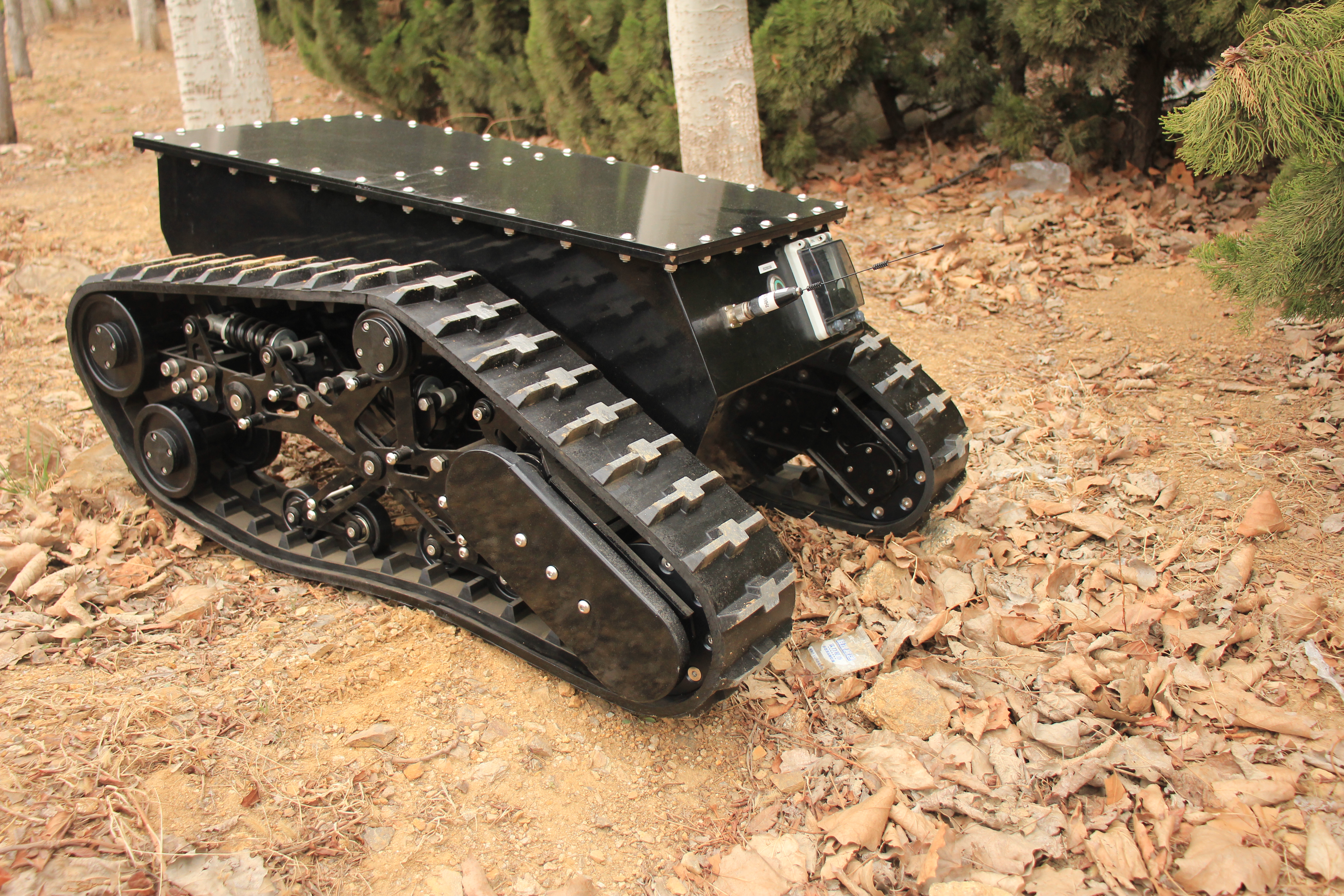
When deployments move outside, environmental unpredictability spikes. Agricultural tech, search and rescue operations, and general outdoor uneven terrain demand maximum surface contact. A tracked robot chassis distributes the payload weight across continuous belts, drastically lowering ground pressure. This prevents the vehicle from sinking into mud, sand, or loose gravel.
You must weigh these traction benefits against severe operational costs. Tracked systems generate high friction during movement, especially during turns. This friction results in lower top speeds and massive power consumption. Your battery budget must accommodate the continuous torque required just to pivot the heavy treads against the ground.
Drive Type | Ideal Environment | Primary Advantage | Major Trade-off |
|---|---|---|---|
2WD Differential | Indoor flat surfaces, tile, polished concrete | High power efficiency, simple kinematics | Poor obstacle climbing, gets stuck in gaps |
Mecanum / Omni | Constrained aisles, hospitality, cleanrooms | True holonomic movement (strafing) | Vulnerable to debris, complex drift control |
Tracked Chassis | Agriculture, disaster zones, loose dirt | Unmatched traction, low ground pressure | High battery drain, severe turning friction |
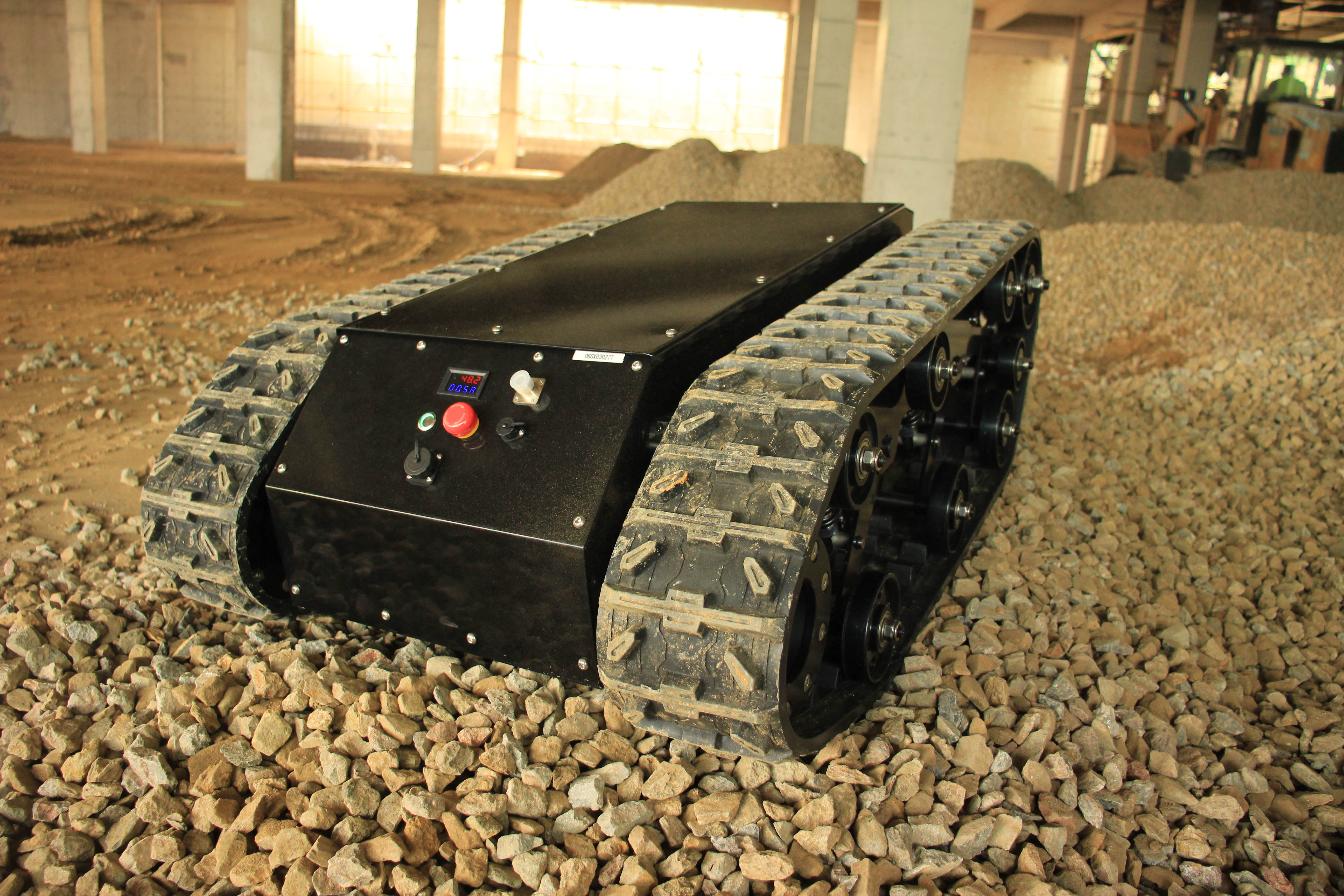
Physical architecture requires rigorous discipline. Treat your mechanical assembly phase as a critical engineering milestone rather than a casual puzzle. A poorly planned frame translates into endless maintenance cycles and catastrophic hardware failures in the field.
Simplify the Bill of Materials (BOM) strictly prior to initiating physical assembly. Engineers frequently fall into the trap of using a dozen different screw sizes for various brackets. You must standardize fasteners across the entire chassis. Limiting the entire build to two or three screw types—such as M3 or M4 metric bolts—massively reduces maintenance overhead. When you deploy a prototype, your field repair kit should only require one hex driver, not a toolbox full of proprietary wrenches.
Hardware developers routinely underestimate horizontal footprint requirements. Avoid consumer-grade kits lacking adequate surface area. These kits inevitably force unstable vertical component stacking. We call this the "Stacking Trap." When you mount a heavy compute module on top of a motor driver, you concentrate heat and elevate the center of gravity.
Prioritize double-deck or multi-tier designs. A segregated layer approach mechanically decouples your high-vibration drive layer from your sensitive compute layer. This prevents motor heat from thermal-throttling your processors and shields sensitive I/O pins from stray wiring snags.
Failing to calculate actual ground clearance post-assembly dooms many robotic projects. Do not simply trust the theoretical dimensions provided by generic component suppliers. You must physically calculate the drop between the motor axle and the lowest point of your structural frame.
Consider these practical steps when configuring undercarriage clearance:
Measure the Motor Diameter: Identify the thickest point of your gearbox housing. Let us assume a 1-inch diameter motor.
Select the Wheel Diameter: Mounting smaller wheels increases torque but lowers the vehicle. If you select a 1.5-inch wheel, you only add 0.25 inches of radius beyond the motor casing.
Calculate the Frame Drop: Factor in the thickness of your mounting brackets. A thick aluminum bracket extending below the motor further reduces space.
Determine Final Clearance: In the above scenario, your actual ground clearance is a mere quarter-inch. A stray cable or door threshold will easily high-center the robot.
Electromechanical integration requires strict electrical boundaries. Treating your power delivery network as a single unified circuit is a guaranteed recipe for unstable logic processing and abrupt system resets.
You must isolate logic power from drive power physically and electrically. Microcontrollers and single-board computers require perfectly stable voltage rails. DC motors act as violent electrical loads. Whenever a motor stalls or reverses direction, it pulls massive current spikes and kicks back electromotive force (Back-EMF). If you connect your logic board and motors to the exact same raw power rail, these spikes will reset your microcontrollers instantly.
Utilize robust decoupling strategies. Use dedicated voltage regulators for your compute layer and separate high-current battery feeds for your motor drivers. Additionally, implement quick-release battery mounting systems. Industrial Velcro straps or standardized sliding rail mounts minimize operational downtime. Screwing batteries permanently into the frame requires complete teardowns just to recharge the system.
Managing Input/Output (I/O) pins is a delicate resource balancing act. Many beginners accidentally consume all available GPIO pins purely on locomotion, leaving nothing for critical perception sensors.
The Trap: Defaulting to standard, cheap motor shields. These beginner shields monopolize logic pins. The problem compounds rapidly when running four independent motors requiring individual rotary encoders. Your microcontroller becomes entirely consumed by basic driving tasks.
The Solution: Shift immediately from direct pin control to bus-based control architectures. Utilize I2C or Serial-based motor drivers. These advanced boards feature daisy-chaining capabilities. They offload the PWM generation to dedicated ICs, liberating dozens of GPIO pins for advanced LiDAR arrays, ultrasonic rings, and camera triggers.
Software algorithms do not operate in a vacuum. They rely entirely on the physical fidelity of the data streaming from the hardware. A rigid, unyielding frame acts as a destructive physical filter, actively corrupting the data your algorithms need to function.
Evaluate your chosen platform for independent suspension features. A rigid frame practically guarantees complete navigational failure on uneven surfaces. Microscopic floor variations—such as grout lines in tile or warped floorboards—will cause one or more wheels to lose simultaneous ground contact.
When a driven wheel lifts off the ground, it spins freely. This free-spinning registers as forward movement on the wheel encoders, feeding false odometry data to the control unit. Simultaneously, the impact of the wheel crashing back down introduces fatal micro-vibrations and drift into your IMU (Inertial Measurement Unit) data. These compounding odometry errors render high-level SLAM algorithms totally inaccurate. Suspension is not about a smooth ride; it is a critical data-integrity requirement.
Core perception components demand mechanical respect. Mount critical sensors, including depth cameras and LiDAR scanners, using custom dampening standoffs. Rubberized isolators absorb the high-frequency vibrations generated by planetary gearboxes.
Furthermore, ensure precise, documented measurements of sensor height relative to the ground plane. Do not guess these values. Software frameworks like ROS (Robot Operating System) require millimeter-accurate hardware offsets—known as URDF transforms—to map the environment safely. If your chassis design causes the LiDAR to pitch forward by just two degrees, the algorithm will falsely interpret flat ground as an approaching wall.
Transitioning from a prototype to a deployable fleet requires financial and engineering pragmatism. You must evaluate the Total Cost of Ownership (TCO) across the entire hardware lifecycle.
You face three distinct procurement pathways when sourcing your foundation. Each path carries unique engineering burdens and financial realities.
Scratch Build: Fabricating from raw materials demands the highest engineering cost. It requires extensive CAD design, CNC machining, and manual tolerance testing. We recommend this route strictly for highly proprietary edge cases where commercial shapes fundamentally fail your requirements.
Commercial Pre-Builts: This pathway offers the lowest time-to-market. Look for native compatibility with standard form factors. Your chosen platform should feature pre-drilled mounts for industry staples like the Raspberry Pi or NVIDIA Jetson Nano. More importantly, prioritize platforms built around industry-standard mounting profiles, such as 1020 aluminum extrusions. This guarantees infinite future-proofing using off-the-shelf T-nuts.
RC Hacking: For proofs of concept requiring complex steering geometries like Ackermann steering, retrofitting commercial RC car components offers a massive shortcut. Ripping the high-grade independent suspension out of a 1:10 scale RC rock crawler provides premium mechanics at a fraction of custom machining costs.
Strategy | Initial Hardware Cost | Engineering Hours Needed | Time-to-Market Speed | Scalability Potential |
|---|---|---|---|---|
Scratch Build | Low (Raw materials) | Extremely High (CAD + CAM) | Slowest | Low (Hard to replicate easily) |
Commercial Pre-Built | Medium to High | Low (Plug and play) | Fastest | High (Standardized parts) |
RC Hacking | Medium (Donor vehicle cost) | Medium (Reverse engineering) | Moderate | Very Low (Vendor lock-in) |
Base your final hardware selection strictly on digital transparency. Look for valid 3D CAD or STEP file availability from the manufacturer. You must map out your microcontroller, battery layout, and sensor payloads digitally before ordering physical hardware. If a vendor does not supply exact digital twins for simulation and mounting planning, disqualify them from your commercial pipeline immediately. Guessing clearance issues during physical assembly wastes thousands of dollars in delayed engineering hours.
Successfully utilizing a mobile platform requires treating it as a fully integrated physical-digital system, rather than just a structural bracket for holding motors. Your mechanical choices actively shape your software performance. Rigid bases corrupt spatial algorithms, while poorly planned power rails trigger erratic compute failures.
Prioritize hardware offering generous horizontal mounting space to avoid thermal stacking. Demand standardized mounting holes to secure your sensor payloads reliably. Most importantly, mandate suspension features to protect your core odometry and algorithm data from microscopic floor shocks.
Your next step is purely digital. Move into the CAD phase right now. Download the precise 3D models of your shortlisted hardware. Map out your compute boards, battery quick-releases, and LiDAR placements in software first, ensuring complete physical harmony before you ever turn a screwdriver.
A: For 90% of basic indoor navigation and obstacle avoidance projects, 2WD (differential drive with a caster wheel) is sufficient, conserves battery, and simplifies coding. 4WD is necessary primarily for inclines, heavy payloads, or uneven terrain.
A: If using a rigid chassis without suspension, wheel lift off uneven surfaces causes harsh vibrations. Additionally, mounting the IMU directly on a high-gauss magnetic area (near large DC motors) without an isolated standoff will distort readings.
A: Opt for continuous tracks when navigating soft, loose, or unpredictable outdoor surfaces (sand, mud, rubble). If your deployment is on concrete, asphalt, or indoor flooring, wheels provide better power efficiency and smoother odometry.