
Views: 0 Author: Site Editor Publish Time: 2026-04-13 Origin: Site


Extreme risk is an unfortunate reality of structural and industrial fires. According to industry baselines like the NFPA's data, tens of thousands of fireground injuries occur annually. Responders face intense heat, sudden collapses, and toxic chemical exposures daily. Fire departments and private industrial facilities share a critical challenge. They must suppress aggressive fires, cool surrounding environments, and conduct thorough hazard reconnaissance. Crucially, they must accomplish this without placing human personnel directly in the path of extreme danger.
A firefighting robot often feels like a futuristic concept to the general public. In reality, it is a highly practical, operator-dependent tool already transforming modern emergency response. This guide breaks down exactly how operators control these machines in the hot zone. We will explore the technical realities of field deployment, the multi-sensor perception layers, and how organizations evaluate them for proper procurement.
Firefighting robots are primarily remotely operated via multi-sensor feedback, keeping a "human in the loop" rather than relying on full AI autonomy.
Operational success depends heavily on the interface (belly-pack controllers), signal strength, and payload capacity (water flow rate and towing power).
Procurement evaluation must weigh power train types (diesel vs. electric), terrain adaptability, and specific compliance ratings (e.g., ATEX/explosion-proof standards for chemical plants).
Total Cost of Ownership (TCO) extends beyond the hardware to include specialized training, maintenance of hydraulic/sensor systems, and deployment transport mechanisms.
Deploying heavy machinery into a burning building requires precise mechanical coordination. Operators do not sit in distant, air-conditioned command centers. They remain on the fireground, managing heavy-duty drive systems and high-pressure suppression tools in real time.
Piloting these units involves industrial-grade, belly-pack remote controllers. Operators wear these consoles strapped securely to their torsos. This ergonomic design provides physical stability while freeing both hands for complex maneuvering. The controllers feature rugged joysticks, dead-man safety switches, and integrated high-definition screens.
Teleoperation relies on dedicated communication protocols. Encrypted Wi-Fi and specialized UHF/VHF radio frequencies prevent critical signal interference. This robust setup allows operators to maintain secure control from safe staging areas. In clear line-of-sight conditions, they can drive the unit up to 1 kilometer away.
Mobility dictates tactical success on a chaotic fireground. Manufacturers build varying drive systems to match specific operational terrains.
Heavy-Duty Tracked Systems: Engineers design these for brutal, unpredictable environments. Broad rubber or steel tracks distribute the machine's weight evenly. They easily climb 30-degree inclines, scale concrete stairs, and aggressively push through fallen structural debris.
Articulating Wheeled Setups: Some environments demand agility over brute force. Nimble, four-wheel-drive systems work best for confined indoor spaces. They navigate narrow factory aisles and tight corners smoothly.
Driving the machine into position is only the first step. Tactical execution involves actuating powerful, integrated tools.
Water Monitor Management: Operators control variable flow rates remotely. They adjust the nozzle pattern from a protective wide fog to a piercing straight stream. Standard municipal models push around 80 L/s. Highly industrial units scale up to massive 3,800 L/min capacities for petrochemical fires.
Secondary Tool Actuation: Many advanced units feature multi-functional mechanical arms. Operators actuate these hydraulic appendages to breach locked doors or shatter tempered glass. They also use them to drag heavy supply hoses or clear large obstacles blocking the exit path.
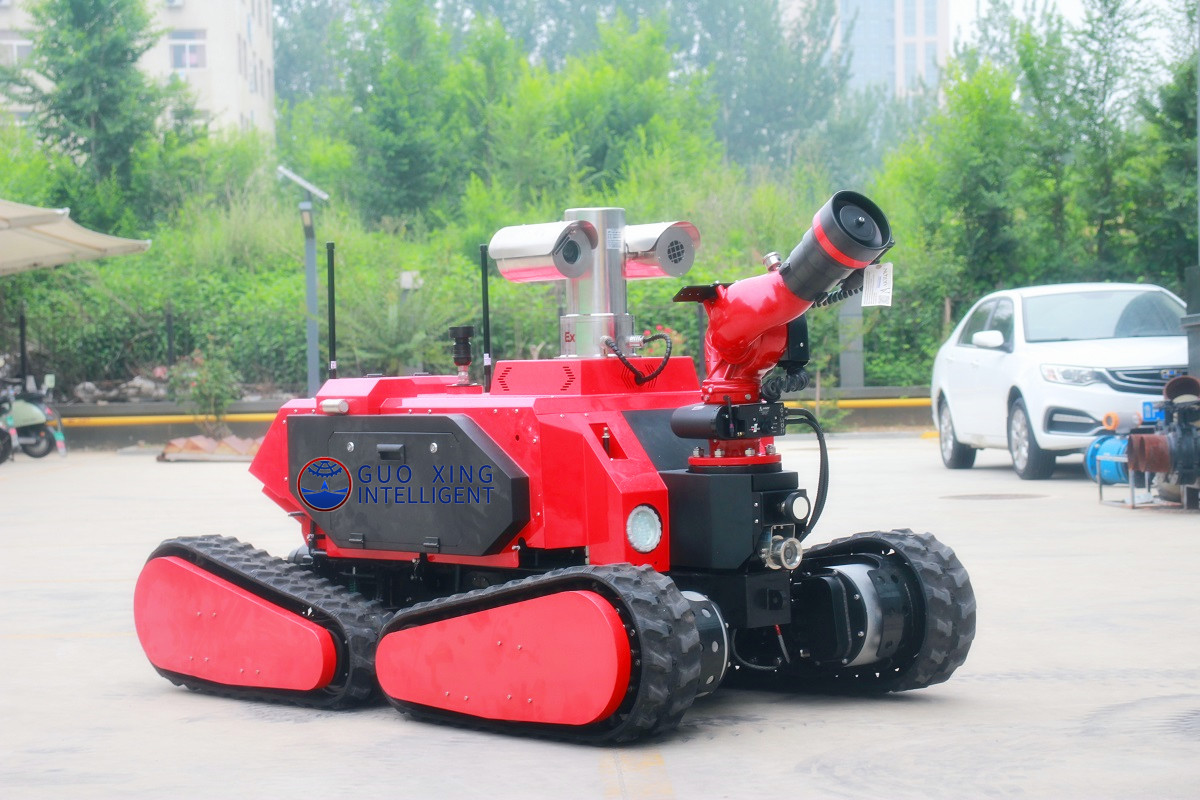
You cannot fight a fire safely if you cannot see the operational environment. Multi-sensor fusion bridges this critical visibility gap. Operating a robot effectively requires an accurate, low-latency digital recreation of the immediate surroundings.
Thick, black smoke renders standard human vision entirely useless. Therefore, thermal imaging cameras (TIC) are absolutely vital. TICs penetrate heavy smoke columns by reading heat signatures. Operators use specific color palettes to identify the exact fire seat hidden deep inside a structure. The system pairs these thermal readings with standard low-light optical cameras. This combination provides a comprehensive, dual-layered visual field on the controller screen.
Modern firegrounds produce invisible killers. Advanced units integrate distributed gas detectors to identify toxic threats early.
They monitor the Lower Explosive Limit (LEL) to detect combustible gas buildup before ignition occurs. They also measure lethal carbon monoxide levels, hydrogen cyanide concentrations, and oxygen depletion. Incident commanders analyze this real-time data to decide whether human teams can eventually enter the sector safely.
Modern emergency tactics increasingly rely on networked technology. Incident commanders frequently deploy aerial drones alongside ground-based machines. Drones provide overhead thermal mapping. They identify weakening roof structures and hidden hot spots from above. Operators use this aerial data to guide the ground robot along the safest possible path. This air-ground collaboration creates a powerful, localized tactical network.
You must match the machine's specific build to your unique hazard profile. A generic approach guarantees tactical failure.
Chemical plants and refineries harbor volatile atmospheric vapors. A tiny spark from a standard DC motor can trigger a catastrophic secondary explosion. You must deploy an explosion-proof firefighting robot in these sectors. These specialized models feature fully encapsulated electronics and sealed wiring harnesses. They utilize non-sparking alloys across their exterior chassis. Intrinsically safe certifications, such as ATEX or Class 1 Division 1 ratings, are strictly required by law.
Large commercial warehouses and subterranean parking garages pose severe collapse risks due to prolonged heat exposure. Heavy-duty suppression models dominate these municipal arenas. They possess immense torque. This allows them to tow massive, fully charged Large Diameter Hoses (LDH) deep into the structure. Rapid, high-volume water application cools the structural steel quickly, preventing total building collapse.
Locating trapped victims is incredibly dangerous in highly unstable environments. A specialized rescue firefighting robot addresses this problem directly. Engineers optimize these models for tight confined space maneuverability. They come equipped with two-way audio modules, allowing operators to speak directly with conscious victims. They operate seamlessly in low-oxygen environments where human lungs would immediately fail. Certain models even feature integrated casualty-dragging sleds to extract incapacitated individuals.
Organizations buy these machines for fundamentally different reasons. Let us compare the primary value propositions across sectors using a simplified application matrix.
Sector | Primary Target Environments | Core Return on Investment (ROI) |
|---|---|---|
Public (Municipal Fire Departments) | High-rises, urban sprawls, major highway accidents | Responder risk mitigation, extreme hazard management, and improved life safety. |
Private (Factories, Tunnels, Warehouses) | Automated storage facilities, petrochemical sites | Rapid initial containment, preventing catastrophic inventory loss, and avoiding business interruption. |
Purchasing robotic technology requires rigorous, objective evaluation. Decision-makers must analyze raw performance metrics alongside ongoing operational expenses.
Always assess the machine's water and foam flow capacity. Compare it directly against your department's standard hose line capabilities. Next, evaluate the payload and towing capacity realistically. Ask the vendor a direct question: Can it pull a fully charged 5-inch hose around a sharp 90-degree corner over rough terrain?
Finally, consider the power train logistics. Battery endurance is a major factor. A premium electric model might offer a 12-hour continuous standby mode, which simplifies indoor operations. Conversely, a diesel alternative offers relentless, constant power output. However, diesel engines introduce fuel management logistics and exhaust ventilation concerns inside enclosed structures.
The initial purchase price represents only a fraction of the total investment. You must account for hidden, long-term maintenance expenses to avoid budget shortfalls.
Cost Category | Key Elements to Evaluate |
|---|---|
Upfront Capital Costs | Hardware chassis, proprietary multi-sensor suites, the main control console, and the customized transport trailer. |
Mechanical Maintenance | Servicing high-pressure water monitor valves, replacing worn rubber track treads, and checking hydraulic fluid levels. |
Sensor Calibration | Calibrating sensitive gas detectors regularly and maintaining pristine thermal camera lenses. |
Personnel Training | Funding continuous tactical simulation hours and overtime pay for specialized operator drills. |
Your new robotic asset must integrate smoothly into your existing fleet. Ensure the robot's water inlet connections match your department's standard Storz or threaded couplings perfectly. Verify the communication frequencies do not interfere with standard dispatch radios or local emergency mesh networks. Finally, check the precise transport dimensions. The unit must load safely onto your current trailers and fit inside standard apparatus bays.
Every piece of technology has inherent limits. Acknowledging these constraints ensures safer deployments and prevents catastrophic equipment failures.
Operators face harsh communication realities inside thick reinforced-concrete structures. Losing line-of-sight teleoperation happens frequently during aggressive interior pushes. Subterranean environments, like subway tunnels or underground parking decks, block standard UHF and Wi-Fi signals easily. Departments must plan for sudden signal degradation. They often use specialized communication relays or localized mesh network nodes to extend operational range.
While these machines boast incredible heat resistance, they are not indestructible. Sensitive internal sensors, lithium batteries, and external wiring harnesses possess strict thermal thresholds. Prolonged exposure to direct, engulfing flames will melt vital components. This physical reality highlights the importance of self-cooling mechanisms. High-end models utilize water-curtain self-protection systems. They continuously spray a protective water mist over their own chassis. This mist absorbs radiant heat, allowing the unit to survive in blistering environments.
Hardware procurement does not automatically equal tactical proficiency. Departments regularly face significant internal adoption friction. You must designate specific personnel and train them continuously. A machine is only as effective as the tactical mindset of its remote driver. Without regular, stressful field drills, operators will struggle to navigate complex obstacles under pressure.
Never purchase robotic equipment based solely on a glossy brochure. We highly recommend scheduling comprehensive field demonstrations. Ask vendors to mimic your department’s most problematic target hazards. Test the robot inside a specific local transit tunnel. Deploy it at a known chemical manufacturing site or an active training tower. Let the challenging terrain reveal the machine's true mobility and perception capabilities.
Operating these machines blends heavy mechanical suppression capabilities with highly sophisticated sensor monitoring.
Investing in this technology is not about replacing human firefighters; it is entirely about extending their operational reach and survivability.
Ensure your chosen power train, drive system, and thermal protection mechanisms align directly with your most frequent hazard environments.
Audit your most dangerous local target hazard zones immediately. Use this audit to dictate the specific payload and sensor requirements you truly need before requesting any formal vendor proposals.
A: No, they rely heavily on human teleoperation and multi-sensor feedback to make tactical decisions. A human remains in the loop to manage suppression and navigation. However, basic autonomous features, such as obstacle avoidance and return-to-base functions, are currently emerging in the market.
A: Typically, operators maintain control between 300 meters and 1 kilometer away. This range depends heavily on environmental interference. Line-of-sight operations offer maximum range, while penetrating heavy concrete structures or subterranean tunnels significantly reduces the effective signal distance.
A: It is a specialized unit built entirely with intrinsically safe, spark-free components and reinforced protective casings. Manufacturers certify these models specifically for safe deployment in highly combustible petrochemical facilities or industrial environments where volatile vapors are present.
A: Yes, certain specialized models feature hydraulic mechanical arms or integrated dragging sleds. Engineers design these tools to physically move casualties or heavy debris. However, their primary rescue function is usually locating victims rapidly via thermal imaging and delivering breathable air supplies.