
Views: 0 Author: Site Editor Publish Time: 2026-06-01 Origin: Site


A persistent challenge in emergency response remains the critical time gap. It exists between initial unit deployment and safe tactical engagement. Extreme-hazard zones magnify this problem significantly. Every minute lost to safety protocols allows fires to escalate. Rapid escalation leads to structural failures and chemical disasters. Enter the Firefighting Robot. We must not view this technology as a science-fiction replacement for human crews. Instead, consider it a highly specialized tactical force multiplier. Engineers design these machines to neutralize specific environments. They target areas deemed too hazardous for immediate human entry. By mitigating fatal risks, they protect our frontline workers. By accelerating site reconnaissance, they gather vital intelligence instantly. Operating without human physiological limits, they transform standard emergency response entirely. They shift it from a human-constrained effort into a continuous operation. It becomes a deeply data-driven process. You will learn how robotic intervention bypasses physical limits. We will explore their scenario-specific impacts across multiple environments. Finally, you will discover real-world procurement frameworks based on rigorous industry standards.
Tactical Acceleration: Firefighting robots compress response times by performing immediate, continuous suppression and hazard containment without the delays of human physiological safety protocols.
Data-Driven Reconnaissance: Integrated thermal imaging and hazard sensors provide incident commanders with real-time structural and chemical data, enabling faster, safer tactical planning.
The Human-Robot Alliance: Robots do not replace the intuition or dexterity of human responders; they handle the highest-risk variables (structural collapse, chemical blasts) to secure safe operational perimeters.
Standardized Evaluation: Procurement should be driven by rigorous, quantifiable performance metrics (such as NIST and ASTM standards) regarding non-line-of-sight (NLOS) communications, mobility, and thermal resilience.
First, we must examine how machines bypass human constraints for rapid deployment. Emergency teams often wait for specialized hazmat gear before entering a scene. Incident commanders must secure structural clearances before authorizing interior operations. A Firefighting Robot deploys instantly into toxic or explosive zones. It rolls seamlessly into oxygen-deprived basements. This rapid access eliminates dangerous staging delays. Time saved directly correlates to property preserved and lives protected. By removing the biological vulnerability, tactical teams engage the threat faster.
Furthermore, consider the concept of zero-fatigue operations. Human responders face severe physiological limitations. Self-Contained Breathing Apparatus (SCBA) tanks deplete very quickly under stress. Heat exhaustion sets in rapidly during intense infernal conditions. Heavy bunker gear restricts physical mobility over time. Robotic endurance completely changes this dynamic. These units maintain constant high-pressure water delivery. They dispense suppression foam continuously without ever requiring shift rotations. They guard critical assets indefinitely. They simply require a continuous power source and a stable water supply. They do not need rehabilitation sectors or medical monitoring.
Enhanced precision through remote operations represents another core mechanism of efficiency. Remote telemetry allows operators to maneuver heavy suppression equipment safely. They drive tracked units deep into highly unstable structures. They navigate narrow corridors inside burning industrial factories. Instead of spraying water from a defensive exterior perimeter, crews attack the source. They apply extinguishing agents directly at the seat of the fire. This direct application cools the core temperature faster. It uses water more efficiently and reduces total run-off.
Operational Factor | Human Responders | Robotic Units |
|---|---|---|
Deployment Speed | Delayed by hazmat preparation and safety checks | Immediate entry into hazardous zones |
Endurance Limits | Constrained by air supply and heat fatigue | Continuous, uninterrupted operation |
Tactical Positioning | Restricted to defensive perimeters | Direct access to the source of ignition |
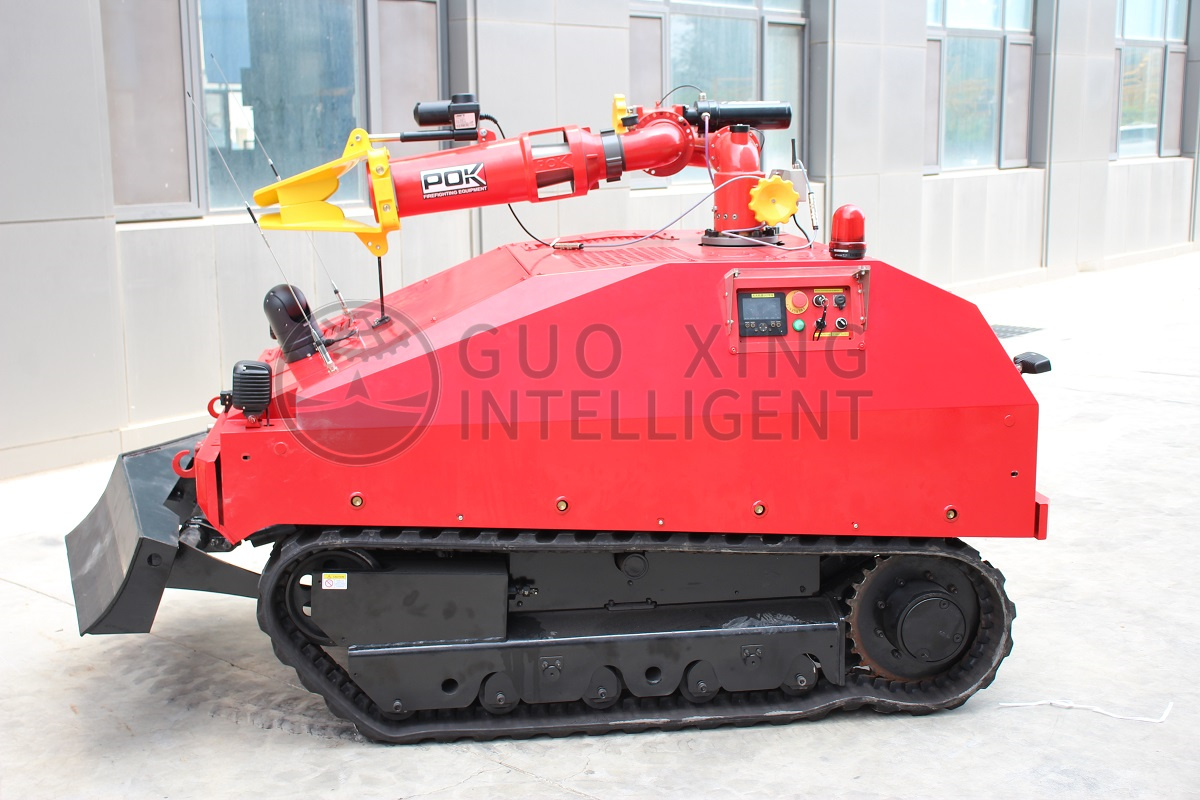
Industrial facilities present immense danger to human crews. Chemical plants and oil refineries contain highly volatile substances. A Firefighting Robot approaches extreme thermal radiation zones safely. It monitors toxic gas leaks at incredibly close ranges. Operators use these units to cool volatile storage tanks directly. This decisive action prevents catastrophic secondary explosions. The machine handles the extreme radiant heat effortlessly. Human crews stay safely behind reinforced blast walls. They execute flow control from a secure, remote command post.
Urban environments introduce high-density tactical challenges. Crews struggle immensely in compromised underground parking facilities. They face severe difficulties preserving delicate historical buildings. Sudden roof collapses can instantly destroy internal support structures. Robotic units navigate narrow, debris-filled corridors. They climb stairs in completely smoke-filled skyscrapers. They apply precise, low-impact water streams to protect load-bearing walls. This targeted suppression prevents total building failure. It also minimizes catastrophic water damage to unaffected floors.
Wildfires demand massive, exhausting logistical efforts. Topographical operations cross rugged, unpredictable mountain terrain. Specialized robotic platforms assist continuously in these sectors. They transport extremely heavy equipment up steep inclines. They drag charged hoses across burning brush effortlessly. Some heavy-duty models handle continuous vegetation clearing. They construct essential firebreaks autonomously. This spares wildland crews from exhausting, dangerous manual labor. It allows human firefighters to focus on complex perimeter containment strategies.
Beyond active fire suppression, intelligence gathering provides incredible value. The primary asset of a Firefighting Robot is often its advanced sensor payload. Incident commanders need accurate data to make life-saving decisions. The robot acts as an advanced, durable scout.
Onboard thermal cameras detect hidden hotspots inside walls. They identify human heat signatures in zero-visibility environments. Gas detectors measure Lower Explosive Limits (LEL) accurately. They assess atmospheric toxicity levels in real time. They map out chemical plumes before human crews enter the sector. This thermal and chemical mapping tracks exact fire propagation paths. Commanders see exactly where the blaze is moving. If the atmosphere turns explosive, the robot detects it immediately. The commander pulls human crews back instantly. This proactive intelligence prevents tragic mass-casualty incidents.
Structural integrity assessment also relies heavily on robotic sensors. Visual and spatial instruments monitor building stability continuously. Spatial sensors generate real-time 3D environments. They scan walls for subtle thermal bowing. They detect micro-shifts in load-bearing columns. They identify invisible collapse risks. Incident commanders formulate exact deployment strategies using this feed. They analyze structural degradation minute by minute. They no longer rely on guesswork or outdated blueprints. They send human teams solely where the structure remains completely secure.
We must acknowledge the reality of technological bottlenecks. Current operational limitations still exist. Extreme ambient temperatures eventually degrade thermal imaging accuracy. They introduce thermal noise into infrared feeds. Thick black smoke filled with oil particles sometimes blinds optical cameras. Falling concrete debris may disrupt sensor fusion modules. Autonomous navigation struggles immensely when sudden structural collapses alter the entire floor plan. The robot can lose its spatial orientation.
Communication hurdles present another serious tactical challenge. Radio signal degradation occurs frequently in dense environments. Thick concrete walls absorb high-frequency signals. Steel enclosures block telemetry feeds entirely. This creates severe multipath interference. Operators often experience sudden video lag when guiding units deep underground. They lose direct control deep inside subterranean facilities.
Despite these technological advances, humans remain entirely irreplaceable. Robots lack social perception and situational intuition. They cannot comfort a trapped victim. They lack the complex manual dexterity required for delicate search and rescue maneuvers. We must position the robot strictly as a heavy-duty assistant. It forcefully clears the path. It neutralizes the immediate thermal threat. Human expertise then takes over for complex, delicate operations.
Deploying remote units into extreme signal-dead zones without deploying radio relay nodes.
Overestimating the machine's thermal shielding during prolonged, direct-flame exposure.
Relying solely on standard optical cameras in dense, oily smoke conditions.
Ignoring the mechanical payload limits when traversing steep, debris-covered stairwells.
Adopting standardized testing protects your operational investment. Decision-makers should demand verified performance data from vendors. Organizations like NIST and ASTM provide excellent elemental robot tasks. You must review continuous pitch and roll ramp tests. Evaluate stair climbing capabilities rigorously. Check their navigation metrics on loose gravel and wet concrete. These quantifiable metrics expose poor engineering instantly.
Next, evaluate the crucial mobility versus payload tradeoff. Some tactical situations require highly agile, lightweight reconnaissance units. They climb stairs swiftly and fit through standard residential doorways. However, they carry small batteries and light hoses. Conversely, heavy-duty tracked machines carry massive water monitors. They discharge thousands of gallons per minute. They push burning vehicles out of the way effortlessly. However, they require dedicated transport trailers. They cannot navigate tight residential stairwells. You must analyze your local jurisdiction's specific hazard profile before purchasing.
Communication reliability remains absolutely non-negotiable. Require transparent data on control ranges. You must test both Line-of-Sight (LOS) and Non-Line-of-Sight (NLOS) conditions. Demand clear fallback protocols for unexpected signal loss. A machine must know how to halt or retrace its path if connectivity drops entirely.
Finally, prioritize system integration and software compatibility. A Firefighting Robot must connect smoothly to your current infrastructure. Ensure the control interfaces integrate directly into municipal command-center software. Industrial facilities need robots speaking the same digital language as their existing hazard alarms. This seamless digital integration guarantees faster response times and unified command coordination.
Request live, on-site demonstrations in heavy NLOS environments.
Verify ASTM compliance documentation for all mobility and traction claims.
Audit the unit's thermal shielding specifications against standard maximum temperatures.
Ensure the platform features modular sensor payloads for future technology upgrades.
A firefighting robot represents a strategic advancement in operational efficiency. It drastically improves life safety metrics across the board. It shifts the heavy, dangerous burdens of suppression onto machines. It handles reconnaissance in zones far too toxic for human lungs. It provides incident commanders with unprecedented tactical data.
Safety directors and procurement officers must take immediate action. Begin by auditing your most prominent hazard zones today. Review all local compliance requirements regarding remote vehicle operations. Initiate pilot programs focusing strictly on extreme-environment communication tests. Invite vendors to demonstrate their units in your most challenging facility sectors. Embracing this reliable technology secures a safer, much more efficient future for all emergency responders.
A: No. Some models feature basic autonomous navigation for return-to-base functions. They might automatically avoid static obstacles while driving. However, active firefighting remains a human-controlled task. Tactical decision-making requires human intuition and extensive experience. Operators manage suppression via remote control to ensure maximum safety and precise targeting.
A: They offer a massive upgrade in operational access over standard manual equipment. Their true value lies in reaching zones humans cannot enter. They prevent catastrophic facility losses by intervening instantly during volatile chemical events. They reduce severe injury risks during structural fires. This strategic advantage of early, aggressive containment justifies deploying specialized robotic platforms alongside traditional fire engines.
A: Yes, but they possess distinct physical limits. Most industrial-grade units feature internal cooling systems. They utilize specialized thermal shielding to withstand intense radiant heat. However, direct and prolonged flame impingement will eventually degrade delicate sensors and electronics. You must consult standardized testing metrics to understand their exact operational envelope before deployment.