
Views: 0 Author: Site Editor Publish Time: 2026-07-04 Origin: Site


In facility and pipeline inspection, a robot chassis represents the single point of failure. It dictates mobility, sensor stability, and power management in unforgiving environments. If the base fails, the entire mission halts. Engineering teams face a critical bottom-of-the-funnel challenge when sourcing these platforms. You must look far beyond basic spec sheets. Teams have to evaluate supply chain reliability, integration readiness, and vendor viability. Choosing the wrong hardware partner leads to integration nightmares and delayed deployments.
This guide provides a realistic, evidence-based framework for evaluating vendors. We aim to help you shortlist suppliers and mitigate integration risks effectively. You will learn how to balance payload capacities, assess software openness, and ensure long-term manufacturing reliability. By the end, you will know exactly how to choose hardware tailored to your specific operational constraints.
Industrial inspections rarely happen in spacious, well-lit environments. You mostly deploy robots into narrow pipelines, cramped HVAC ducts, and tight under-machinery gaps. Defining "compact" relies entirely on these strict volumetric constraints. A few extra centimeters in width can render a robot useless for a specific pipeline network. Engineering teams must measure absolute clearance requirements before ever looking at vendor catalogs. You have to account for the chassis size plus the turning radius required inside confined spaces.
When operating within tight footprints, mobility becomes a major engineering trade-off. Tracked systems and wheeled systems behave very differently in confined industrial zones. Tracked robots offer superior traction in uneven, debris-filled, or sloped environments. They easily conquer stairs and obstacles. However, tracks consume more battery power and turn slower. Wheeled systems provide higher speeds and lower power consumption. They excel on flat concrete facility floors. Yet, wheels struggle when navigating loose gravel or steep industrial inclines.
| Mobility Type | Ideal Environment | Key Advantages | Main Limitations |
|---|---|---|---|
| Tracked Systems | Uneven terrain, pipelines, stairs, debris-heavy zones. | High traction, superior obstacle clearance, low ground pressure. | Higher power draw, slower speeds, complex maintenance. |
| Wheeled Systems | Flat facility floors, smooth pipes, paved exterior yards. | Energy efficient, high speed, highly accurate odometry. | Poor obstacle climbing, slippage on wet inclines. |
Thermal and environmental realities also dictate hardware choices. Enclosing high-draw motors and dense batteries inside a small metal box creates massive heat. These robots often lack active cooling fans due to strict IP rating requirements. High IP ratings keep dust and water out. Unfortunately, sealed enclosures trap heat inside. High internal temperatures degrade battery life and throttle motor performance. You must evaluate how effectively a chassis dissipates thermal loads passively. A poorly cooled chassis will inevitably fail during long facility patrols.
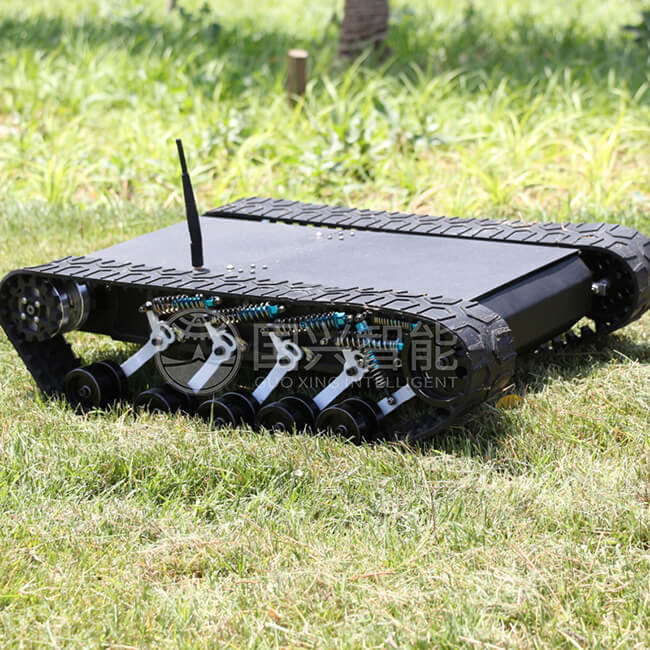
Evaluating raw hardware requires looking past marketing claims. You must assess mechanical integrity, power distribution, and software openness. Sourcing a dependable inspection robot chassis determines the entire trajectory of your deployment project. Hardware failures in the field destroy project credibility instantly. Therefore, systematic evaluation across three core dimensions is non-negotiable.
You must rigorously assess the weight-bearing capabilities relative to the vehicle's own mass. A heavy platform drains its own battery just moving around. Structural materials play a massive role here. Aviation-grade aluminum offers incredible rigidity for heavy sensor payloads. Conversely, reinforced polymers reduce overall weight and resist corrosive chemical environments better. Your operational environment should dictate the material choice.
Center of Gravity (CoG) represents another major mechanical hurdle. Inspection robots rarely carry simple, flat payloads. They usually mount top-heavy payloads like articulating robotic arms, heavy NDT probes, or spinning LiDAR arrays. A high CoG makes the robot tip over on inclines. You must ensure the platform provides a low internal battery placement to counterweight heavy top-mounted sensors.
Battery chemistry defines operational endurance. LiFePO4 batteries offer safer thermal profiles and longer lifecycles compared to standard Li-ion packs. You should prioritize platforms offering hot-swappable battery configurations. Hot-swapping allows field operators to change batteries without rebooting the robot's primary computer. This saves critical time during continuous pipeline inspections.
Furthermore, consider power distribution architectures. The platform must supply stable auxiliary power to your external sensors. Review these power management necessities:
Hardware means nothing without seamless software integration. Standardized communication protocols remain essential for rapid development. The chassis must support reliable CAN bus or serial interfaces. Avoid platforms relying solely on unstable wireless communication for core motor control.
Most importantly, prioritize vendor support for ROS and ROS2 environments. Open-source compatibility prevents proprietary ecosystem lock-in. It allows your engineering team to utilize existing navigation stacks and sensor drivers. A closed-loop system forces your developers to rewrite basic locomotion algorithms from scratch. This wastes valuable R&D time and inflates project timelines unnecessarily.
Finding a good prototype is easy. Finding a partner capable of mass-producing that prototype is difficult. Sourcing demands a thorough audit of the vendor's actual manufacturing capabilities. You must verify their ability to support your project from day one through year five.
Many vendors build excellent one-off prototypes in their workshops. However, they fail entirely when you order fifty identical units. You must gauge their ability to transition your project from a low-volume proof-of-concept to full-scale commercial deployment. Ask about their monthly production capacity. Inquire about their standard tooling processes. A reliable vendor uses standardized assembly lines even for modular robotic platforms. They maintain consistent tolerances across large batches.
Global supply chains remain highly volatile. Evaluating the origin of critical sub-components mitigates massive logistical risks. You need to know where the motors, motor drivers, and tracks originate. If a vendor relies on a single overseas factory for a custom gearhead, your production line is vulnerable. Partnering with a transparent Compact Robot Chassis Supplier protects your deployment schedule. They should maintain multiple sourcing channels for vulnerable microchips and mechanical parts.
Never trust unverified durability claims. You must look for documented testing in simulated industrial environments. Reputable manufacturers provide raw data regarding their QA processes. Look for the following documented test protocols:
Hardware procurement involves numerous hidden pitfalls. Many engineering teams fall for impressive spec sheets, ignoring practical deployment realities. These oversights lead to severe implementation bottlenecks, wasted capital, and grounded inspection fleets.
Engineers love high specifications. However, paying for unnecessary military-grade tolerances often wastes project budgets. If your robot inspects indoor HVAC ducts, you do not need tracks rated for sub-zero arctic tundras. Industrial-grade components yield a much higher return on investment for standard facility inspections. Over-speccing increases the robot's weight, drains the battery faster, and complicates basic maintenance. You must align the hardware specifications strictly with your actual environmental requirements.
Proprietary software introduces massive hidden barriers. Some vendors sell affordable hardware but force you into restrictive, closed-loop software ecosystems. They charge exorbitant licensing fees just to access basic motor telemetry. You might find yourself unable to integrate standard third-party LiDAR sensors. This closed architecture severely restricts future upgrades. Always demand transparent API access and avoid vendors hiding basic locomotion commands behind paywalls.
Robots break in the field. Tracks snap, wheels crack, and motors burn out. If your vendor uses bespoke, non-standard mechanical parts, your inspection fleet will eventually ground to a halt. You must investigate their replacement parts inventory. How long does it take to ship a replacement track? Do they use off-the-shelf industrial bearings or custom-machined ones? A supplier lacking a robust aftermarket inventory turns a simple two-hour maintenance job into a three-month deployment delay.
Once you narrow down your options, you must move from theoretical evaluation to physical testing. Do not sign a bulk contract based on a brochure. Implementing a strict shortlisting framework protects your team from overpromising vendors.
Purchasing a single evaluation unit is the critical first step. Once it arrives, immediately test it at its maximum rated payload capacity. Mount heavy weights simulating your NDT sensors and cameras. Drive the robot over inclines and uneven surfaces. Monitor the motor temperatures and battery drain. Many platforms handle maximum payloads on flat ground but fail completely on a 15-degree incline. The physical stress test exposes thermal inefficiencies and suspension weaknesses instantly.
Hardware integration always requires technical troubleshooting. You must test the supplier’s engineering response times during the API/SDK integration phase. Send their support team a complex technical question regarding ROS2 node integration. Measure how long it takes them to provide a coherent, engineering-level answer. If they take two weeks to explain a serial command during the pre-sales phase, their post-sale support will be abysmal.
Never commit to a long-term contract without clear service level agreements. You must define terms for hardware warranties and firmware update schedules. Clarify bulk-order lead times in writing. What happens if they miss a delivery deadline? You need contractual protection against supply chain delays. A trustworthy vendor willingly signs clear SLAs guaranteeing their delivery and support timelines.
| Evaluation Phase | Primary Action | Red Flag Indicator |
|---|---|---|
| 1. Hardware Audit | Perform maximum payload stress tests on inclines. | Motors overheat or tracks slip under stated max load. |
| 2. Software Review | Verify native ROS/ROS2 driver availability. | Vendor requires proprietary, closed-loop control software. |
| 3. Support Check | Test engineering response times to API queries. | Vague answers or response times exceeding 48 hours. |
| 4. Contract Stage | Negotiate clear SLAs and bulk lead times. | Refusal to guarantee replacement part availability. |
Selecting the right hardware platform heavily impacts your entire operational strategy. The right inspection robot chassis bridges the critical gap between software development and real-world commercial viability. If the base fails, your advanced navigation algorithms and expensive sensors cannot save the mission. By strictly evaluating mechanical integrity, software openness, and manufacturing reliability, you eliminate massive downstream deployment risks.
We strongly recommend prioritizing a vendor who acts as a true integration partner. Transactional vendors just ship metal boxes and disappear. Integration partners provide robust SDKs, transparent supply chains, and rapid engineering support. They actively help you get your final product to market faster.
Your next step requires clear documentation. Define your specific payload dimensions, required IP ratings, and environmental constraints immediately. Draft a standardized technical requirements document. Reach out to your shortlisted vendors and demand data-backed answers to your toughest integration questions. Stop guessing and start testing.
A: Payload capacity varies heavily based on mobility type. Compact wheeled chassis typically support 10kg to 30kg. Small tracked models handle 20kg to 50kg due to their broader footprint and geared torque. Always ensure this capacity accommodates both your NDT sensors and secondary power banks.
A: Tracked models are generally better for pipeline inspections. They provide superior obstacle clearance over debris and maintain traction on steep inclines. However, if the pipeline is perfectly smooth, dry, and flat, a wheeled chassis saves battery life and travels faster.
A: It is absolutely critical. ROS/ROS2 compatibility drastically accelerates your development speed. It allows engineers to seamlessly integrate standard sensors, LiDARs, and navigation stacks without reverse-engineering proprietary motor controllers. Lack of ROS support almost guarantees project delays.
A: Yes, reputable suppliers easily accommodate custom mounting. Most offer standardized modular top-plates with pre-drilled grid patterns. For highly specialized sensors, advanced vendors can manufacture fully customized chassis configurations or specialized mounting brackets tailored to your exact center-of-gravity needs.