
Views: 0 Author: Site Editor Publish Time: 2026-07-01 Origin: Site


Transitioning from a lab prototype to a commercial deployment is a massive engineering leap. You require a robust foundation capable of surviving harsh environments. This physical base must manage volatile payloads while maintaining continuous operation. However, a frustrating reality plagues the robotics market today. Countless hobbyist-grade RC platforms flood the industry. Manufacturers frequently label these lightweight models as "heavy-duty" to attract commercial buyers. They often lack the structural integrity required for rigorous industrial tasks. We built this guide to help you cut through the marketing noise.
Our purpose is to provide engineering and procurement teams a pragmatic, evidence-based framework. We will show you how to evaluate a reliable supplier for industrial deployment. You will learn how to parse technical trade-offs and vet supplier capabilities. Ultimately, you will discover how to select an industrial-grade partner capable of supporting your scaled robotic deployments.
Marketing brochures often blur the line between toy components and industrial hardware. You must shift the definition away from vague marketing claims. Instead, rely entirely on quantifiable metrics. A true heavy-duty mobile robot chassis must sustain a continuous payload capacity exceeding 100kg. Intermittent burst capacities do not count for commercial deployments. You should also evaluate environmental protection ratings. Drive systems and motor controllers require IP65+ ratings minimum. Lower ratings invite dust ingress and water damage during outdoor operations. Real heavy-duty platforms provide detailed torque curves rather than simple top-speed claims.
Material selection directly dictates a platform's survivability. Hobbyist platforms often use cheap extruded plastics or thin aluminum sheets. Industrial applications demand full-metal platforms. You must analyze the necessity of different metals based on your payload. Aluminum alloy offers excellent corrosion resistance and keeps the overall weight manageable. High-strength steel provides superior yield strength for extreme payloads. You also need to examine structural integrity. Bolted frames offer easier maintenance but can loosen under continuous vibration. Welded frames provide superior rigidity for off-road impacts. The chart below summarizes these material trade-offs.
| Material Type | Tensile Strength | Weight Impact | Ideal Application Scenario |
|---|---|---|---|
| Standard Aluminum (e.g., 6061) | Medium | Lightweight | Indoor logistics, medium-payload outdoor tasks. |
| High-Strength Steel | Very High | Heavy | Mining, construction, extreme-payload lifting. |
| Stainless Steel (304/316) | High | Heavy | Corrosive environments, chemical processing. |
Outdoor and off-road applications introduce unpredictable variables. You must establish strict criteria for environmental resilience. Shock absorption is critical to protect sensitive top-mounted sensors like LiDAR. Insufficient damping translates terrain vibrations directly into your navigation stack. Ground clearance also dictates off-road capability. Low clearance causes high-centering on rocks or debris. Finally, you must evaluate thermal management. Enclosed motor compartments trap heat quickly during continuous high-torque operations. Industrial chassis use passive heat sinks or active cooling to prevent motor demagnetization.
Tracks determine how your robot interacts with the physical world. Material selection is highly dependent on your deployment environment.
You cannot evaluate shock absorption without examining the specific suspension mechanisms. Christie suspension systems use large road wheels and trailing arms. They allow high-speed travel over uneven off-road terrain. Bogie suspensions group wheels together to distribute massive weights across soft ground. You must compare independent suspension setups against rigid setups. Independent systems handle obstacles brilliantly. Conversely, rigid setups provide predictable kinematics for flat-surface environments. Rigid tracks ensure stability when carrying top-heavy payloads in warehouses.
A heavy-duty platform lives or dies by its drive train. Hobby motors burn out quickly under commercial strain. You must validate the technical specifications strictly.
Industrial applications demand brushless DC (BLDC) motors paired with planetary gearboxes. Planetary gearboxes distribute loads across multiple gears. This prevents tooth shearing under heavy acceleration.
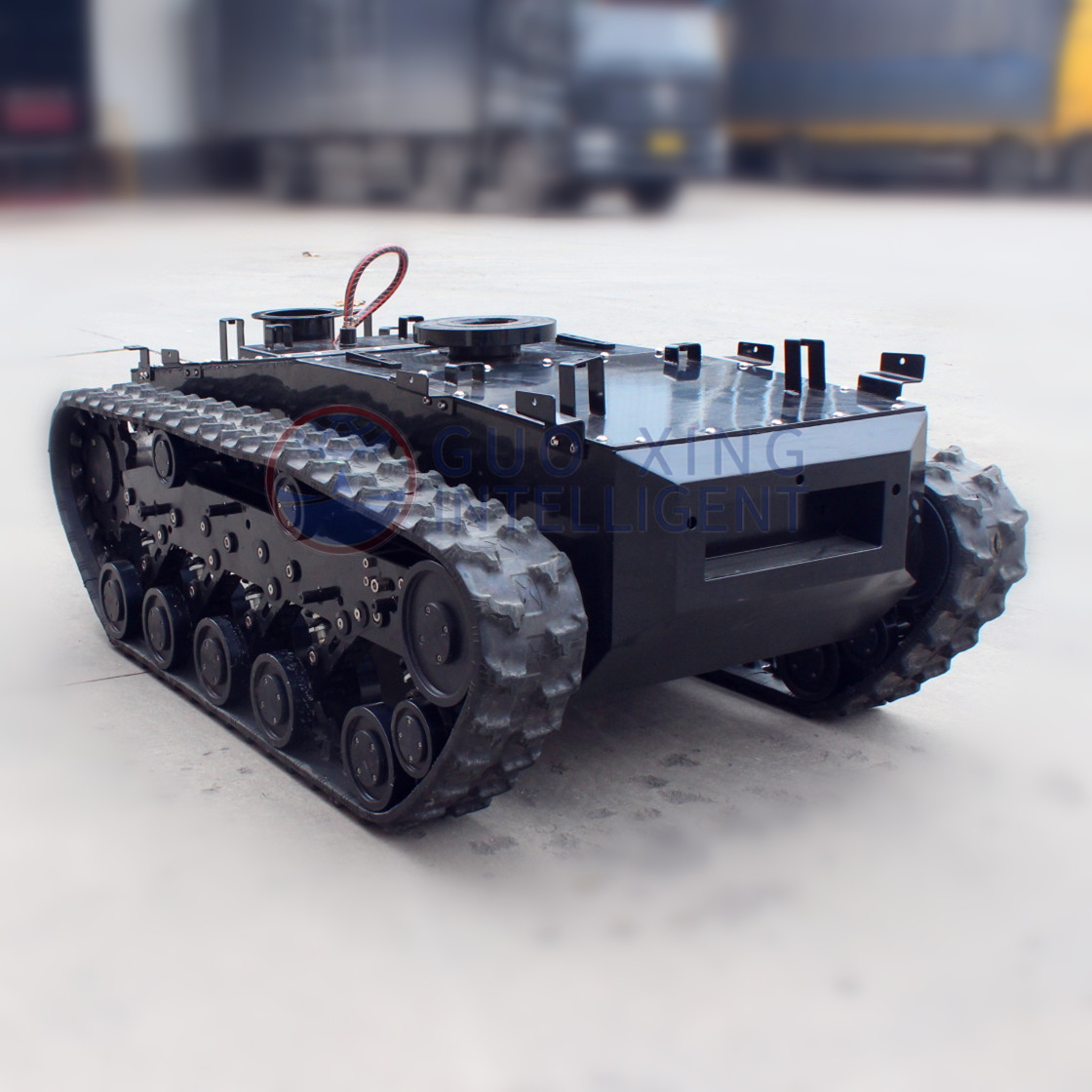
Finding a competent Robot Tank Chassis Supplier goes beyond comparing spec sheets. A reliable partner acts as an extension of your engineering team. They must provide accessible 3D CAD models. You need these STEP or IGES files to design your top-plate payloads. A professional vendor also supplies kinesthetic data for simulation environments. You should demand accurate performance curves. These documents illustrate how motors perform under thermal stress. Lack of basic documentation usually signals an amateur operation.
Many companies simply rebrand generic platforms. You must assess whether the supplier manufactures core components or merely acts as an assembler. Assemblers often struggle to control quality or guarantee long-term parts availability. Request full Bill of Materials (BOM) transparency. You need to know the exact brand of motors, drivers, and track belts. BOM transparency secures your future maintenance capabilities. If a specific driver chip goes out of stock, you need an alternative path forward.
Your R&D project will inevitably require hardware tweaks. You must evaluate the supplier's capacity to modify standard platforms. Can they adjust chassis dimensions or mounting points easily? Can they swap gear ratios for more torque? You need to request these changes without triggering prohibitive non-recurring engineering (NRE) costs. Standardized modular designs allow for rapid modifications. Excessive lead times for minor tweaks will stall your entire deployment schedule.
Industrial buyers require proof of reliability. Investigate the manufacturer's internal testing methodologies. Do they perform rigorous dynamic load testing? You should ask for tilt-angle validation reports. These reports prove the robot will not flip on specified inclines. Furthermore, relevant industrial certifications demonstrate institutional maturity. Look for CE and ISO certifications. These marks ensure the electrical and mechanical systems meet international safety standards.
| Testing Methodology | Purpose | Pass/Fail Indicator |
|---|---|---|
| Dynamic Load Testing | Simulates moving payloads | No structural deflection under max load. |
| Tilt-Angle Validation | Determines center of gravity | Maintains stability at 30+ degree inclines. |
| Thermal Stress Testing | Checks motor cooling | Operating temps stay below 85°C continuously. |
Tracked vehicles steer by skidding. This pivot turning creates immense friction against the ground. Consequently, it causes massive power consumption spikes. You must address these electrical realities early. Standard battery banks often trip their internal BMS during a pivot turn on high-friction surfaces like concrete. You must size your battery banks accordingly. Ensure your motor controllers can handle these sudden amperage draws. Neglecting this leads to spontaneous robot shutdowns during basic maneuvers.
Mechanical excellence means nothing if you cannot command the chassis. Proprietary motor drivers pose severe integration risks. Some suppliers force you into closed-loop control ecosystems. You should avoid these at all costs. Standard hardware interfaces like CAN bus and RS485 are absolutely mandatory. They offer reliable, noise-immune communication for industrial environments. Additionally, ROS and ROS2 compatibility accelerates your development. Verified ROS driver nodes allow rapid integration of advanced sensors like LiDAR and RTK GPS.
Field operations are rarely gentle. Track shedding is a harsh reality in off-road deployments. Derailment usually occurs during lateral-slope operations. Gravity pulls the heavy chassis downhill while the tracks grip the slope. You must assess the chassis for accessible mechanical tensioning systems. Quality suppliers utilize deep-groove guide wheels to keep tracks aligned. They also design tensioning bolts that operators can reach easily. Field-repairability is paramount. If a track snaps, your technicians must be able to replace it without dismantling the entire drive train.
Never commit to a volume order without a rigorous Proof of Concept. You must establish clear, indisputable pass/fail criteria for the PoC. Vague goals lead to wasted budgets. Write down exact physical requirements. For example, the chassis must traverse a 30-degree incline carrying a 50kg payload at 1 meter per second. It must perform zero-radius turns on dry asphalt without triggering overcurrent protection. Documenting these metrics holds the supplier accountable.
Begin your testing by purchasing an off-the-shelf development platform from your shortlisted vendors. Avoid requesting complex custom modifications during this initial phase. You first need to test baseline kinematics and driver reliability. Evaluate the raw build quality of the welds and the precision of the machined parts. Check if the published ROS nodes communicate flawlessly with the hardware. Once the standard platform passes your PoC metrics, you can confidently negotiate custom modifications for volume production.
The physical capabilities of your autonomous system are entirely dictated by the underlying chassis. A brilliant navigation algorithm cannot compensate for a weak drive train or derailed tracks. Selecting the right vendor requires balancing mechanical robustness against engineering transparency. You need a partner who supplies honest documentation and utilizes reliable standard protocols. We encourage engineering teams to clearly outline their non-negotiable payload, terrain, and API requirements today. Lock down these parameters before engaging manufacturers for Requests for Quotation (RFQs). This rigorous approach guarantees a successful transition from prototype to field-ready product.
A: Realistic timelines vary based on customization. You can typically expect 4 to 8 weeks for standard heavy-duty units. If you require custom dimensions, specialized gear ratios, or unique mounting patterns, lead times usually extend to 10 to 16 weeks. Always confirm raw material availability with your supplier.
A: Tracks offer superior ground pressure distribution. They excel in off-road, muddy, or high-debris environments where wheels would sink. Conversely, wheels provide higher energy efficiency and faster top speeds on flat, predictable surfaces like warehouse concrete. Choose tracks for rough terrain and wheels for flat logistics.
A: Yes, but physical integration relies entirely on the motor controller's communication protocol. You must use CAN bus or RS485. You also need to verify that the supplier provides pre-compiled driver nodes for ROS or ROS2. This ensures your navigation stack can send twist commands directly to the hardware.
A: Track shedding stems from improper tensioning and extreme lateral forces on inclines. When traversing a slope sideways, the tracks peel away from the road wheels. You can prevent this by selecting chassis with deep-groove guide wheels and robust, easily accessible mechanical tensioning systems.