
Views: 0 Author: Site Editor Publish Time: 2026-07-03 Origin: Site


In disaster response and emergency rescue operations, hardware failure is not an option. The base platform dictates the operational ceiling of the entire robotic system. System integrators and R&D teams constantly face a saturated market of robotics platforms. This overwhelming market saturation makes it difficult to distinguish between hobbyist-grade developer kits and field-ready industrial machines. Lives depend on flawless functionality when you deploy a robot into a hazardous collapsed structure. Selecting the right base requires moving far beyond basic specification sheets. You must critically evaluate hidden elements like ingress protection, payload scalability, integration frameworks, and supply chain reliability. This comprehensive guide will help you navigate these complex hardware choices. We will explore exactly why standard commercial platforms fail in extreme hazard conditions. You will learn how to compare various drive systems and assess core engineering criteria accurately. Ultimately, you will discover how to identify an ideal All-Terrain Robot Chassis Manufacturer capable of supporting your most critical emergency missions.
Commercial off-the-shelf (COTS) warehouse chassis excel in highly controlled indoor environments. However, they completely lack the ruggedized suspension required for debris negotiation outdoors. You cannot expect a flat-floor warehouse robot to manage stair climbing safely. They also struggle heavily when navigating through unpredictable collapsed structures. A severe mobility and durability gap exists between commercial and industrial applications. Standard platforms typically use basic rigid suspension designs. They bounce erratically when encountering uneven terrain or jagged concrete rubble. Rescue operations demand specialized hardware capable of absorbing massive kinetic impacts dynamically.
Standard chassis also face massive environmental vulnerabilities in the field. They frequently fail due to fine silica dust and pressurized water ingress. Fine particles quickly grind down unprotected commercial gears. Extreme temperature fluctuations also cripple their standard internal electronics. Furthermore, industrial accident zones often feature high electromagnetic interference (EMI). Standard consumer-grade shielding cannot block this invisible interference effectively. Your robot will likely lose communication abruptly during a mission. It might also suffer catastrophic sensor malfunctions during a critical search phase.
Finally, severe payload constraints expose the fundamental weakness of standard platforms. Rescue missions require heavy modular payloads for deep situational awareness. Your engineering teams will mount spinning 3D LIDAR units, heavy thermal cameras, and robotic arms. You will also add various heavy hazmat sensors to the chassis deck. Standard platforms suffer from a dangerously high center of gravity when overloaded. They become highly prone to tipping over on slight inclines. Battery drain accelerates exponentially under these heavy operational loads. You need a platform designed specifically to carry massive loads while maintaining a low center of mass.
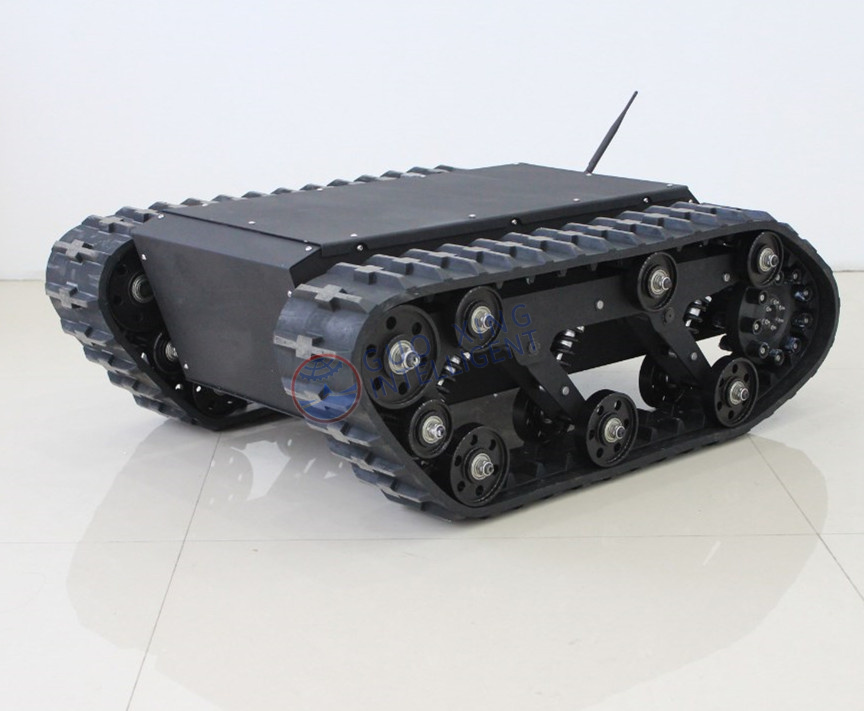
Tracked chassis systems offer superior weight distribution across soft or unstable surfaces. They provide maximum traction on loose terrain like mud, snow, and jagged rubble. Tracked designs also boast exceptional stair-climbing capabilities for complex urban search operations. Continuous tracks span wide gaps easily. However, they carry distinct operational risks. Tracked systems demand significantly higher power consumption to overcome friction. They introduce increased mechanical complexity into your overall machine build. Furthermore, aggressive lateral maneuvers can easily cause them to throw a track. This mechanical failure immediately immobilizes the entire robotic unit in the field.
Multi-wheeled systems encompass 4WD, 6WD, and 8WD configurations. They achieve much higher top speeds than their tracked counterparts. You will experience lower maintenance downtime due to simpler drivetrain mechanics. They also deliver much better energy efficiency for extended perimeter sweeps. Conversely, wheeled chassis exert high ground pressure on specific contact points. They risk high-centering on jagged debris unless they feature advanced articulated suspension. Rocker-bogie mechanisms can successfully mitigate this dangerous high-centering risk.
You must carefully match the chosen drive system to your primary mission profile. A structural collapse recovery mission strongly favors a tracked platform. Wide-area chemical leak reconnaissance better suits a high-speed multi-wheeled system. Partnering with a reliable supplier for your rescue robot chassis ensures you select the correct configuration for these demands.
| Performance Metric | Tracked Chassis | Multi-Wheeled (4WD/6WD/8WD) |
|---|---|---|
| Terrain Traction | Exceptional on loose mud, snow, and steep stairs. | Good, but requires advanced suspension for complex stairs. |
| Power Efficiency | Lower efficiency due to high friction; higher power draw. | High efficiency; ideal for extended flat perimeter sweeps. |
| Mechanical Complexity | High; severe risk of thrown tracks during pivot turns. | Moderate; elevated risk of high-centering on obstacles. |
| Weight Distribution | Excellent spread across a massive contact patch. | Concentrated ground pressure on specific tire points. |
When vetting potential manufacturing partners, you must look strictly past colorful marketing claims. You need verifiable ruggedization standards to ensure operational survival. Demand documented testing for IP67 or IP68 ingress protection. An IP67 rating ensures dust protection and temporary water immersion survival. Look for certified MIL-STD-810G shock and vibration ratings. Ensure the chassis operates effectively in extreme temperatures ranging from -20°C to +55°C. Without these certifications, you risk deploying a fragile system into a dangerous environment.
Power and thermal management directly dictate your mission longevity. Evaluate the underlying battery chemistry carefully. Lithium Iron Phosphate (LiFePO4) batteries offer excellent thermal stability in hot hazardous zones. They prevent thermal runaway better than standard Lithium-ion packs. Your chassis should support hot-swappable batteries to minimize downtime during critical shift changes. Active and passive cooling systems are absolutely essential. They protect drive motors during sustained high-torque climbing operations.
Consider the control and integration architecture thoroughly. You want a system communicating seamlessly via standard industrial languages.
Finally, assess the suspension and kinematics dynamically. Evaluate specific geometry like Christie suspension setups or independent swing arms. These advanced designs enable dynamic obstacle negotiation without throwing the robot off balance. Your expensive sensor payload relies entirely on this kinetic stability to map environments accurately.
Choosing a specific hardware development path introduces various implementation risks. You must align your choice closely with your deployment timeline and reliability needs. We categorize these paths into three distinct engineering approaches.
DIY and open-source kits serve a very specific educational purpose. They are best for initial proof-of-concept projects. Universities frequently use them for basic research and navigation algorithm testing. However, they pose massive risks for actual field deployment. They lack the rigid structural integrity necessary for real-world impact. You also receive zero liability support if a critical component fails during a rescue mission.
Standard commercial off-the-shelf platforms offer another rapid prototyping route. They work well for quick iteration. You might also deploy them in secondary logistical support roles safely. The primary risk involves strict vendor lock-in regarding proprietary replacement parts. You will also encounter extremely limited physical modification headroom. You cannot easily scale these closed systems up for heavier rescue payloads.
Purpose-built platforms and custom manufacturer partnerships provide the ultimate long-term solution. They suit massive enterprise deployment perfectly. They excel in specialized hazmat or automated firefighting applications. The risks include longer production lead times and higher upfront Non-Recurring Engineering (NRE) costs. You must mitigate these financial risks through strict service level agreements. We highly recommend robust milestone tracking during the early development phase. Finding an experienced industrial partner helps you navigate custom engineering hurdles successfully.
Procuring an industrial-grade platform requires a highly methodical approach. Follow this logical framework to shortlist your potential engineering partners effectively.
Take immediate action once you complete this initial evaluation. Contact the engineering teams of your shortlisted vendors directly. Request detailed specification sheets and comprehensive API documentation. Arrange a remote or in-person technical capability demonstration to see the platform perform in a realistic environment.
Sourcing a reliable rescue robot chassis is fundamentally an exercise in strict risk mitigation. The hardware must guarantee absolute mobility and survival in highly unpredictable zones. By securing a highly reliable physical base, developers can focus entirely on autonomous navigation. You remove the difficult mechanical guesswork from the complex engineering equation.
Prioritize a manufacturing partner acting as a transparent engineering collaborator. They should provide robust physical platforms backed entirely by open control architectures. Developer-friendly systems allow you to scale your rescue capabilities over time efficiently. Choose structural durability, demand open software integration, and equip your emergency response teams properly to save lives safely.
A: Payload requirements remain highly variable, but 30kg to 50kg serves as the typical baseline. This capacity securely supports a basic sensor suite including LIDAR and a PTZ camera. It also leaves enough capacity for onboard compute units and a lightweight manipulator arm without stressing the drive motors.
A: Reputable B2B manufacturers typically provide URDF models and basic ROS navigation nodes to accelerate your development. However, the depth of this documentation varies heavily between vendors. You should always verify the extent of their API support and request sample code before finalizing any hardware purchase.
A: You should set realistic procurement expectations immediately. Standard commercial off-the-shelf platforms typically require a 4 to 8-week lead time. Modified or fully customized builds generally demand 12 weeks or more. These specific timelines depend heavily on current supply chain variables and custom engineering requirements.
A: This presents a fundamental physics constraint. While specialized 6WD and 8WD systems featuring articulating arms can successfully negotiate stairs, tracked systems remain the absolute industry standard. Continuous tracks provide reliable, high-angle structural climbing with superior weight distribution, making them far safer for critical structural ascents.