
Views: 0 Author: Site Editor Publish Time: 2026-09-21 Origin: Site


Sourcing robotics hardware in China represents a critical transitional phase for your business. It shifts operations from costly localized prototyping to scalable, cost-efficient commercial production. Moving from small-scale assembly to high-volume manufacturing introduces a stark inherent tension in B2B procurement. You must aggressively balance unit economics against stringent technical demands. Your deployment relies heavily on hardware reliability, software interoperability, and absolute supply chain stability. Getting this balance wrong leads to delayed launches and severe integration failures.
This guide provides a pragmatic, evidence-based framework tailored for technical and procurement teams. We aim to help you objectively evaluate, shortlist, and partner with the right hardware supplier. You will discover practical methods to mitigate risks and establish clear operational baselines. We will explore drive system selection, hardware-to-software integration standards, and phased procurement strategies. You will learn exactly how to navigate international logistics and compliance. Armed with these insights, your team can transition smoothly from initial documentation reviews to successful, full-scale commercial deployments.
You must define what constitutes a successful partnership far beyond the initial purchase order. A vendor might deliver the first batch flawlessly. However, long-term operational success requires establishing strict baselines for ongoing performance. Set explicit thresholds for acceptable defect rates before signing any agreements. Demand consistent lead times across multiple production runs. Highly responsive engineering support is equally critical. When a firmware update breaks your navigation stack, you need immediate vendor assistance. Establish these performance metrics early to ensure ongoing supply chain stability.
Assess the specific trade-offs between customization and off-the-shelf platforms carefully. Standardized, field-tested platforms accelerate your time to market significantly. They eliminate upfront engineering fees. They also bypass the lengthy debugging phases typical of new designs. Commissioning custom molds and bespoke layouts increases lead times dramatically. Customization introduces entirely new points of failure into your mechanical build. Choose custom platforms only when standard configurations absolutely cannot meet your strict spatial constraints or payload requirements.
Different operational environments demand distinctly different kinematic configurations. You must align chassis specifications directly with your exact deployment environment. A mismatch here guarantees poor navigation and frequent hardware breakdowns.
Always align ground clearance, suspension type, and motor torque to your specific payload weight. Terrain constraints dictate your mechanical baseline. Ensure the chassis you select provides adequate shock absorption for delicate onboard sensors like LiDAR.
| Drive System | Ideal Environment | Key Advantages | Main Limitations |
|---|---|---|---|
| Differential Drive | Indoor Warehouses | Tight turning radius, simple control | Struggles on uneven outdoor terrain |
| Ackermann Steering | Outdoor Campuses/Streets | High-speed stability, low tire wear | Large turning radius, poor maneuverability |
| Tracked Chassis | Agriculture / Off-Road | High traction, excellent obstacle climbing | High power consumption, slow speeds |
| Mecanum Wheels | Clean Room / Manufacturing | Omnidirectional, precise positioning | Low payload, requires perfectly flat floors |
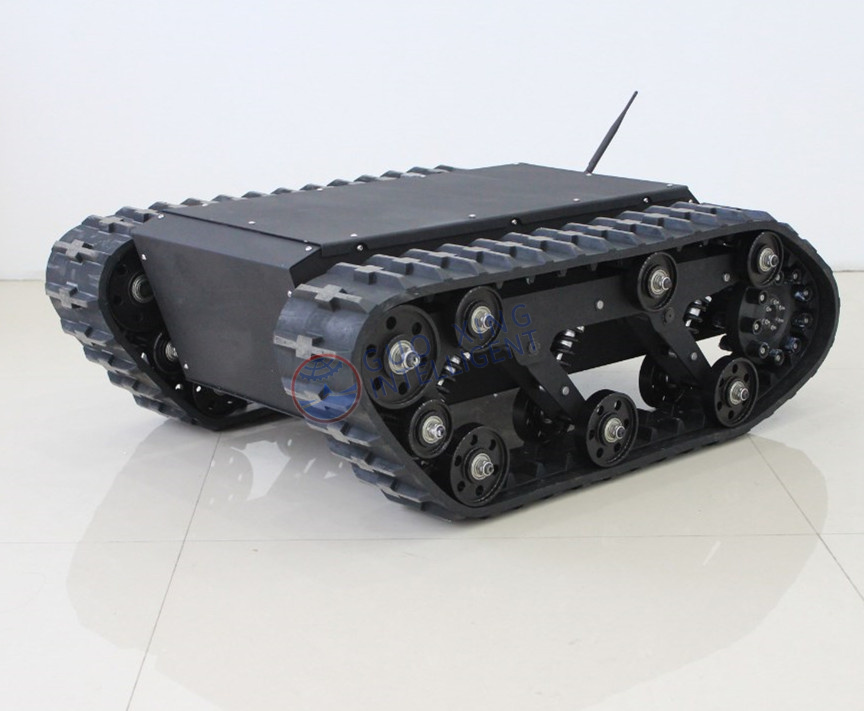
The strongest mechanical build fails rapidly without seamless software integration. Hardware-to-software interoperability remains the ultimate dealbreaker. You must rigorously assess the availability and quality of open SDKs and APIs. Check the documentation yourself before placing an order. Verify seamless integration with the Robot Operating System (ROS) or ROS2. A top-tier Robot Chassis Manufacturer in China provides comprehensive ROS driver nodes. They should also support standard communication protocols like CAN bus, RS232, and RS485. These industrial protocols are essential. You need them to reliably integrate external LiDAR modules, depth cameras, and industrial PCs.
Question potential suppliers deeply on component provenance. You need to know the exact origin of critical internal components. High-quality suppliers remain completely transparent about their sub-tier supply chains. Ask them who manufactures the internal brushless DC (BLDC) motors. Inquire about the planetary reducers and motor controllers. Component redundancy is vital. If a sub-tier motor supplier faces production halts, your primary manufacturer must have pre-approved alternative vendors ready.
Demand hard evidence of internal quality assurance and testing protocols. Do not accept simple verbal assurances. Request actual logs of their payload stress tests. Ask for continuous operation benchmarking data. A reliable supplier tests their chassis on simulated uneven terrain under maximum payload. They must provide legitimate environmental validation. If they claim an IP65 rating, ask for the third-party testing certificate proving dust and water resistance.
Export compliance introduces severe logistical hurdles. Addressing the realities of shipping high-capacity lithium batteries is paramount. Aviation and maritime regulations heavily restrict lithium battery transport. You must verify that your chosen China robot chassis supplier holds valid UN38.3 certifications. They must also provide accurate Material Safety Data Sheets (MSDS). Missing or falsified documentation guarantees immediate customs seizures. Seizures lead to mounting port storage fees and catastrophic project delays.
Navigate Minimum Order Quantities (MOQs) and lead times strategically. Discuss standard industry practices early in the negotiation. A credible manufacturer offers a clear, transparent roadmap. They allow single-unit sample purchases for your initial engineering evaluation. They should seamlessly transition you to pilot runs of 10 to 20 units. Finally, they must handle scaled production of 100+ units without imposing arbitrary bottlenecks. Beware of suppliers demanding massive upfront MOQs before you can conduct basic software testing.
Protect your intellectual property aggressively. Understand the strict limitations of standard western Non-Disclosure Agreements (NDAs). A standard NDA rarely holds legal weight overseas. Instead, utilize NNN (Non-Disclosure, Non-Use, Non-Circumvention) agreements. Structure these documents specifically for enforceability within Chinese legal jurisdictions. This prevents the factory from legally replicating your custom top-module designs and selling them to competitors.
Evaluate communication channels and technical support alignment. Complex kinematic troubleshooting demands highly responsive engineering support. Assess their time-zone overlap capabilities. Determine if their engineering team has sufficient English proficiency for deep technical debugging. If your software engineers cannot communicate directly with their firmware engineers, minor bug fixes will stretch into weeks of downtime.
Never rush the vetting process. Use a structured, objective methodology to evaluate a potential Robot Chassis Manufacturer in China. Follow this phased approach to eliminate high-risk vendors early.
| Audit Phase | Key Deliverable Required | Red Flag to Avoid |
|---|---|---|
| Documentation | Detailed API/CAN Protocol Manuals | Refusal to share docs before a deposit |
| Certification | Verifiable UN38.3 & CE/FCC marks | Blurred or expired certificate images |
| PoC Testing | Stable ROS node communication | Frequent firmware crashes under load |
| Factory Audit | Live view of active assembly lines | Only showing a small showroom floor |
Selecting a manufacturing partner represents a highly strategic operational decision. It is never just a simple procurement task. Your choice directly influences your product's reliability, your brand's reputation, and your deployment timeline. You must prioritize software openness and validate strict component quality above superficial pricing discounts. Rigorously test a single sample unit before you ever attempt to scale operations.
Take concrete steps today to structure your sourcing efforts. Finalize your exact payload, terrain, and integration requirements internally. Compile these technical constraints into a formal Request for Quotation (RFQ). Use the evaluation dimensions outlined above to filter responses aggressively. By demanding clear documentation, validating export compliance, and securing enforceable NNN agreements, you ensure a highly resilient, long-term manufacturing partnership.
A: Yes, leading suppliers provide out-of-the-box ROS/ROS2 support and open communication protocols (CAN/Serial). However, you must explicitly verify this capability by requesting and reviewing their technical documentation before making any purchase.
A: For standard, off-the-shelf configurations, sample lead times typically range from 7 to 15 days. If you require custom modifications to the payload deck or motor configurations, expect lead times to extend to 30-45 days.
A: Ensure the supplier provides valid UN38.3 test reports and an accurate MSDS. You must work closely with freight forwarders who are highly experienced in transporting DG (Dangerous Goods) cargo to avoid severe customs delays.
A: Most reputable B2B manufacturers allow single-unit purchases specifically for R&D and PoC testing. Be aware that single-unit pricing will inherently be higher than standardized volume production rates.