
Views: 0 Author: Site Editor Publish Time: 2026-08-09 Origin: Site


Selecting the right robot chassis supplier is a critical inflection point. It directly dictates your project's overall time-to-market. It also impacts your integration overhead and ultimate field reliability. Mismatched chassis capabilities and application requirements cause costly engineering rework. You might encounter severe payload limits, mismatched drive systems, or software stack incompatibilities. These hardware issues inevitably delay your commercial deployment.
This guide provides a systematic, bottom-of-funnel evaluation framework. You will learn how to evaluate vendors comprehensively. We carefully assess technical specifications, manufacturing capabilities, and integration support. You can avoid costly hardware mismatches by applying these targeted criteria. We designed this framework to help you navigate vendor discussions confidently. You will secure a reliable platform tailored perfectly to your robotics application.
Establish strict baseline limits for your static and dynamic load capacity. Static load refers to the maximum weight the chassis holds while completely stationary. Dynamic load accounts for acceleration, braking, and turning forces. These operational forces stress the structural frame heavily. You must calculate these forces accurately to prevent structural failure.
Next, map the operating terrain to your drive system requirements. Indoor flat surfaces allow for simple wheeled configurations. Facilities utilizing tight warehouse aisles benefit greatly from omnidirectional kinematics. Conversely, rugged outdoor environments demand aggressive suspension mechanisms. Define your power consumption thresholds early in the design phase. Consider your internal battery housing constraints carefully. Your chassis must accommodate enough battery cells to meet continuous runtime targets.
Differentiate between buying off-the-shelf development kits and sourcing modular platforms. Makers and agile R&D teams often use off-the-shelf kits. These accessible kits validate software algorithms rapidly. However, fleet deployment requires commercial-grade platforms. Commercial platforms offer superior durability and predictable lifecycle management.
Establish the compliance and safety certifications required for your target market. You must verify CE, FCC, or ISO compliance early. Failing to secure these critical certifications blocks your market entry entirely. Choose vendors who already build compliant hardware architecture. This proactive approach saves your engineering team months of regulatory redesign.
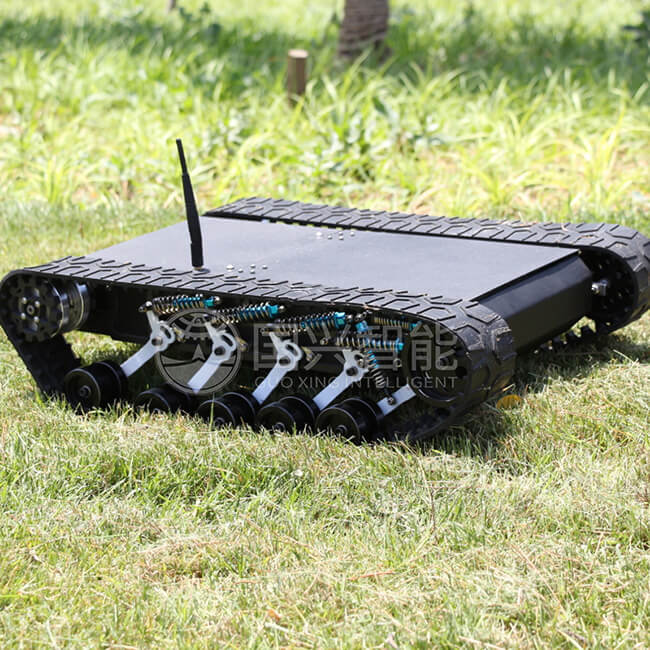
Assess the supplier’s expertise regarding structural integrity. Custom sheet metal fabrication offers excellent rigidity for heavy payloads. Lightweight materials like aluminum alloys reduce unnecessary power drain. Ensure the manufacturer integrates effective vibration dampening. Persistent vibration ruins sensor data and damages fragile compute modules over time.
Verify the availability of standardized mounting grids. Check for accessible peripheral expansion ports across the top plate. Modular rails let you mount LiDAR, cameras, and robotic arms quickly. A well-designed chassis allows your hardware team to iterate payload configurations seamlessly. They will not need custom-machined adapter plates for every new sensor.
Compare specific motor specifications carefully. Brushless DC motors provide excellent longevity and require zero maintenance. Servo motors deliver unmatched positional accuracy for precision tasks. Evaluate encoder precision closely during your vendor review. High-resolution encoders ensure accurate odometry data for your navigation stack.
Evaluate suspension mechanisms based on terrain absorption requirements. Independent suspension systems keep all wheels grounded over rough obstacles. Rigid axles bounce over uneven terrain, causing severe sensor jitter.
| Drive System Type | Primary Terrain | Maneuverability Level | Ideal Application |
|---|---|---|---|
| Differential Wheeled | Flat / Indoor | Moderate (Zero-turn) | Warehouse Logistics |
| Mecanum / Omni | Smooth / Clean floors | High (Holonomic) | Tight Space Assembly |
| Tracked / Tread | Uneven / Outdoor | Moderate (Skid steer) | Agriculture / Tactical |
Check for out-of-the-box compatibility utilizing standard control protocols. You need robust CAN bus or UART communication capabilities. Require transparent API documentation before signing any purchase order. The vendor must provide easily accessible SDKs for your development team.
Ask for native ROS or ROS2 nodes. These ready-made nodes minimize software engineering friction significantly. Your software engineers should focus on autonomous navigation algorithms. They should not waste weeks writing basic motor driver scripts. Proper software support accelerates your time-to-market dramatically.
Identify specific use cases demanding extremely high traction. Tracked systems excel at obstacle climbing and stair navigation. They maintain exceptionally low ground pressure by distributing weight broadly. Agriculture, infrastructure inspection, and tactical applications rely heavily on these traits. Deep mud, loose snow, and steep stairs trap wheeled robots easily.
When conducting a Robot Chassis Suppliers,tracked robot chassis supplier comparison, you must prioritize different performance metrics. Evaluate track material composition carefully. Rubber tracks offer surprisingly quiet operation indoors and protect facility floors. Composite or steel tracks survive harsh outdoor environments easily. Track tensioning systems and overall ground clearance dictate true mobility.
Evaluate how the supplier handles track derailment prevention. A thrown track paralyzes your autonomous robot immediately in the field. Good suppliers design robust guide wheels and active tensioners. Consider routine maintenance accessibility closely. Ask if you can replace a broken track section directly in the field.
Assess the trade-offs between maneuverability speed and raw torque. High-torque gearboxes conquer steep inclines effortlessly. However, they sacrifice top-end travel speed. You must balance these mechanical traits against your specific operational requirements. Discuss these exact trade-offs openly during vendor capability interviews.
Prioritize OEM or ODM manufacturers whenever possible. Seek partners operating in-house CNC machining centers. They should own dedicated quality testing facilities. Pure white-label assemblers introduce severe quality control risks. They lack direct oversight of component fabrication processes.
In-house manufacturing facilities guarantee tighter mechanical tolerances. They also allow for substantially faster prototype iterations. You can request custom mounting hole modifications swiftly. An assembler must outsource this request, delaying your timeline by weeks.
Scrutinize the supplier's reliance on secondary component markets. Motor or specialized motor driver shortages paralyze entire assembly lines rapidly. Reliable Robot Chassis Suppliers maintain strategic buffer stock for critical electronics. They proactively manage global supply chain volatility.
Verify realistic lead times for your initial sample delivery. You must also forecast timelines for high-volume production runs. Ask about their maximum monthly output capacity. A vendor excelling at single prototypes might completely fail at producing hundreds monthly.
Highlight the hidden engineering hours lost to undocumented software APIs. Mismatched wiring diagrams frustrate electrical developers endlessly. Language-barrier support issues delay critical hardware troubleshooting processes. Your engineers require clear, highly accurate operational manuals.
Poor documentation forces them to reverse-engineer basic kinematic functions. This severely drains your engineering budget. Prioritize vendors offering comprehensive, English-language developer wikis. Active community forums also indicate a healthy, supportive vendor ecosystem.
Define clear expectations for hardware RMA processes early. Return Merchandise Authorization workflows must remain straightforward and transparent. Assess the reliable availability of essential spare parts. You will definitely need replacement belts, wheels, and motor drivers.
Ensure parts remain available over a standard 3-5 year lifecycle. Factor in complex international shipping logistics carefully. Import duties and customs delays add friction if evaluating overseas suppliers. Consider the average turnaround time for shipping replacement compute modules.
Request detailed technical drawings immediately. You absolutely need CAD step files to plan your internal payload layouts. Ask for accurate payload versus battery life degradation curves. Request verifiable case studies matching your specific industry vertical.
We recommend including the following items in your RFI package:
Below is a simple scoring chart you can use to evaluate vendor RFI responses:
| Evaluation Category | Critical Requirements | Scoring Weight |
|---|---|---|
| Hardware Quality | CNC Machining, Payload Capacity, Material Strength | 30% |
| Software Support | ROS/ROS2 Nodes, API Documentation, SDK Access | 35% |
| Manufacturing Scalability | In-house production, Lead times, Monthly capacity | 20% |
| Vendor Support | RMA policy, English support, Spare parts availability | 15% |
Never commit to large bulk orders without completing a Proof of Concept. Establish strict, measurable acceptance criteria for your sample unit. The sample chassis must survive rigorous, real-world testing environments.
Follow these structured steps during your sample evaluation:
Document every failure point meticulously. Share this detailed feedback directly with the supplier's engineering team. Their response speed indicates their future support reliability.
Sourcing the right chassis is an exercise in strict risk mitigation. A truly reliable partner offers much more than welded metal. They provide a documented, highly scalable foundation for your robotics stack. Weigh their structural customizability and software support heavily. These factors matter just as much as the baseline unit price.
Establish your kinematic constraints and payload limits accurately before contacting vendors. Utilize our shortlisting framework to filter out pure assembly-only workshops. Prioritize manufacturers offering native software nodes and robust documentation.
Contact our engineering team directly for a tailored technical consultation. Request a detailed spec sheet today. See exactly how our advanced chassis solutions align seamlessly with your project’s complex integration requirements.
A: Off-the-shelf units usually ship within 7 to 14 days. Custom structural modifications or specific motor configurations extend lead times to 4 or 6 weeks. International ocean freight adds roughly 30 days, while air freight takes about one week. Always ask vendors about their current component buffer stock.
A: Look closely for officially published URDF files. Search for open-source driver repositories hosted publicly on GitHub. Check if the vendor provides detailed ROS2 launch files. Active developer community forums also strongly indicate reliable, ongoing software compatibility.
A: Beginner kits use fragile acrylic parts and lack high-resolution motor encoders. Their payload capacity rarely exceeds 5 kilograms. Industrial chassis utilize rugged sheet metal or aluminum. They feature precision servo motors, high-capacity battery housings, and support payloads exceeding 100 kilograms easily.
A: Choose a tracked chassis for outdoor, uneven terrain requiring high traction and obstacle climbing. Tracks navigate mud and stairs easily. Conversely, choose a mecanum chassis strictly for indoor, flat-floor applications. Mecanum wheels allow omnidirectional movement, perfect for tight warehouse aisles.