
Views: 0 Author: Site Editor Publish Time: 2026-08-21 Origin: Site


Procuring firefighting robotics is a high-stakes, life-safety investment. Hardware failure in the field is simply catastrophic. Fire departments and industrial safety teams face intense pressure to modernize operations. However, choosing the wrong equipment jeopardizes lives and critical infrastructure.
The market currently floods buyers with new entrants. Many companies simply repurpose standard industrial chassis. These retrofitted units inevitably fail under extreme thermal radiation, toxic smoke, and uneven disaster terrain. You need equipment built explicitly to survive infernos. Understanding the subtle differences between purpose-built machines and generic warehouse bots is essential.
Selecting a legitimate Firefighting Robot Manufacturer requires deep technical scrutiny. You must look past glossy spec sheets. Instead, evaluate their engineering rigor, system integration capabilities, certification transparency, and post-deployment support. We will guide you through this critical evaluation process so you can make an informed, safe decision.
Modern incident response relies heavily on remote technology. You must accurately assess your operational needs before buying hardware. Understanding these requirements prevents critical capability gaps during active emergencies.
You must differentiate between scouting needs and heavy-duty suppression needs. Reconnaissance missions require nimble platforms. They carry toxic gas detectors, thermal cameras, and environmental mapping software. Their primary goal is situational awareness.
Conversely, suppression missions demand heavy-duty platforms. These machines deliver high-flow water or foam directly into the combustion zone. They require immense torque to drag charged hoses. Trying to use a lightweight reconnaissance bot for heavy suppression always ends in failure. You must define your primary tactical objective first.
Choosing an unverified manufacturer introduces severe operational risks. Bad procurement leads to catastrophic field failures. We often see sensor blindness occur when standard cameras enter dense smoke. Operators lose visual feedback instantly.
Physical degradation is another major risk. Cheap tracks melt rapidly under flashover conditions. Poorly insulated wiring harnesses fail, causing complete communication loss during critical operations. When command loses control of a robot inside a burning structure, the machine becomes an obstacle rather than an asset.
Beware of suppliers offering standard warehouse Automated Guided Vehicles (AGVs) retrofitted for emergencies. Painting a factory bot red and applying fire-retardant paint does not make it a rescue vehicle.
Common Mistake: Buying units without dedicated cooling systems. Purpose-built platforms utilize self-protection water curtain systems to lower their own chassis temperature. Retrofitted AGVs lack these vital survival mechanisms. Always demand purpose-built, hazardous-environment engineering.
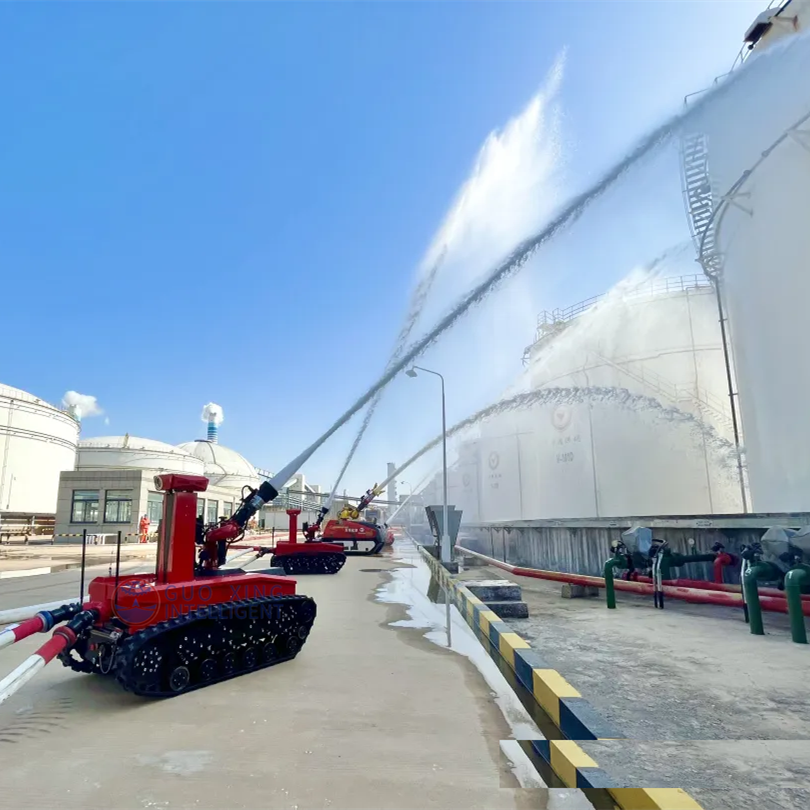
Evaluating hardware requires strict adherence to engineering standards. You must scrutinize materials, software fail-safes, and regulatory compliance.
Start by evaluating specific construction materials. Aerospace-grade aluminum and specialized steel alloys provide necessary thermal resistance. Check the Ingress Protection (IP) ratings carefully. The chassis must boast IP67 or higher waterproofing to survive continuous exposure to high-pressure monitor spray.
Next, assess towing capacity and payload limits. Dragging a heavy, water-filled hose across debris demands tremendous continuous torque. If the powertrain stalls under the weight of a charged 2.5-inch line, the robot is tactically useless.
Demand transparent data on continuous operational endurance under peak load. Compare battery arrays against internal combustion engines based on your expected deployment times.
| Power System | Endurance | Payload Torque | Best Use Case |
|---|---|---|---|
| High-Capacity Lithium Battery | 2 - 4 hours | Moderate to High | Municipal response, enclosed spaces, zero emissions. |
| Diesel Engine | 8+ hours | Extremely High | Large petrochemical fires, continuous pumping. |
| Hybrid (Gas/Electric) | 6 - 8 hours | High | Versatile deployments requiring long standby times. |
Standard optical sensors fail entirely in thick smoke. This represents an industry-wide challenge. Look for manufacturers utilizing advanced multi-sensor fusion. This blends thermal imaging, millimeter-wave radar, and specialized LiDAR. Thermal imaging detects heat signatures. Radar penetrates thick smoke. LiDAR maps the physical geometry of the room.
Evaluate the remote control modules rigorously. Test both line-of-sight (LOS) and non-line-of-sight (NLOS) ranges. Urban environments feature thick concrete walls. These structures severely degrade radio signals. Your equipment must include signal fail-safes. If the robot loses connection, it should automatically halt and initiate a self-cooling protocol.
Never deploy uncertified equipment in explosive environments. Chemical and petrochemical deployments necessitate recognized explosion-proof certifications. Look for ATEX Zone 1 or Zone 2 compliance. These ratings guarantee the machine will not act as an ignition source in vapor-rich atmospheres.
Cross-reference all claimed specifications against authoritative mechanical engineering standards. For instance, check if the pressure vessels and hydraulic systems comply with ASME guidelines. Manufacturers who readily share their compliance documentation operate with higher integrity.
Robots do not operate in a vacuum. They must plug seamlessly into your existing tactical ecosystem. A standalone machine creates logistical nightmares during an emergency.
Partnering with a reliable firefighting robot supplier ensures smooth integration. Their units must connect flawlessly with your standard municipal or industrial water couplings. Whether your department uses Storz couplings or threaded connections, the robot's manifold must match. Custom adapters often leak under high pressure. Standardized hose connections are non-negotiable.
Evaluate if the manufacturer allows interchangeable payloads. Modular designs offer far greater tactical flexibility. Common interchangeable modules include:
Modern incident commanders rely on data. Assess how the robot transmits telemetry back to the command post. The interface should stream heat maps, gas readings, and video feeds directly into existing incident command software. Furthermore, if you plan to scale, ensure the software supports multi-robot fleet management. Coordinating multiple units prevents them from spraying each other or crossing paths.
Hardware represents only half the equation. Successful robotic adoption relies heavily on human factors and ongoing support.
Even the best hardware fails if human operators cannot confidently maneuver it under stress. Navigating a machine via a 2D screen while managing water pressure is incredibly complex. Evaluate the manufacturer's training programs.
Best Practice: Ask if the vendor provides virtual simulators. Simulators allow operators to practice driving, aiming monitors, and interpreting sensor data safely. Consistent simulation training builds vital muscle memory before an actual alarm sounds.
Firefighting degrades hardware rapidly. Water, heat, debris, and foam compounds all attack mechanical components. Detail the importance of accessible replacement parts. Your internal mechanics should be able to perform modular repairs quickly.
Examine the supplier's domestic SLA response times. If a track snaps, you cannot wait three months for an overseas shipment. A dependable partner guarantees swift parts delivery and provides comprehensive maintenance manuals.
Acknowledge reality: robots do not replace firefighters. They change tactical deployment strategies. They handle the highest-risk zones so humans can focus on rescue and command. The manufacturer should provide realistic use-case limitations rather than claiming a "silver bullet" solution. Avoid vendors who promise full autonomy; current technology still requires human judgment for suppression tactics.
Filtering out subpar vendors requires a structured procurement approach. Follow these three steps to guarantee you select a qualified engineering partner.
Never rely solely on marketing brochures. Ask for actual deployment data from high-risk sectors. Request case studies from petrochemical plants, nuclear facilities, or municipal hazmat teams. Ask for references and speak directly with the chiefs or safety officers who actively use the equipment. Discover how the machines performed during actual alarms, not just in controlled tests.
Construct a rigorous Request for Proposal (RFP). Provide a strict checklist of required technical disclosures. Demand specific numbers regarding:
Vendors who hesitate to provide this raw engineering data typically hide inferior build quality.
Never buy emergency hardware based off a video. Video demonstrations are highly choreographed. Require a live field test in a simulated disaster environment.
Make the robot work hard. Force it to navigate concrete debris while pulling a fully charged hose. Test the remote signal penetration by driving the unit behind thick concrete walls. Observe how it handles staircases and steep inclines. Only a live, demanding demonstration reveals the true capabilities of the chassis and control links.
Partnering with a legitimate robotics manufacturer is a long-term operational commitment. It is never a simple, one-off hardware purchase. Your chosen vendor becomes an integral part of your safety infrastructure.
You must prioritize vendors offering verifiable safety certs, proven integration capabilities, and transparent limitations. Those competing solely on low prices inevitably cut corners on thermal shielding and sensor redundancy. When deploying equipment into a burning refinery, cheap hardware costs lives.
Take action today to protect your personnel. Download a comprehensive vendor evaluation checklist. Contact your internal engineering and tactical teams for a thorough feasibility consultation before issuing your next RFP.
A: A reputable vendor must provide verified Ingress Protection (IP) ratings, typically IP67 or higher, ensuring complete waterproofing. For hazardous deployments, demand EX or ATEX explosion-proof certifications, guaranteeing the machine will not ignite flammable gases. Additionally, verify compliance with ISO manufacturing standards and relevant ASME mechanical engineering guidelines to ensure structural integrity.
A: Payload requirements vary significantly based on tactical needs. A machine must generate enough torque to drag several hundred feet of charged (water-filled) hoses. Industrial units often need towing capacities exceeding 500 kilograms to manage large-diameter hoses, heavy water monitors, and high-pressure suppression systems simultaneously over debris-covered terrain.
A: Standard optical cameras fail completely in dense smoke. To navigate safely, advanced platforms utilize multi-sensor fusion. They combine thermal imaging to detect heat sources, millimeter-wave radar to penetrate thick particulate smoke, and specialized LiDAR to map room geometry. This combination allows operators to maneuver safely when visual feedback is impossible.
A: Maintenance must happen immediately after every deployment. Post-mission schedules include rigorous cleaning to remove corrosive foam and ash. Technicians must perform precise track tensioning and inspect the self-cooling nozzle systems. Additionally, routine battery health checks and communication system diagnostics are required monthly to ensure instant readiness for the next alarm.