
Views: 0 Author: Site Editor Publish Time: 2026-09-03 Origin: Site


High-risk industrial and municipal fire departments are increasingly shifting from manual hazard containment to autonomous and remote-controlled robotic intervention. They make this shift to significantly reduce human casualty rates during extreme hazard exposure. The rapid maturation of Chinese industrial robotics has created a dense market of options. These options balance advanced sensor architectures alongside aggressive manufacturing efficiencies. Procurement teams face a difficult challenge when evaluating vendors today. You must distinguish between commercially viable, field-tested equipment and unverified prototypes disguised as robust tools. Not all manufacturers produce at an industrial or compliance-ready grade. Selecting the right Firefighting Robot Manufacturer in China requires a rigorous evaluation process. You must verify engineering tolerances, analyze empirical deployment data, and demand long-term ecosystem support. We will guide you through establishing strict success criteria for your procurement journey. You will learn how to evaluate chassis mobility, assess sensor architecture, and structure a robust request for proposal.
The global firefighting robotics market is expanding rapidly. Chinese manufacturing uniquely blends rapid research and development cycles with localized supply chain advantages. Robotics engineers iterate on designs much faster today. They leverage dense supply networks for high-torque motors, lithium-ion battery arrays, and advanced sensor modules. This rapid pace drives highly competitive growth in the industrial hazard sector. However, this speed also introduces notable procurement risks.
Buyers frequently encounter a severe sourcing dilemma. Quality variance across different factories remains incredibly high. Some vendors take white-labeled, consumer-grade components and repurpose them for industrial hazard zones. These machines might look formidable under showroom lights. Yet, they routinely fail under intense thermal radiation or chemical exposure. Your team must differentiate between genuine engineering firms and opportunistic assemblers.
To navigate this landscape, you must establish strict success criteria early. A successful procurement goes far beyond securing a functioning machine. It requires seamless integration into your existing dispatch systems. The equipment must deliver a verifiable reduction in first-responder hazard exposure. Partnering with a proven China firefighting robot supplier means demanding equipment built specifically for disaster zones, not retrofitted commercial toys.
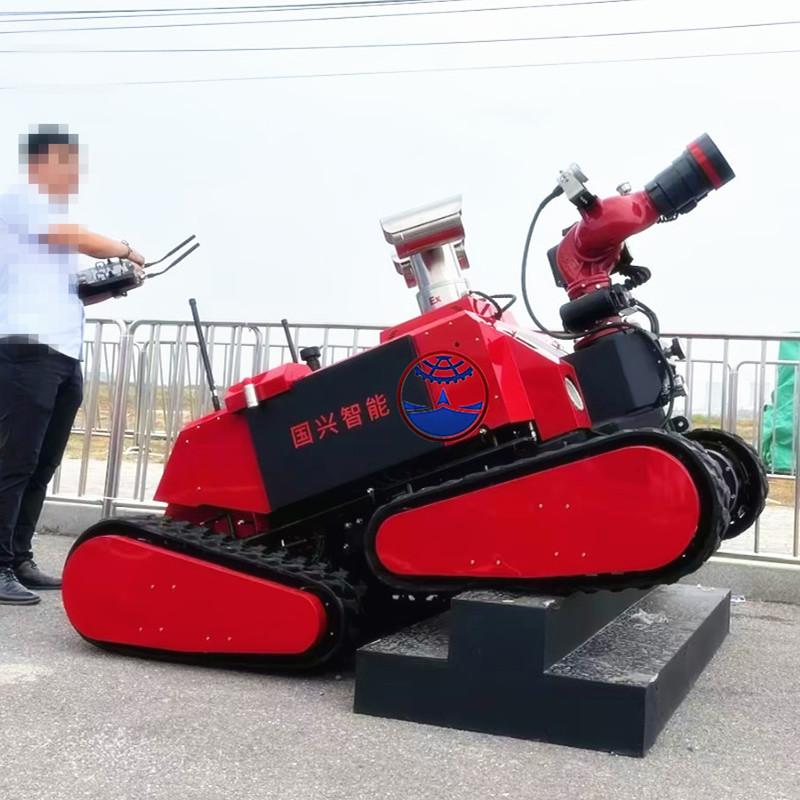
You cannot compromise on foundational engineering. Heavy industrial fires create chaotic, unpredictable environments. Your equipment must conquer physical obstacles, withstand extreme heat, and deliver massive suppression force.
Evaluating chassis design is your first operational hurdle. You will typically choose between tracked and wheeled architectures. Wheeled designs offer speed on flat, paved surfaces. Tracked designs dominate debris-heavy, uneven terrain. You must ask vendors specific questions regarding slope-climbing capacity. Verify their stair traversal metrics. Analyze how payload weight distribution affects the robot in muddy or debris-laden environments.
| Chassis Type | Best Use Case | Obstacle Clearance | Speed & Agility |
|---|---|---|---|
| Tracked (Rubber/Steel) | Petrochemical plants, collapsed structures, forests. | Excellent. Can traverse stairs and high debris. | Moderate. High torque but lower top speed. |
| Wheeled (Pneumatic/Solid) | Municipal roads, flat warehouses, airports. | Limited. Struggles with high curbs and deep mud. | High. Faster deployment over paved distances. |
Marketing brochures often exaggerate heat-shielding capabilities. You must assess thermal durability through hard data. Look for specific continuous operating temperatures. Many high-end units feature internal cooling mechanisms. A water-curtain self-protection system is a non-negotiable feature for close-range containment. This system sprays a continuous halo of water over the chassis. It prevents sensitive internal electronics from melting. Additionally, demand rigorous IP ratings. The machine needs an IP67 or IP68 rating to survive deep water pools and chemical ingress.
A mobile chassis is useless without effective suppression power. Evaluate the integration of the mounted monitors and cannons. Require empirical data on water and foam discharge rates, usually measured in liters per second (L/s). Standard industrial models should output between 80 L/s and 120 L/s. Examine the effective operational range and trajectory angles. Crucially, ask about recoil stabilization mechanics. High-pressure water jets generate immense backward force. The chassis must automatically anchor itself to prevent flipping.
Modern firefighting is data-driven. The robot acts as your eyes, ears, and primary sensor array in zones completely hostile to human life.
Assess the maturity of the onboard sensor suite. Standard optical cameras fail immediately in zero-visibility smoke. You need robust thermal imaging (infrared) to locate fire cores. LiDAR integration is becoming mandatory for advanced units. LiDAR helps the robot map enclosed environments and avoid obstacles autonomously. Evaluate how well the robot navigates when visual data drops to zero.
Signal loss is a critical vulnerability. Concrete walls, steel bulkheads, and dense smoke severely degrade wireless signals. Standard 2.4GHz connections will fail in complex industrial plants. Look for sub-GHz radio frequencies or mesh networking solutions. They penetrate structures much more effectively. Furthermore, you must evaluate built-in fail-safes. If the control connection drops entirely, the robot must initiate an auto-return function or safely power down its water cannon.
Your incident commanders need actionable intelligence. The robotic system should output real-time environmental data back to your base station. This includes basic telemetry, motor temperatures, and camera feeds. More importantly, it should transmit toxic gas concentrations. Sensors detecting hydrogen sulfide, carbon monoxide, and explosive gases are vital. Verify if this data easily integrates into your existing command-and-control software.
Theoretical capabilities mean nothing without rigorous validation. You must demand authoritative proof of performance from any vendor you evaluate.
Identify the essential national and international certifications relevant to your region. Do not accept vague assertions of safety. Look for ISO 9001 quality management standards. If you operate in Europe, CE marks are mandatory. For petrochemical applications, explosion-proof certifications (such as ATEX or regional EX standards) are absolute prerequisites. The robot cannot be the source of a secondary spark.
Buyers must demand raw test logs over glossy marketing brochures. Brochures show the robot in ideal conditions. You need to see how it performs when things go wrong. Request unedited video logs of blast-proof testing or extreme thermal trials. Third-party validation carries immense weight here. If a recognized national testing laboratory validated the equipment, you can trust the performance claims far more easily.
Examine the manufacturer’s past deployments carefully. You want to see precise pain-point resolution. Did they deploy a fleet of units during a major chemical facility fire? How did the robots perform during a 12-hour continuous operation? Discard theoretical applications. Look for case studies showing real-world stress, equipment damage, and successful hazard containment.
Procuring the hardware is only the first step. The operational reality of deploying robotics requires deep manufacturer support.
Adoption carries hidden operational friction. Your human operators need comprehensive training to drive these machines under pressure. Does the manufacturer provide structured operator training programs? Check if they supply detailed Standard Operating Procedure (SOP) documentation. The best vendors offer digital simulation software. Simulators allow your team to practice driving and suppression tactics safely before touching the physical machine.
Industrial robots take heavy abuse. Tracks degrade from chemical spills. Sensors require frequent recalibration after intense heat exposure. You must assess the longevity of the vendor partnership. Evaluate their Service Level Agreement (SLA) frameworks rigorously. Look for transparent warranty terms. Check if they have a regional service network or rely entirely on overseas shipping. You must demand guaranteed lead times for critical replacement parts. A robot sitting idle for three months awaiting a new motor is a massive liability.
Consider your long-term fleet requirements. Can the manufacturer handle phased rollouts? A vendor might build one excellent prototype but struggle to deliver ten identical units. Evaluate their actual factory production capacity. You need a partner capable of supporting single-unit trial orders and subsequent fleet-level procurement seamlessly.
You need a structured method to eliminate weak candidates quickly and formalize your procurement demands.
Use a quick-reference checklist to drop unqualified vendors immediately. Strike them from your list if they show any of the following red flags:
Your RFP must be uncompromising. Demand specific engineering tolerances. Follow this structure when drafting your requirements:
Never sign a final contract based on paperwork alone. A localized trial or live-fire demonstration is a mandatory final step. Bring the unit to your facility. Test the remote control latency through your actual concrete walls. Verify the water curtain effectively deploys. A physical PoC reveals manufacturing flaws instantly. It ensures the equipment matches the precise operational demands of your first responders.
Sourcing complex hazard-response machinery requires moving past superficial spec sheets. You must demand rigorous, empirical proof of performance and reliability from your chosen partners. The landscape of Chinese manufacturing offers incredible engineering advantages, provided you apply a strict evaluation matrix. Focus heavily on chassis durability, thermal resilience, and advanced sensor architecture.
The right manufacturing partner balances structural robustness with uncompromising safety standards. They also deliver the long-term operational support necessary to keep fleets functional. Superficial capabilities fail when exposed to real disaster conditions. Prioritize validated testing and specialized deployment history above all else.
Take action immediately by integrating these specific engineering baselines into your next procurement cycle. Prompt your safety engineers to utilize our outlined elimination matrix. By demanding a stringent Proof of Concept, your department will secure a robotic asset that genuinely protects human lives on the front lines.
A: Standard models usually require 4 to 6 weeks for production and testing. Custom integrations, such as specific gas sensors or localized communication frequencies, add 2 to 4 weeks. You must also account for shipping logistics. Ocean freight typically takes 3 to 5 weeks, plus additional time for customs clearance at your destination port.
A: Request the original certification documents directly from the vendor. Do not accept screenshots. Cross-reference the certificate numbers directly with the issuing bodies, such as ISO or standard CE testing laboratories. Always look for universally recognized industrial standards, like ATEX for explosion-proofing, rather than obscure local equivalents.
A: Yes, top-tier manufacturers design their systems with integration in mind. They often utilize open APIs and standard transmission protocols for video and telemetry data. However, you must verify software interoperability early. We strongly recommend testing the data handshake between the robot and your specific legacy dispatch software during the Proof of Concept phase.
A: The most common hardware failures involve track degradation from harsh chemical exposure and debris damage. Thermal cameras and gas sensors also require frequent recalibration after intense heat. The biggest operational risk is lacking a guaranteed spare-part pipeline. You must secure firm Service Level Agreements to ensure motors and batteries arrive quickly when replacements are needed.