
Views: 0 Author: Site Editor Publish Time: 2026-02-06 Origin: Site


Tracked robot chassis are revolutionizing the way robots navigate difficult terrains. Unlike wheeled systems, their continuous tracks provide unmatched stability and traction.
In this article, we will explore the role of tracked robot chassis, focusing on their stability, versatility, and key applications. You'll learn how these chassis excel in various industries, including military, agriculture, and search and rescue.
Tracked robot chassis are designed for robust and reliable movement over difficult terrains. The most prominent feature is the continuous track system, which provides superior traction compared to wheels, especially on rough or uneven surfaces. The tracks, made of durable materials like rubber, metal, or composites, spread the robot's weight evenly, helping it maintain balance and avoid tipping over. This is crucial for tasks that require stability, such as search and rescue missions or industrial inspections.
● Rubber: Ideal for smooth, indoor environments with lower wear and tear.
● Metal: Provides greater durability for rugged and heavy-duty tasks.
● Composites: Lightweight, high-strength material, used in advanced designs for specific applications.
While wheeled robots are faster and more energy-efficient on smooth, flat surfaces, tracked chassis excel in more demanding environments. The ability of tracked robots to distribute their weight across a broader surface area allows them to navigate through mud, gravel, snow, and rocky terrain, offering advantages over wheeled robots in complex environments. Tracked robots also demonstrate enhanced stability and traction, which are critical for operations in rough, unpredictable conditions.
Feature | Tracked Robot Chassis | Wheeled Robot Chassis |
Terrain Adaptability | Excellent for rough and uneven terrain | Best on flat surfaces |
Speed | Lower speed, but more stable | Higher speed |
Traction | Superior in muddy, snow, gravel | Limited in soft or uneven terrain |
Energy Efficiency | Generally lower efficiency | More energy-efficient on flat surfaces |
The mechanism driving tracked robot chassis typically includes high-torque DC motors and robust suspension systems designed to absorb shock and maintain stability. The tracks can rotate independently, allowing for greater maneuverability and precision. This drive system enables tracked robots to pivot in place or perform sharp turns, which are essential for tasks that require agility in confined spaces or when navigating obstacles.
One of the primary advantages of tracked robot chassis is their ability to maintain stability on uneven and rugged terrain. This feature is crucial for operations in environments where surfaces are often unpredictable, such as agriculture, mining, and military reconnaissance. The tracks of the chassis evenly distribute the robot's weight across a larger surface area, providing superior stability on challenging surfaces like slopes, gravel, mud, and snow. This enhanced stability helps prevent tipping, a common issue that wheeled robots struggle with when navigating rough terrains. For instance, in agricultural fields, a tracked robot can easily move over soft soil or uneven land without losing its balance, making it more efficient for tasks like crop monitoring or soil analysis.
The stability provided by tracked robot chassis makes them ideal for several critical applications:
Search and Rescue Operations: In disaster zones, such as after earthquakes or landslides, tracked robots can navigate through debris and rubble to locate survivors. Their ability to maintain balance in unstable environments enables them to reach areas where human rescuers might be at risk, providing a safer, faster way to perform life-saving operations.
DIY-friendly Reconnaissance: Tracked robots are used extensively in military applications, especially for reconnaissance missions. Their stability ensures they can traverse hazardous and often rough terrain, such as dense forests, rocky hills, or even minefields, without the risk of tipping over. This makes them invaluable for gathering real-time intelligence in environments that are too dangerous for soldiers.
A key feature of tracked robot chassis is their wide surface area, which plays a significant role in distributing weight evenly across the robot. This design reduces the likelihood of slippage and helps prevent tipping, a common issue for wheeled robots in uneven environments. The enhanced traction provided by the tracks enables the robot to maintain control even when navigating difficult obstacles such as rocks, tree roots, or steep inclines.
For example, in construction sites, tracked robots are often tasked with moving through debris and rough terrain while carrying heavy loads or performing tasks like material transport. The increased traction offered by tracked systems ensures the robot can climb over obstacles or navigate through unstable surfaces, maintaining its stability and ensuring uninterrupted operation.
Tracked robot chassis are often deployed in environments where stability is a critical factor. For example, in search and rescue operations, these robots can navigate through rubble, collapsed buildings, or unstable ground to locate survivors. Their ability to remain stable on uneven surfaces, even while carrying heavy sensors or cameras, makes them an invaluable tool for first responders in disaster zones.
In military reconnaissance, tracked robots are used to explore hostile and unpredictable environments. For instance, they can travel through dense vegetation, rocky hills, or other rugged terrains, allowing them to collect data or relay information without getting stuck or losing balance. This makes them particularly useful in reconnaissance missions in areas that are too dangerous for human soldiers.
Tracked robots are also beneficial in mining operations, where they must traverse difficult landscapes to transport materials or perform inspections. The stability of tracked robots allows them to operate efficiently in harsh conditions, such as underground tunnels or open-pit mines, ensuring that they can carry out tasks without the risk of accidents or disruptions.
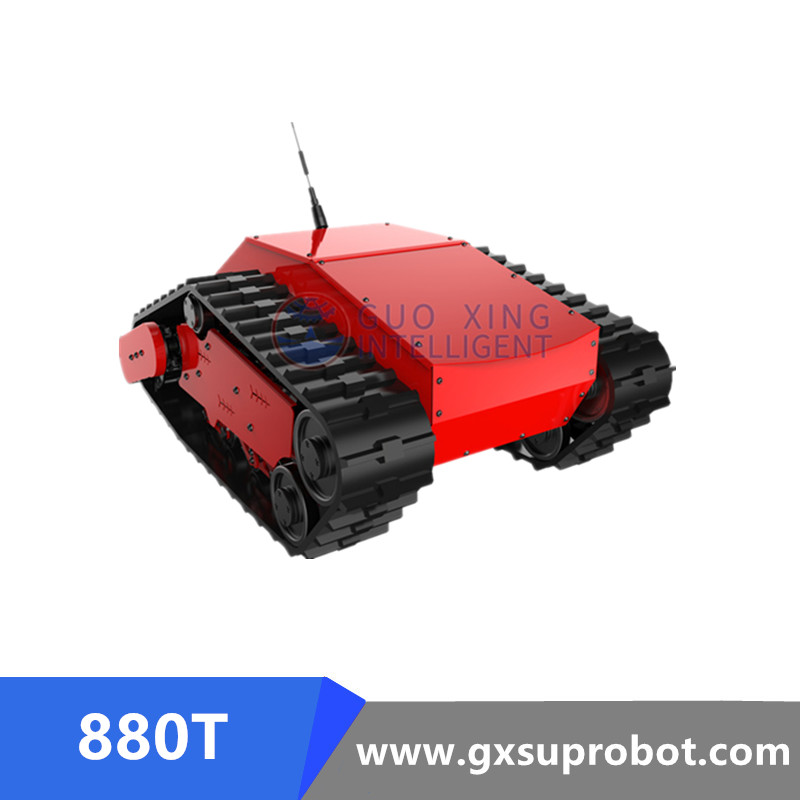
Tracked robot chassis are widely used in exploration and reconnaissance, where their stability and maneuverability are key. These robots are deployed to explore areas that are dangerous or hard to reach by humans, such as military conflict zones or remote environmental research sites. The ability to traverse difficult terrains allows them to gather vital data without risking human lives.
● DIY-friendly: Surveillance of hazardous areas.
● Scientific: Exploration of remote or hard-to-reach environments.
One of the most significant applications of tracked robot chassis is in search and rescue operations. After natural disasters like earthquakes or floods, these robots can be sent into debris-filled environments to locate survivors, deliver supplies, or provide real-time data to rescuers. Their ability to move through rubble and unstable terrain without losing stability is crucial for saving lives in hazardous environments.
● Sensors: To detect signs of life.
● Cameras: To provide real-time visuals of the environment.
Tracked robots also play a significant role in agriculture and industrial sectors. In agriculture, they are used for crop monitoring, precision irrigation, and even harvesting. Their ability to navigate fields and orchards, often with heavy attachments like plows or harvesters, allows for efficient automation of labor-intensive tasks. Similarly, in mining and construction, tracked chassis are used to transport materials or perform site preparation, offering reliability in harsh conditions.
Tracked robot chassis are highly customizable, with the ability to equip various sensors, cameras, and other attachments depending on the specific application. This flexibility makes them adaptable to a wide range of tasks, whether in military operations or agricultural monitoring. Customization allows the chassis to meet the exact requirements of different industries and environments.
The combination of excellent traction and maneuverability is a hallmark of tracked robot chassis. The tracks ensure that robots can navigate through challenging environments, while their precise steering allows for quick turns and movement in tight spaces. This performance is critical for tasks that require the robot to adapt to changing conditions or navigate around obstacles, such as in reconnaissance missions or construction sites.
Tracked robot chassis are typically powered by electric motors or diesel engines that provide the necessary torque to propel them across rough terrains. These power systems are designed for efficiency and longevity, reducing the need for frequent maintenance and ensuring reliable performance in demanding environments. Depending on the application, some tracked robots are designed to be energy-efficient, running on clean energy sources such as electric motors or hybrid systems.
Tracked robot chassis contribute to the precision and efficiency of robots by enabling them to perform complex tasks with accuracy. Whether it's inspecting infrastructure, navigating hazardous environments, or transporting goods, the stability and maneuverability offered by tracked systems help the robot perform tasks that require both speed and precision, reducing the risk of errors or accidents.
As robotics technology advances, tracked robot chassis are being integrated with AI and machine learning algorithms to enhance their autonomy. These systems enable robots to make decisions in real-time, adapt to dynamic environments, and avoid obstacles without human intervention. Autonomous tracked robots are poised to revolutionize industries by performing tasks more efficiently and safely, particularly in hazardous or hard-to-reach locations.
Future tracked robot chassis will benefit from advancements in materials science, allowing for lighter, more durable, and more efficient tracks. New composite materials and alloys will increase the durability and performance of tracked chassis, enabling them to operate in even more extreme conditions while maintaining reliability and reducing maintenance costs.
With a growing focus on sustainability, the future of tracked robot chassis will likely see an increased shift towards energy-efficient and environmentally friendly propulsion systems. Hybrid and fully electric tracked robots will become more common, reducing their carbon footprint and making them suitable for applications in environmentally sensitive areas such as agriculture or environmental monitoring.
Tracked robot chassis offer unmatched stability, versatility, and maneuverability across a variety of applications. From search and rescue to industrial tasks, these robots are crucial for navigating challenging terrains. As technology evolves, the integration of AI, sensor systems, and energy-efficient solutions will further enhance their capabilities. For industries seeking reliable solutions, Shandong Guoxing Intelligent Technology Co., Ltd. provides tracked robot chassis that deliver exceptional value with advanced features tailored to diverse operational needs.
A: A tracked robot chassis is a robotic platform using continuous tracks for superior traction and stability on rough terrain.
A: Tracked robot chassis offer better stability and traction, allowing robots to navigate challenging environments like mud or snow.
A: The tracks evenly distribute weight, preventing tipping and enhancing traction on uneven or slippery surfaces.
A: Tracked robot chassis are used in search and rescue, military exploration, industrial inspection, and agriculture.
A: Tracked chassis provide stability, versatility, and maneuverability in rugged terrains, offering enhanced traction and durability.
A: Yes, tracked robot chassis can be equipped with various sensors, cameras, and attachments for specific applications.