
Views: 0 Author: Site Editor Publish Time: 2025-12-26 Origin: Site


Firefighting is one of the most dangerous professions, with high risks of injury and fatalities each year. According to the National Fire Protection Association (NFPA), nearly one-third of firefighter injuries occur during fireground operations—the most hazardous aspect of the job. This highlights the need for innovative solutions to enhance firefighter safety.
One such breakthrough technology is robotics. Firefighting robots are revolutionizing fire suppression and rescue operations. They can navigate hazardous environments, reduce human exposure to danger, and help improve overall firefighting safety.
In this article, we will discuss how firefighting robots work, how they contribute to reducing injuries, and how they are transforming firefighting operations for the better.
Firefighting robots are designed to handle high-risk tasks in dangerous environments. By doing so, they help reduce the exposure of human firefighters to life-threatening situations such as high heat, toxic smoke, and structural collapses. Robotics allows for interventions in fire scenarios where it would be too risky or impossible for human personnel to act, such as in hazardous chemical fires, nuclear plant fires, and wildfires.
These robots perform various essential tasks like fire suppression, reconnaissance, and search-and-rescue missions, often in environments that would be too dangerous for firefighters. By stepping in during the most hazardous operations, they reduce the number of injuries and fatalities on the fireground.
Firefighting robots provide invaluable real-time data, offering a comprehensive picture of the fire situation without risking human lives. Robots are equipped with sensors, cameras, and thermal imaging to assess fire spread, temperature changes, and potential hazards in real time. Remote operations allow operators to control these robots from a safe distance, ensuring that firefighters can strategize from a position of safety and act quickly when required.
By deploying firefighting robots early in an emergency, fire departments can make better decisions, quickly evaluate the situation, and improve the effectiveness of their firefighting strategies.
Remote Fire Suppression and Safe Operation
Modern firefighting robots, such as the Guoxing Intelligent series, enable remote fire suppression, allowing operators to control the situation from a safe distance. For example, the high-flow firefighting robot RXR-M150GD is equipped with a dual-purpose water/foam cannon that delivers up to 150 L/s, with a range of over 95 meters and can be controlled remotely from up to 1000 meters. This robot helps fire crews suppress fires without directly exposing themselves to the hazards of extreme heat, smoke, or explosion risks. The robot’s powerful all-terrain tracked drive system allows it to reach fire sources in difficult landscapes, reducing firefighter exposure to dangerous environments, thus minimizing burn injuries and smoke inhalation risks.
Equipped with advanced sensor systems, 360° rotating high-definition cameras, thermal imaging, and gas detection modules, Guoxing firefighting robots can collect critical data and transmit it back to the control station in real time. For example, the RXR-MC80BD is equipped with thermal imaging monitoring and toxic gas detection capabilities, enabling it to identify potential hazards in smoke-filled, explosive, and low-oxygen environments. By accessing temperature, gas concentration, obstacles, and structural information before entering hazardous zones, firefighting crews can plan their response more effectively and avoid unnecessary risks. This capability significantly reduces the need for human entry into dangerous zones.
Firefighting robots also play a critical role in rescue operations. In many high-rise buildings, industrial environments, or other risky scenarios, traditional human rescue efforts may pose extreme safety challenges. Guoxing firefighting robots can be equipped with search and rescue features, including navigation systems to locate trapped victims, and can assist in tasks like dragging hoses, clearing obstacles, or providing lighting and alarms for the operation. Their ability to conduct remote rescue operations reduces the need for firefighters to enter danger zones, significantly lowering the potential for injuries.
Compared to traditional firefighting methods, Guoxing firefighting robots can target fire sources more accurately, which helps to optimize the use of water and foam. Their precision in directing water or foam onto the fire reduces resource waste while increasing suppression efficiency. These robots can operate continuously without fatigue, making them an essential tool in large-scale fire scenarios. With their ability to sustain long-duration operations, they optimize the firefighting process, leading to faster, safer, and more sustainable operations.
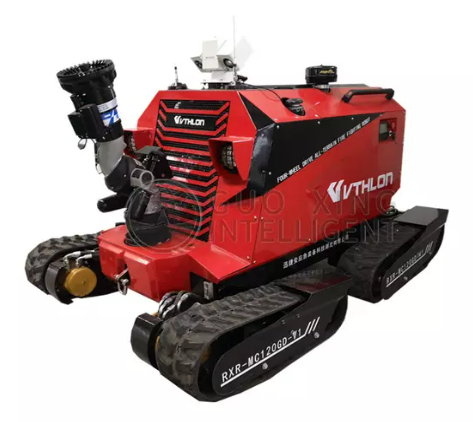
The cost of firefighting robots can vary widely depending on their capabilities and specifications. Factors such as the robot's size, the tools it can equip, its mobility, and the technology onboard (such as sensors, cameras, and hydraulic systems) all play a role in determining its price.
Robots with advanced features like all-terrain capabilities, powerful water cannons, or demolition tools tend to be more expensive. Customizations and enhancements, such as remote sensors or enhanced maneuverability, can also impact the cost.
While firefighting robots require a substantial upfront investment, their long-term value is clear. Firefighting robots help reduce the number of injuries and fatalities by limiting human exposure to dangerous environments. They also improve operational efficiency, allowing fire departments to respond faster and more effectively to emergencies.
The ROI of firefighting robots can be evaluated in terms of the potential cost savings, such as reduced property damage, fewer firefighter injuries, and faster response times. In many cases, the benefits far outweigh the initial investment.
The future of firefighting robots holds great promise. As robotics technology continues to evolve, firefighting robots are becoming more autonomous, efficient, and adaptable to different types of fires. Innovations in AI, machine learning, and sensor technology will enable robots to make decisions independently, enhancing their ability to navigate complex fire scenarios and provide real-time responses to changing conditions.
As firefighting robots continue to prove their value in real-world fire scenarios, we expect to see their widespread adoption across fire departments, industrial sites, and military operations. The increasing demand for these robots is likely to lead to improvements in their functionality, affordability, and accessibility.
In addition to combating fires, robotics could play a key role in preventing wildfires. With advanced sensors and AI, robots can detect fires early, helping to stop them before they escalate. Drones and ground-based robots could monitor large expanses of land, providing critical early-warning systems for fire teams.
Firefighting robots are transforming fire operations by improving safety and efficiency. They reduce firefighter injuries, enhance fire suppression, and provide real-time decision-making capabilities. With advancements in AI and sensor technology, these robots will become increasingly important in firefighting.
At Shandong Guoxing Intelligent Technology Co., Ltd., we offer innovative firefighting robots designed to reduce risks, enhance operational efficiency, and save lives. Our solutions are tailored to meet the unique challenges of modern firefighting, ensuring unmatched safety and success.
A: Firefighting robots perform hazardous tasks, such as fire suppression and search-and-rescue, reducing firefighter exposure to danger.
A: Firefighting robots help reduce risks by operating in dangerous environments, minimizing the need for human intervention in high-risk areas.
A: Firefighting robots handle fire suppression, monitoring hazardous environments, and evacuation tasks, reducing physical risks for firefighters.
A: Robotics improve safety by providing real-time data and performing tasks remotely, allowing firefighters to strategize from a safe distance.
A: Firefighting robots assist in evacuations and rescues, safely transporting injured civilians or firefighters from hazardous locations.
A: Firefighting robots are equipped with high-powered water cannons, sensors, and cameras that enhance fire suppression and decision-making.