
Views: 0 Author: Site Editor Publish Time: 2025-12-24 Origin: Site


Firefighting robots are transforming fire response by tackling dangerous scenarios where human intervention is risky. These robots combine advanced robotics with firefighting capabilities to improve safety and efficiency.
In this article, we will explore how firefighting robots work, their types, how they operate, and the benefits they offer in emergency response situations.
Firefighting robots are designed to enter hazardous environments like burning buildings, toxic fumes, or areas with high heat that would be impossible for human firefighters to safely navigate. Equipped with advanced sensors, cameras, and tools, these robots assist human firefighters by performing tasks that minimize exposure to danger.
For instance, robots can be deployed in situations where fire conditions are extremely dangerous, such as wildfires or large industrial fires. They can enter areas that are too dangerous for humans, conduct reconnaissance, suppress fires, and even locate trapped individuals.
Firefighting robots work efficiently by providing real-time data and visuals to the operator. This helps firefighters make well-informed decisions in high-pressure situations. Remote-controlled robots, equipped with multi-sensor systems, can navigate through smoke and debris, attack fires, and handle potentially dangerous situations without endangering human lives.
With their ability to perform fire suppression and reconnaissance tasks remotely, these robots enhance the speed and accuracy of firefighting operations. They can be sent into perilous areas while operators remain at a safe distance, allowing for better decision-making and improved outcomes.
Robot Type | Main Features | Use Case | Special Capabilities |
HCR Series Firefighting Robots | Diesel-driven, compact, mobile | Demolition, navigating confined spaces, fire suppression | Large load-bearing capacity, obstacle-crossing, can climb stairs |
RXR-M150GD All-Terrain Robots | Four-wheel drive, articulated suspension | Complex terrain, underground facilities | Excellent climbing and obstacle-crossing performance |
Humanoid Robots | Designed to mimic human actions, equipped with advanced sensors | Indoor firefighting and rescue tasks | Can operate valves, open doors, handle fire hoses |
Aerial Drones | Light, compact, remote-controlled | Surveillance, aerial fire suppression | Equipped with cameras and fire suppression systems |
This table compares key firefighting robots by their type, features, and specific use cases. Each robot is designed to handle specific fire scenarios with unique capabilities to enhance firefighting operations.
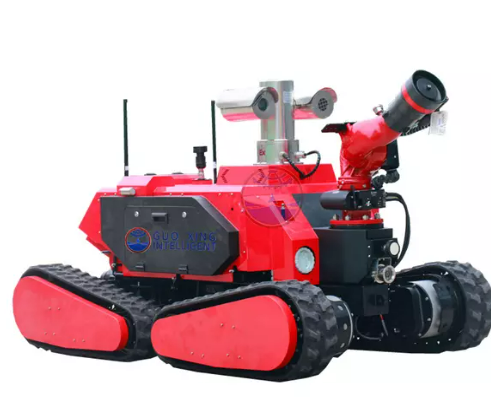
Firefighting robots are remotely controlled by operators who navigate them through hazardous environments. These robots are equipped with video feeds, sensors, and manual controls, which allow operators to steer them safely and efficiently. Firefighting robots can be controlled from a safe distance, ensuring that operators are not exposed to harmful conditions such as smoke, heat, and toxic fumes.
In some cases, the robots are fully autonomous, requiring little to no input from the operator once they are programmed to follow a specific set of instructions. This allows them to perform tasks like fire suppression, reconnaissance, and rescue without direct human involvement.
Firefighting robots are equipped with advanced sensors such as infrared cameras, thermal imaging, gas sensors, and range finders to help them navigate through smoke and fire. These sensors enable the robots to detect fire, map out the environment, avoid obstacles, and locate the exact source of the fire.
Thermal imaging sensors allow robots to see through thick smoke, while gas sensors help detect dangerous levels of toxic fumes, enabling operators to make informed decisions about the robot's movement and firefighting tactics.
Robots come equipped with a variety of firefighting tools to help tackle flames effectively. These tools include high-pressure water cannons, foam nozzles, and hydraulic equipment for demolition tasks.
Additionally, robots can be outfitted with specific firefighting equipment based on the situation, such as hydraulic tools for demolition or extraction. These tools ensure that robots can manage a wide variety of fire suppression tasks, from dousing flames to rescuing trapped victims.
The cost of firefighting robots can vary widely depending on their capabilities and specifications. Factors such as the robot's size, the tools it can equip, its mobility, and the technology onboard (such as sensors, cameras, and hydraulic systems) all play a role in determining its price.
Robots with advanced features like all-terrain capabilities, powerful water cannons, or demolition tools tend to be more expensive. Customizations and enhancements, such as remote sensors or enhanced maneuverability, can also impact the cost.
While firefighting robots require a significant initial investment, they offer long-term value by improving safety and reducing risks to human lives. These robots can help minimize property damage, enhance firefighting efficiency, and provide critical support in dangerous environments. The value of these robots lies in their ability to perform life-saving tasks in places that would be too dangerous for humans, making them a worthy investment for fire departments and emergency responders.
Firefighting robots reduce the risk to human firefighters by performing dangerous tasks, such as entering burning buildings or toxic environments. Robots can assess fire conditions and suppress flames without putting human lives at risk. This enhances the overall safety of firefighting operations.
Robots equipped with sensors and cameras allow operators to monitor and manage firefighting operations from a safe distance, ensuring that human firefighters are not exposed to hazardous conditions.
Firefighting robots can often work faster and more efficiently than human firefighters, especially in hazardous environments. They can quickly assess fire conditions, extinguish flames, and navigate through dangerous areas that may be difficult for humans to access.
In addition, robots can continuously operate in extreme heat or dangerous conditions for extended periods, whereas human firefighters need to take breaks due to fatigue or exposure to harmful fumes.
Firefighting robots incorporate advanced technologies such as artificial intelligence (AI), machine learning, and real-time data processing. These technologies enable robots to adapt to changing fire conditions, improve decision-making, and optimize fire suppression strategies in real-time.
The integration of AI and machine learning allows these robots to learn from previous firefighting scenarios, improving their effectiveness in future operations.
The future of firefighting robots holds great promise as technology continues to evolve. Future robots will likely incorporate even more advanced sensors, AI, and machine learning capabilities to enhance their ability to suppress fires, locate trapped individuals, and adapt to changing conditions in real-time.
Additionally, innovations in robotics and firefighting technology will improve the efficiency and cost-effectiveness of these robots, making them more accessible to fire departments around the world.
As firefighting robots continue to prove their value, we can expect to see their widespread adoption in emergency services. Fire departments, industrial facilities, and military organizations will increasingly rely on these robots to enhance their firefighting capabilities, reduce risks, and save lives.
Robots will become more integrated into firefighting strategies, providing support in high-risk areas and complementing the efforts of human firefighters.
In the future, firefighting robots may also play a significant role in preventing wildfires. With the ability to quickly detect fires and suppress them in their early stages, these robots can help prevent the spread of large-scale wildfires.
Robots, particularly aerial drones, could become essential tools for monitoring vast areas of land, detecting potential fire hazards, and responding rapidly to prevent catastrophic wildfires.
Firefighting robots are essential in modern firefighting, enhancing safety and efficiency in high-risk environments. As technology evolves, these robots will play a larger role in firefighting strategies, helping fire departments handle complex situations. The collaboration between humans and robots will save lives and reduce property damage.
At Shandong Guoxing Intelligent Technology Co., Ltd., we offer advanced firefighting robots that address the unique challenges of modern fire suppression. Our products provide enhanced safety and operational efficiency, supporting fire departments in protecting communities.
A: A firefighting robot is a remotely controlled machine designed to suppress fires and navigate hazardous environments, enhancing fire safety.
A: Firefighting robots reduce risks to human firefighters by performing dangerous tasks in high-heat, toxic environments.
A: Firefighting robots are equipped with water cannons, foam systems, and sensors to fight fires efficiently in hazardous areas.
A: Firefighting robots typically include thermal sensors, high-pressure water systems, and remote control capabilities for real-time decision-making.
A: Firefighting robots are usually operated remotely, allowing operators to control them from safe distances while receiving real-time data.
A: Firefighting robots can handle a variety of fires, including industrial, structural, and wildfires, using specialized equipment for each scenario.